
Acceptance and Commitment Therapy (ACT) helps shift self-worth away from external achievements like grades or promotions and toward internal values. This approach focuses on four main strategies: accepting tough emotions, separating from self-critical thoughts, identifying personal values, and taking actions aligned with those values. By practicing these skills, ACT reduces the pressure to achieve perfection, promotes self-compassion, and helps you live a more meaningful life. Key benefits include:
- Acceptance: Allow emotions like shame or anxiety without suppressing them.
- Cognitive Defusion: Recognize self-critical thoughts as temporary, not absolute truths.
- Values Clarification: Focus on qualities like kindness or courage instead of accomplishments.
- Committed Action: Take small, meaningful steps that reflect your values.
If perfectionism or self-criticism feels overwhelming, ACT therapists can provide deeper support. For example, Empower Counseling in Alabama specializes in ACT to help clients struggling with anxiety, depression, and achievement-driven self-worth. By integrating ACT into daily life, you can build a stable sense of self not tied to external success.
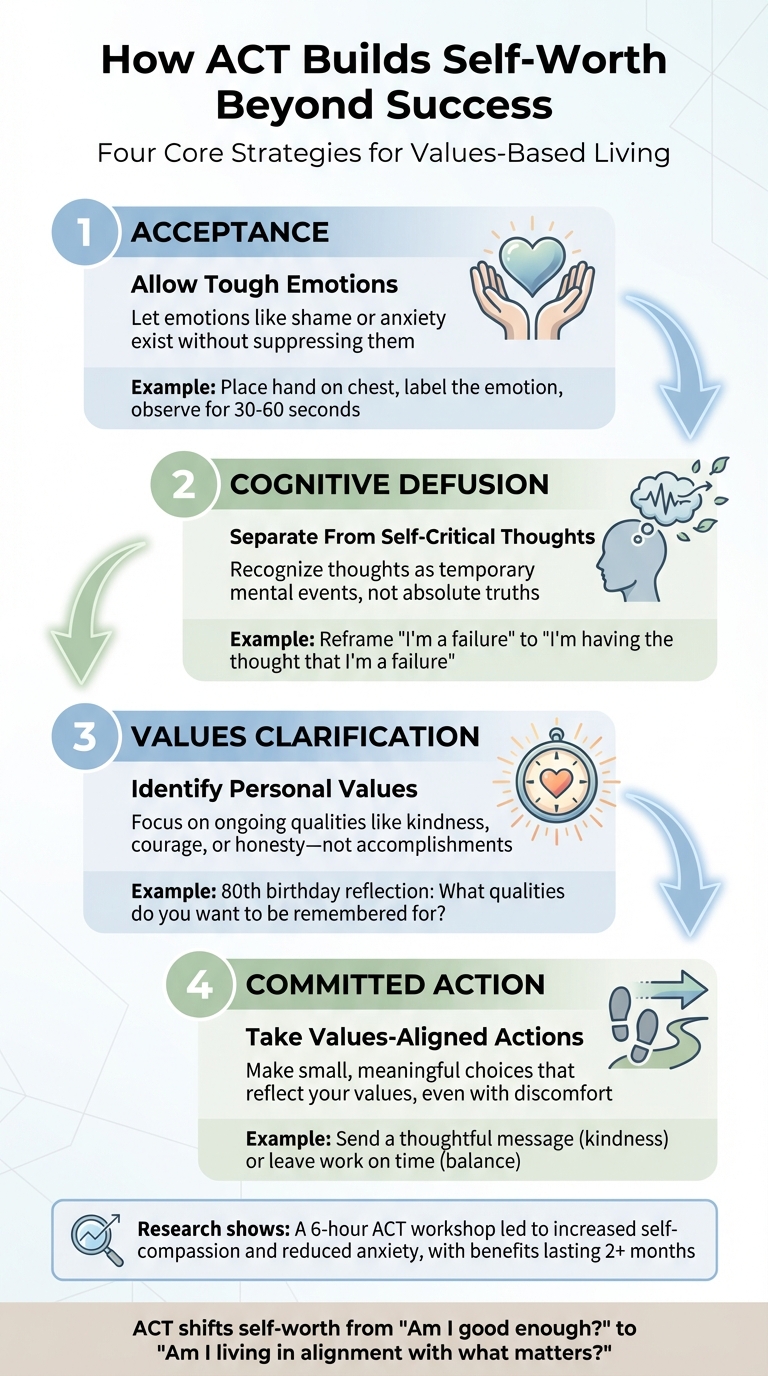
Four Core ACT Strategies for Building Self-Worth Beyond Achievement
Zara & Dr Russ Harris on the ACT concept: "Self-Acceptance vs Self-Esteem"
When Self-Worth Depends on Achievement
If your sense of value is tied to external achievements – like grades, promotions, salary, or even how busy you seem – setbacks can feel like personal failures. This mindset, called achievement-dependent self-worth, causes self-esteem to rise and fall based on success or failure in areas like academics, work, or gaining approval from others. Instead of thinking, "I have worth simply because I exist", the internal narrative shifts to, "I matter only when I succeed." This conditional sense of self-worth often stems from early life experiences.
How Achievement-Based Self-Worth Takes Root
The seeds of achievement-based self-worth are often planted in childhood, where love, attention, or praise may have been linked to performance – like excelling in sports or getting straight A’s – rather than inherent traits. Over time, children internalize the belief that their value lies in their accomplishments. This message is reinforced as they grow, particularly in environments that emphasize results over effort. In the U.S., societal norms that celebrate busyness, productivity, and a "hustle" mentality make it especially hard to rest or set boundaries without feeling guilty.
Perfectionism also fuels this mindset. Perfectionists often equate mistakes with personal failure and feel they are "never enough." They set impossibly high standards, trapping themselves in a cycle of striving to avoid feelings of inadequacy. This reinforces the belief that self-worth is dependent on flawless performance.
Signs and Consequences of a Success-Driven Identity
When self-worth is overly tied to achievement, it shows up in specific behaviors and emotions. Common signs include chronic overwork and relentless self-criticism. Even small mistakes can trigger harsh internal judgment. High achievers often downplay their successes with remarks like, "Anyone could have done that", and quickly move on to set new, often unrealistic, goals. They may avoid challenges unless success feels guaranteed, driven by a deep fear of failure. When identity becomes solely defined by measurable outcomes (e.g., "I am my job"), it signals an overdependence on external validation.
The costs of this mindset are steep. Studies link high self-criticism and achievement-dependent self-worth to increased anxiety, depression, and stress. The belief that "I’m only okay if I’m succeeding" creates relentless pressure and a constant sense of threat, often leading to burnout. Burnout manifests as emotional exhaustion, cynicism, and a diminished sense of accomplishment. Despite outward success, many feel hopeless, empty, or like a "fraud."
Interestingly, interventions like an ACT-based self-compassion workshop for undergraduates (N = 73) have shown promise. Participants with low self-compassion reported significant improvements in self-compassion and reductions in psychological distress and anxiety after two months. These benefits were tied to gains in psychological flexibility, offering a potential path forward.
How ACT Builds Self-Worth Beyond Success
ACT reshapes the way we view self-worth by moving away from achievement-based identities and focusing on practical skills that nurture an inner sense of value. Instead of trying to erase self-doubt or "fix" negative thoughts, ACT emphasizes psychological flexibility – staying present with challenging emotions while acting in alignment with your values. This shift helps you find stability in who you are, not just in what you achieve, making setbacks less overwhelming. The approach relies on four key processes to create a values-driven sense of worth.
Acceptance: Letting Go of the Fight Against Self-Judgment
Struggling against feelings like shame, anxiety, or inadequacy often makes them stronger. Acceptance in ACT encourages you to allow these emotions to exist without trying to control or suppress them. By letting go of the inner battle against self-judgment – the voice that says, "I shouldn’t feel this way" – the pressure to prove your worth through constant achievement can begin to fade.
Here’s a simple exercise: when self-judgment surfaces after a setback, pause and place a hand on your chest. Mentally label the emotion, such as "shame" or "pressure", and observe it for 30–60 seconds. The goal isn’t to make the feeling go away but to create space for it. Alternatively, try focusing on the sensation as you breathe in and out.
Cognitive Defusion: Seeing Thoughts for What They Are
Cognitive defusion helps you recognize that thoughts are just temporary mental events, not absolute truths. This perspective creates space between you and self-critical thoughts, making them easier to manage.
One technique is thought labeling – silently acknowledging, "I’m noticing the thought that I’m not good enough." Another option is to repeat a self-critical phrase for 30 to 45 seconds until it starts to lose its emotional charge. You can also visualize your self-critical thoughts as leaves drifting down a stream, simply observing them without holding on.
Values Clarification: Grounding Self-Worth in What Truly Matters
ACT defines values as ongoing qualities of action – like kindness, courage, or honesty – rather than specific accomplishments. When your self-worth is tied to these values, criticism or failure becomes less personal and less damaging.
Try an "80th birthday reflection" exercise: picture your loved ones sharing stories about you at your 80th birthday, describing qualities like your bravery, authenticity, or supportiveness. This reflection can help you uncover the values that matter most to you.
Committed Action: Aligning Your Life With Your Values
Committed action is all about taking meaningful steps that reflect your values, even when faced with discomfort or fear. For someone who’s used to seeking external validation, this might mean prioritizing actions that embody courage, balance, or self-care over striving for perfection.
For example, if kindness is a core value, you might send a thoughtful message to a friend. If balance is important, you could commit to leaving work on time. Focus on process-oriented goals instead of fixed outcomes. Additionally, practicing courageous communication – like setting boundaries or expressing needs despite the fear of disapproval – reinforces that your worth stems from your values, not from others’ opinions. Keeping a daily log of the values you act on can help you see that your worth is defined by how you live, not by what you achieve.
These practices lay the groundwork for incorporating ACT into your everyday life, which will be explored further in the next section.
sbb-itb-92e3c8f
Using ACT in Everyday Life
The real magic of Acceptance and Commitment Therapy (ACT) happens when its principles become a part of your everyday life – not just something you practice during therapy sessions. Research backs this up: a 6-hour ACT-based workshop led to increased self-compassion and reduced anxiety and psychological distress, with these benefits still evident two months later. By practicing ACT techniques in small, consistent ways, you can let go of the pressure to achieve perfection and quiet that inner critic. Over time, these tools evolve from abstract concepts into meaningful daily habits.
Daily and Weekly ACT Practices
Incorporating ACT into your routine can be surprisingly simple. Start small: set aside 60 seconds for mindfulness check-ins during everyday activities like sipping your morning coffee, commuting, or waiting in line. Use this time to notice your breathing, any tension in your body, and the flow of your thoughts – without trying to change anything. Regular mindfulness and defusion exercises, like these, help you pause before reacting to self-critical or unhelpful thoughts.
When thoughts about achievement or failure pop up, try defusing them immediately. For instance, if you catch yourself thinking, "I’m such a failure", reframe it by saying, "I’m having the thought that I’m a failure." This small shift helps you see the thought for what it is – just words, not an undeniable truth. At the start or end of your day, take a moment to reflect: “What kind of person do I want to be today?” Then, identify one small, meaningful action you can take to align with that intention.
On a weekly basis, spend 5–10 minutes reviewing key areas of your life, such as work, relationships, and health. Identify one or two qualities that matter most to you in each area, and choose a couple of small actions to live out those values. At the end of the week, reflect on how you embodied your values rather than focusing solely on outcomes like grades or sales figures. This habit helps shift your mindset toward being the person you aspire to be, rather than chasing external metrics.
Responding to Achievement-Related Triggers
Sometimes, life throws a curveball – a tough performance review, a disappointing test score, or a bout of social media comparison. When these moments hit, you can use a step-by-step ACT approach to navigate them with more clarity and self-compassion. Here’s a five-step process to try:
- Notice and label what you’re feeling. For example, say to yourself, "I feel anxious and think I’m falling behind."
- Allow the feelings to be there. Take 3–5 slow, deep breaths and remind yourself, "These feelings are here, and they don’t need to be fixed right now."
- Defuse the thought by saying, "I’m having the thought that I’m not good enough", or imagine the thought floating away like a cloud.
- Reconnect with your values by asking, "What kind of person do I want to be in this moment?"
- Take one small, values-based action, like asking a clarifying question at work or offering yourself a kind word.
Of course, challenges can crop up. If you think, "I don’t have time for this", try pairing these practices with something you already do, like brushing your teeth or driving to work. If you expect immediate results, remind yourself that ACT isn’t about erasing discomfort – it’s about building psychological flexibility and living in line with your values. And when perfectionism sneaks in, tempting you to act on every value all at once, focus on just a few core values and take small, manageable steps. Remember, being human means embracing imperfection, and that’s perfectly okay.
Working With an ACT Therapist
While daily practices can help reshape how you relate to self-critical thoughts, working with a therapist trained in Acceptance and Commitment Therapy (ACT) offers deeper support. This approach helps untangle the roots of perfectionism, shame, and trauma that often fuel achievement-based self-worth. In therapy, sessions focus on building psychological flexibility – helping you stay present with tough emotions, step back from harsh self-judgments, and make choices driven by your values rather than fear or the need to prove yourself.
Early sessions often explore how past experiences with achievement and criticism have shaped your sense of self-worth. The therapist introduces the concept of psychological flexibility, shifting the goal from simply "feeling better" to living a more meaningful life. Through mindfulness and acceptance techniques, you’ll learn to observe thoughts like "I’m not good enough" without immediately trying to suppress or escape them. Together, you’ll also examine coping strategies – like overworking, people-pleasing, or avoidance – and how they might temporarily ease anxiety but ultimately reinforce feelings of low self-worth. From there, the focus turns to clarifying your core values and identifying small, actionable steps that align with them. For example, you might commit to leaving work on time to prioritize family or speaking up in a meeting to honor your value of courage. These steps, practiced between sessions, complement daily ACT exercises and pave the way for sustainable change.
Empower Counseling, based in Birmingham, Alabama, specializes in ACT to address challenges like anxiety, depression, and perfectionism. Services are available online for residents of Alabama. Kathryn Ely, the founder and a Licensed Professional Counselor, shares her personal journey:
"I struggled with anxiety and perfectionism for most of my life. I found Acceptance Commitment Therapy while obtaining my master’s degree in Clinical Mental Health. Acceptance Commitment Therapy was like no other therapy we learned about in school. It saved me from a life of being in my head, afraid to take action, and unable to focus on all of the wonderful parts of my life. The transformation I experienced was so amazing that it became my mission and my purpose to bring this effective form of therapy to you so that you may experience freedom from what has been holding you back, and a clear vision of how wonderful life can be."
One of ACT’s strengths is that it teaches enduring skills for long-term resilience. Over time, therapy helps you move away from defining your worth solely by achievements. Instead, you develop a more grounded and stable sense of self – one that reflects who you choose to be, not just what you accomplish.
Conclusion
Acceptance and Commitment Therapy (ACT) provides a steady foundation for building self-worth that isn’t tied to achievements. Instead of asking yourself, "Am I good enough?" based on grades, promotions, or external validation, ACT encourages a more meaningful question: "Am I living in alignment with what truly matters to me?" By embracing acceptance, defusion, mindfulness, and values-driven actions, ACT helps you create an inner compass that stays steady, no matter the ups and downs life throws your way.
Shifting from an achievement-focused identity to one rooted in personal values fosters resilience and a deeper sense of fulfillment. For example, research highlights that a 6-hour ACT workshop centered on self-compassion resulted in significant increases in self-compassion and notable reductions in psychological distress and anxiety two months later. These improvements were linked to greater psychological flexibility. When your worth is grounded in how you live – whether through kindness, courage, or honesty – rather than in what you accomplish, you gain a sense of purpose that external achievements simply can’t replicate. This evidence underscores the importance of moving from chasing external validation to cultivating a values-based sense of self.
Of course, old patterns of achievement-oriented thinking can creep back in, especially during stressful times. ACT doesn’t aim to eliminate these thoughts but instead transforms how you relate to them. Each time you notice self-critical thoughts and intentionally refocus on your values, you strengthen both your psychological flexibility and self-compassion. Progress comes not from perfection but from the small, consistent choices you make every day.
To get started, try incorporating one ACT practice into your routine this week – maybe a daily check-in with your values or a simple defusion exercise. And if perfectionism or self-criticism feels overwhelming, consider reaching out to a trained ACT therapist. Empower Counseling in Birmingham, Alabama, offers both in-person and online sessions across the state, specializing in ACT to help clients build self-worth rooted in who they truly want to be. Their approach helps you take those first steps toward a more values-centered life.
FAQs
What makes ACT therapy unique in helping build self-worth?
ACT therapy offers a fresh perspective on cultivating self-worth by guiding individuals to acknowledge and embrace their thoughts and emotions instead of pushing them aside or avoiding them. The focus is on connecting with personal core values and making decisions that align with those values, creating a sense of self-worth that isn’t tied to achievements or societal pressures.
This approach encourages people to embrace who they genuinely are, even during tough times, and to find satisfaction in leading a life driven by what holds real meaning for them.
How can I use ACT techniques to boost self-worth in everyday life?
Start by practicing mindfulness – pay attention to the present moment and notice your thoughts without criticism or bias. Take time to reflect on your core values and allow them to shape your choices, instead of seeking validation through external accomplishments. Each day, take small but intentional steps that align with these values, helping you develop a sense of self-worth based on your true self, not just your achievements.
How does ACT therapy help with perfectionism and self-criticism?
ACT therapy offers a way to escape the cycle of perfectionism and self-criticism by shifting the focus toward personal values instead of impossible standards. Using techniques like mindfulness and cognitive defusion, it encourages individuals to notice their thoughts without attaching judgment, helping to weaken the hold of negative self-talk.
By embracing acceptance of imperfections and encouraging actions that align with one’s values, ACT helps cultivate self-compassion and emotional strength. This method supports individuals in developing a kinder, more genuine relationship with themselves, driven by inner purpose rather than seeking approval from others.