
Mindfulness can play a key role in preventing relapse during addiction recovery. By helping individuals stay present, it allows them to observe cravings and triggers without acting on them impulsively. Techniques like focused breathing, urge surfing, and body scans can interrupt automatic reactions and create space for healthier choices. Programs like Mindfulness-Based Relapse Prevention (MBRP) combine mindfulness with relapse prevention strategies, showing promising results in reducing substance use and cravings over time. Research also highlights the positive impact mindfulness has on the brain, strengthening self-control and reducing stress. Simple daily practices, combined with professional guidance, can significantly support long-term recovery.
Mindfulness-Based Relapse Prevention for Addictive Behavior
sbb-itb-92e3c8f
Mindfulness Techniques for Relapse Prevention
MBRP 8-Week Program Structure and Core Mindfulness Techniques
Learn how mindfulness strategies can help identify triggers and manage cravings, reducing the risk of relapse.
Mindfulness-Based Relapse Prevention (MBRP)
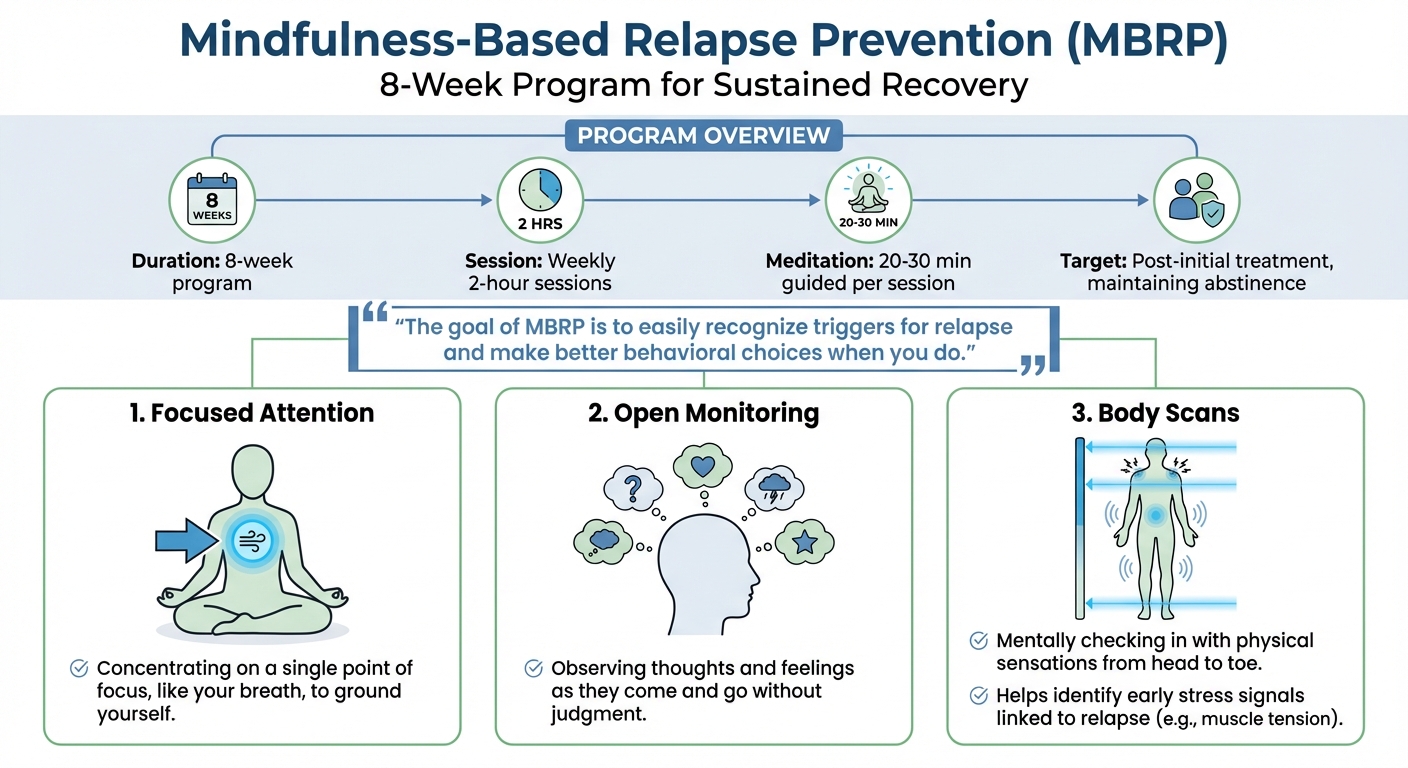
Mindfulness-Based Relapse Prevention (MBRP) is an 8-week program designed to blend cognitive-behavioral relapse prevention methods with mindfulness meditation practices. Participants attend weekly 2-hour sessions, which include 20–30 minutes of guided meditation.
The program focuses on three main techniques:
- Focused Attention: Concentrating on a single point of focus, like your breath, to ground yourself.
- Open Monitoring: Observing thoughts and feelings as they come and go without judgment.
- Body Scans: Mentally checking in with physical sensations from head to toe, which can help identify early stress signals linked to relapse, such as muscle tension.
"The goal of MBRP is to easily recognize triggers for relapse and make better behavioral choices when you do." – Buddy’s Ranch
MBRP works best for individuals who have already completed initial treatment and maintained a period of abstinence. The program is structured around eight weekly themes, such as recognizing automatic behaviors, practicing mindfulness in high-risk scenarios, and balancing acceptance with deliberate action.
Even outside formal programs, practicing mindfulness with a nonjudgmental approach can deepen its effectiveness.
Self-Compassion and Nonjudgmental Awareness
Viewing cravings and thoughts without judgment can help reduce self-criticism and ease the intensity of cravings. When you perceive a craving as a fleeting mental event rather than a personal failure, it removes the shame that often fuels the urge.
"Mindfulness skills are intended to help the patient increase their awareness of cravings and other unpleasant feelings without judgment of the feelings as ‘bad’ or necessitating a reaction." – Recovery Research Institute
This shift in perspective can reshape your response to cravings. For example, instead of thinking, "I’m failing because I have this craving", you might say, "I notice this craving happening right now." Research shows that individuals practicing MBRP report significantly lower craving levels compared to those in standard treatments. Adding self-compassion through healthy routines and self-care further supports long-term recovery.
In addition to self-compassion, specific techniques can help you stay present during challenging moments.
Breathwork and Grounding Exercises
When cravings strike, breathwork and grounding exercises can help you regain focus and control.
- 4-7-8 Breathing: Inhale for 4 seconds, hold for 7, and exhale for 8. This technique calms the nervous system and creates a moment of pause before reacting.
- Urge Surfing: Visualize a craving as a wave that rises, peaks, and eventually fades. This helps you observe the craving without being consumed by it.
- 5-4-3-2-1 Grounding: Identify five things you can see, four you can touch, three you can hear, two you can smell, and one you can taste. This sensory exercise anchors you to the present and reduces distress.
"From this perspective of experiencing feelings and bodily sensations without acting on them, the patient may decide to engage in a healthier alternative activity, or even simply ‘sit with the feeling.’" – Recovery Research Institute
Even short, consistent practices – like 20 minutes of daily meditation or body scans – can sharpen your ability to stay present. These grounding techniques interrupt automatic reactions, giving you the space to make healthier choices.
For personalized guidance on incorporating mindfulness into your recovery journey, visit Empower Counseling at https://empowercounselingllc.com.
The Science Behind Mindfulness and Relapse Prevention
Mindfulness has been shown to create measurable changes in the brain, helping to reduce the risk of relapse.
Research on Mindfulness-Based Interventions
A clinical trial involving 286 participants compared three approaches: Mindfulness-Based Relapse Prevention (MBRP), standard relapse prevention (RP), and treatment as usual (TAU). At the 6-month mark, both MBRP and RP demonstrated lower relapse rates compared to TAU. By 12 months, participants in the MBRP group reported fewer days of substance use and a reduction in heavy drinking.
"Targeted mindfulness practices may support long‑term outcomes by strengthening the ability to monitor and skillfully cope with discomfort associated with craving or negative affect."
– Sarah Bowen, PhD, Researcher and Lead Author
A meta-analysis of nine randomized controlled trials, which included 901 participants, found that MBRP significantly reduced withdrawal symptoms and cravings when compared to other interventions. These findings suggest that mindfulness not only delays the onset of substance use but also supports a more sustained recovery.
Next, let’s dive into how mindfulness impacts the brain to enhance self-control and resilience.
How Mindfulness Changes the Brain: Improved Self-Control and Resilience
The positive outcomes of mindfulness stem from its ability to reshape brain function. It strengthens "top-down" executive control by enhancing activity in the prefrontal cortex while reducing "bottom-up" reactivity by decreasing sensitivity in the amygdala and reward-related brain regions.
Mindfulness training also sharpens "discriminative awareness", which is the ability to notice uncomfortable feelings – like cravings or negative emotions – without automatically reacting to them. This awareness supports extinction learning, which breaks the habitual link between triggers and automatic responses. Neuroimaging studies even show increased gray matter in critical brain areas, along with changes in the amygdala that are tied to reduced stress levels.
"MBRP may affect numerous brain systems and may reverse, repair, or compensate for the neuroadaptive changes associated with addiction and addictive‑behavior relapse."
– Sarah Bowen, Researcher and Author, Psychology of Addictive Behaviors
Perhaps most crucially, mindfulness helps restore natural reward processing, often referred to as "savoring." This process repairs the disrupted reward systems frequently seen in addiction, giving individuals the tools to better manage triggers and maintain their recovery. These brain changes highlight why mindfulness plays such a key role in relapse prevention.
How to Add Mindfulness to Your Recovery Plan
Understanding mindfulness is one thing – working it into your daily life is another. The good news? You don’t need hours of meditation to make a difference. Simple, consistent practices can help you stay on track and reduce the risk of relapse.
Daily Mindfulness Practices for Recovery
To strengthen your recovery, try weaving mindfulness into your everyday routine. Start with mindful breathing, a powerful tool for managing stress and cravings. Techniques like Box Breathing – inhaling for 4 seconds, holding for 4 seconds, exhaling for 4 seconds, and holding again for 4 seconds – can help calm your nervous system. Another option is 4-7-8 breathing, which is great for quickly easing stress.
Another helpful practice is Urge Surfing, where you imagine cravings as waves that rise and fall, reminding yourself they’re temporary. When facing high-risk moments, try the SOBER breathing space:
- Stop what you’re doing
- Observe your thoughts and emotions
- Breathe deeply
- Expand your awareness to your surroundings
- Respond with intention
Grounding techniques like the 5-4-3-2-1 method can also keep you present. This involves focusing on:
- 5 things you can see
- 4 things you can touch
- 3 things you can hear
- 2 things you can smell
- 1 thing you can taste
Journaling is another way to stay mindful. Write about what you’re grateful for or note patterns that trigger cravings. Adding mindful movement – like walking while focusing on each step or doing a body scan to relax muscle groups – can release tension and help you reconnect with your body. Even simple tasks, like eating or washing dishes, can become mindful moments when you fully engage with the sensations involved.
"Recovery is not just about abstaining from your addictions, it’s also about learning to navigate your life with self-awareness, acceptance, and inner peace."
– Beachside Rehab
To deepen these practices, pairing mindfulness with Acceptance Commitment Therapy (ACT) can enhance your ability to handle challenges.
Combining Mindfulness with Acceptance Commitment Therapy (ACT)
Once you’ve established daily mindfulness habits, combining them with ACT can take your recovery to the next level. ACT focuses on building flexibility in how you manage cravings and emotional discomfort, helping you avoid turning to substances. Mindfulness plays a key role by teaching you to observe your thoughts without judgment. For example, instead of thinking, "I need a drink", you might reframe it as, "I am having the thought that I need a drink." This subtle shift creates space to make healthier choices.
ACT also encourages techniques like repeating distressing thoughts in a playful or exaggerated voice. This approach can strip away the emotional intensity tied to those thoughts. Acceptance is another cornerstone of ACT. Instead of avoiding uncomfortable feelings, you allow yourself to experience them without reacting impulsively. The RAIN technique can help in these moments:
- Recognize the emotion
- Accept it without judgment
- Investigate where it’s felt in your body
- Non-identify with the sensation
ACT also emphasizes reflecting on your core values – like family, health, or service – to ensure your actions align with your long-term recovery goals.
"The primary ACT goal is to help patients develop the psychological flexibility to cope with challenges without using substances."
– Recovery Research Institute
Working with a Therapist to Build Mindfulness Skills
While self-guided practices are valuable, working with a therapist can refine your approach and provide tailored support. For example, Empower Counseling in Birmingham, Alabama, offers mindfulness and ACT-based therapy designed to meet individual needs. Their therapists use evidence-based methods to help you build lasting skills for managing triggers and high-risk situations. Sessions are available in-person or online, with fees ranging from $150 to $225 depending on the therapist’s expertise.
Therapists can help you adapt mindfulness techniques to your unique challenges and track your progress over time. Research shows that therapist-led mindfulness training can disrupt the link between triggers and relapse by addressing the brain’s underlying mechanisms. This professional guidance provides a safe space to explore tough recovery topics while ensuring your mindfulness practices are as effective as possible.
Conclusion
Mindfulness offers a practical way to break free from old habits and maintain progress. By helping you recognize and manage cravings and negative emotions, it allows you to respond thoughtfully to triggers instead of reacting automatically. Rather than fighting urges or avoiding discomfort, mindfulness teaches you to observe these feelings, uncover the needs behind them, and make deliberate choices that align with your recovery goals. Research consistently highlights these benefits.
For example, a March 2014 study in JAMA Psychiatry followed 286 individuals after substance use treatment. Those who practiced Mindfulness-Based Relapse Prevention (MBRP) experienced better outcomes after 12 months, including less drug use and fewer heavy drinking days. As Dr. John Renner emphasizes, focusing on long-term results is essential for effective substance use interventions. This study underscores how mindfulness not only addresses immediate cravings but also strengthens long-term relapse prevention.
What sets mindfulness apart is its lasting impact on recovery. While traditional approaches may provide short-term relief, mindfulness builds skills that grow stronger over time. These skills help you manage emotional distress, ease anxiety and depression, and stay connected to your deeper values. This ability to enhance self-regulation makes mindfulness a valuable tool when combined with expert support.
Recovery is an ongoing process. Combining mindfulness with professional guidance can help you create a solid foundation for lasting sobriety. For personalized support, consider reaching out to Empower Counseling in Birmingham, Alabama. Their experienced therapists use evidence-based methods, including Acceptance Commitment Therapy (ACT), to complement your mindfulness journey.
FAQs
How do I know mindfulness is working for my cravings?
You’ll recognize the impact of mindfulness on your cravings when they start to show up less frequently or feel less overwhelming. You might also notice it’s easier to acknowledge and accept these cravings without giving in to them. Practices like urge surfing and mindful awareness play a key role in this process, making it easier to handle cravings and lowering the chances of a relapse.
What should I do if mindfulness makes me feel worse at first?
Feeling worse at the start of practicing mindfulness is a normal experience, especially during addiction recovery. This happens because mindfulness heightens your awareness of thoughts and emotions, which can feel overwhelming at first. The key is to meet these feelings with patience and self-kindness. Techniques like urge surfing – riding out cravings without acting on them – or simply pausing to take a few deep breaths can make a difference. If the discomfort feels too intense or lingers, reaching out to a trained therapist for support can be helpful. This challenging phase is often a natural part of the recovery journey.
Do I need a therapist to do MBRP or ACT?
You don’t always need a therapist to practice Mindfulness-Based Relapse Prevention (MBRP) or Acceptance and Commitment Therapy (ACT). Both approaches can be explored through structured programs or self-guided resources. That said, working with a trained clinician can provide personalized guidance, making the experience more tailored to your specific needs and challenges.


