Burnout can leave you feeling drained, detached, and ineffective. Acceptance and Commitment Therapy (ACT) offers practical techniques to help you manage workplace stress and reconnect with what matters. Here’s a quick overview of how ACT can support recovery:
- Burnout Symptoms: Persistent exhaustion, detachment, and reduced productivity.
- ACT Focus: Emphasizes psychological flexibility – accepting stress, staying present, and taking meaningful actions.
- Key Techniques:
- Present Moment Awareness: Mindful breathing, body scans, and grounding exercises to reduce stress.
- Cognitive Defusion: Reframe negative thoughts to lessen their impact.
- Values Clarification: Identify what truly matters and align actions with those priorities.
- Self-Compassion: Replace self-criticism with understanding and kindness.
ACT doesn’t aim to eliminate stress but helps you respond to it differently. Small, consistent practices like mindful breathing or values-based actions can make a big difference over time.
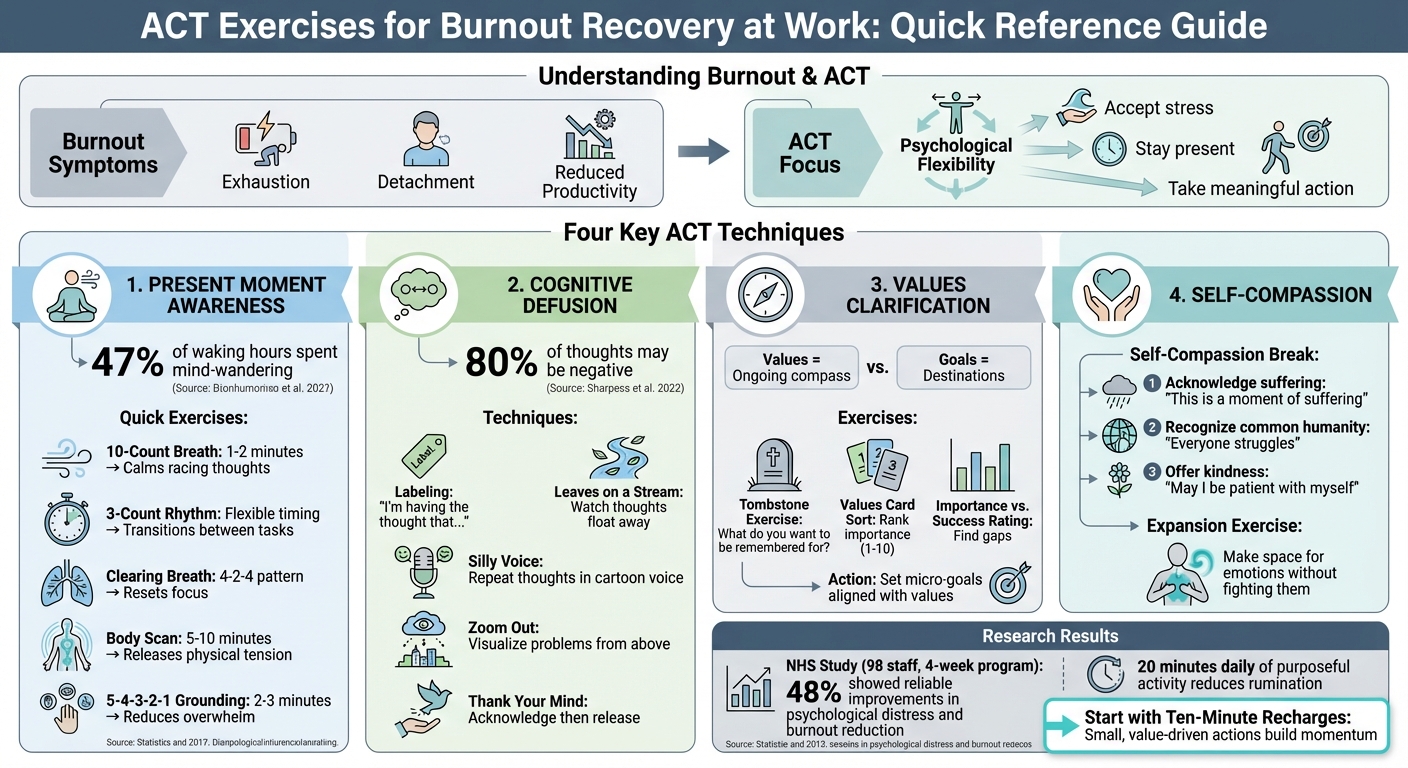
ACT Exercises for Workplace Burnout Recovery: Quick Reference Guide
ACT for Burnout: Present Moment Exercises
sbb-itb-92e3c8f
Present Moment Awareness: Staying Grounded at Work
When burnout takes over, it’s hard to keep your mind in the here and now. Research shows that nearly half of our waking hours – about 47% – are spent thinking about something other than what we’re doing at the moment. This mental wandering, whether it’s replaying past conversations or stressing over deadlines, zaps energy and spikes cortisol levels. Practicing present moment awareness helps interrupt this cycle by anchoring your focus on the present.
Jessica Borushok, Ph.D., Clinical Psychologist, explains: "The goal isn’t to breathe in a certain way, or be an attention champion, but just to be aware. Not modifying the breath in any way, but noticing its pace and depth, and the way the body moves".
Science backs this up. Cortisol, our primary stress hormone, peaks within minutes of waking as the brain starts planning the day ahead. This fight-or-flight response kicks in before we even get out of bed. Present moment practices train the brain to recognize these stress triggers and let them go.
Rasmus Hougaard, Founder of The Potential Project, puts it this way: "Mindfulness is not about living life in slow motion. It’s about enhancing focus and awareness both in work and in life. It’s about stripping away distractions and staying on track".
Mindful Breathing Exercises
Breathing exercises are simple, portable, and effective tools for staying grounded. The focus isn’t on perfect technique but on awareness. Here are three techniques to try during your workday:
- The 10-Count Breath: This exercise takes just 1–2 minutes and is great when your mind feels scattered. Place one hand on your chest and the other on your belly. Breathe naturally, counting each inhale and exhale up to 10. It’s a quick way to calm racing thoughts.
- The 3-Count Rhythm: This flexible method involves inhaling for three counts and exhaling for three counts. Adjust the timing to suit your comfort. It’s especially helpful when transitioning between tasks or decompressing after a tough email.
- The Clearing Breath: Inhale for four counts, pause for two, and exhale slowly. This technique is perfect for resetting your focus before meetings or switching projects.
Another helpful habit is Morning Breathwork – spend two minutes focusing on your breath as soon as you wake up. This simple practice can counteract the cortisol surge that often sets the tone for the day. Additionally, taking one-minute mindful breaks every hour can help you stay sharp and avoid slipping into autopilot mode.
| Exercise Type | Duration | Primary Benefit |
|---|---|---|
| 10-Count Breathing | 1–2 Minutes | Slows wandering thoughts and promotes calm |
| Mindful Performance Break | 1 Minute (Hourly) | Prevents autopilot and keeps focus sharp |
| Body Scan | 5–10 Minutes | Identifies and eases physical stress patterns |
| 5-4-3-2-1 Grounding | 2–3 Minutes | Quickly reduces feelings of overwhelm |
Body Scan for Stress Awareness
The body scan is another tool for recognizing and releasing stress. Our bodies often store tension in areas like the jaw, shoulders, or stomach, but we may not notice it until it becomes pain. A body scan helps you tune into these sensations and let go of built-up stress.
Here’s how to do it:
- Sit comfortably or stand, whichever feels better.
- Close your eyes and take a few deep breaths.
- Slowly direct your attention through your body, starting at your toes and moving upward.
- Notice areas of tension or discomfort without judgment.
- Breathe into those areas, imagining the stress melting away with each exhale.
Lai Tattis, Insight Timer meditation teacher, shares: "Clients often notice a significant shift in their ability to stay present and reduce emotional distress through regular body scan meditations".
Starting with just five minutes in the morning can help build this habit. Use the body scan after long meetings or at the end of the day to release lingering stress. If you find it hard to notice sensations in the moment, try reflecting on how your body felt after a stressful event – like a tight jaw or clenched fists. For those who struggle with stillness, movement-based mindfulness, such as yoga or walking, can offer similar relief.
Grounding Techniques for the Workplace
Grounding techniques are another practical way to manage stress at work. They shift your focus from internal worries to physical sensations, helping to activate the parasympathetic system, which calms the body.
- The 5-4-3-2-1 Method: When feeling overwhelmed, identify five things you can see, four you can touch, three you can hear, two you can smell, and one you can taste. This quick exercise redirects your mind and eases anxiety.
- Physical Anchoring: Before tackling a high-stakes task, press your heels firmly into the ground and notice the weight of your legs in your chair. This simple act can help stabilize racing thoughts.
- Sensory Grounding at Your Desk: Engage your senses by holding a smooth object, like a stone or pen, and focusing on its texture. Alternatively, run your hands under water, paying attention to its temperature and sensation.
Eszter Farkas, Insight Timer meditation teacher, notes: "It’s impressive how quickly and tangibly these techniques can pull us out of overwhelmed states, bringing about moments of calm and centeredness".
A study conducted between October 2017 and October 2018 with 98 National Health Service (NHS) staff members in Yorkshire and Humberside highlighted the benefits of mindfulness in the workplace. Participants attended four 2-hour group sessions over four weeks, focusing on mindfulness and values-based work. Results showed that 48% of participants experienced noticeable improvements in psychological distress and reduced burnout symptoms compared to a control group.
Present moment awareness isn’t about clearing your mind or achieving perfect calm. It’s about noticing where your attention is and gently bringing it back to the present. This simple practice, repeated throughout the day, creates space to manage stress and prevent burnout.
Cognitive Defusion: Changing How You Relate to Thoughts
ACT’s concept of cognitive defusion builds on the idea of staying present and helps you separate yourself from unhelpful thoughts.
Burnout often fuels harsh, repetitive mental loops: "I’m not good enough", "I’ll never catch up", or "Everyone else has it together except me." These thoughts might feel true, but they’re just fleeting mental events. Cognitive defusion is a technique that helps you step back and see these thoughts for what they are – just thoughts, not absolute truths.
Studies suggest that up to 80% of human thoughts might lean negative. During burnout, your brain can get stuck in "cognitive fusion", where self-critical thoughts take over and start influencing your behavior. This fuels rumination – those endless, unproductive thought cycles that only intensify workplace stress.
Russ Harris, ACT therapist and author, puts it this way: "In ACT, our main interest in a thought is not whether it’s true or false, but whether it’s helpful; that is, if we pay attention to this thought, will it help us create the life we want?"
The aim of defusion isn’t to erase negative thoughts or prove them wrong. Instead, it’s about creating space – a buffer between you and those inner criticisms. Just 20 minutes of focused, purposeful activity daily can engage the brain’s Central Executive Network and reduce rumination.
The goal is simple: stop letting mental chatter control you. When you stop treating thoughts like commands or undeniable truths, you gain the freedom to act based on your values – even when uncomfortable thoughts persist. Below are some practical strategies to apply cognitive defusion at work.
Labeling Thoughts Exercise
One effective way to create distance from a stressful thought is by labeling it. For example, if you catch yourself thinking, "I’m going to fail at this project", pause and reframe it as: "I’m having the thought that I’m going to fail at this project." This slight adjustment reminds you that the thought is just an experience you’re having – not a reflection of who you are.
For recurring thoughts, try naming the pattern – like calling it "the Incompetence Story" – or briefly thank your mind for the alert before letting the thought float away. Even if these thoughts aren’t helpful, your brain is just trying to protect you in its own way.
Laura K. Schenck, Ph.D., LMHC, notes: "The first step is to recognize that you are the observer of your thoughts, not the thoughts themselves".
For thoughts that feel especially persistent, use auditory defusion. Repeat the thought in a silly voice – like a cartoon character – or sing it to a tune, like "Happy Birthday." This can take the emotional sting out of the thought, making it feel less intimidating. Another option is Titchener’s Repetition: pick a triggering word (like "failure") and repeat it out loud as fast as you can for 30–60 seconds. Eventually, it will lose its meaning and sound like just a random noise.
Visualization Techniques for Perspective
Visualization exercises are another way to detach from unhelpful thoughts and gain clarity.
One popular method is Leaves on a Stream. Visualize yourself sitting by a flowing stream, with leaves floating on the water’s surface. For several minutes, imagine placing each thought onto a leaf and watching it drift away. If a thought gets stuck, let it stay until it’s ready to move on. If your mind starts to wander, label the distraction as "wandering", place it on a leaf, and refocus on the stream.
Laura K. Schenck, Ph.D., LMHC, explains: "Cognitive defusion is a tool that, when mindfully and diligently practiced, serves to disentangle you from thoughts that cause you to suffer".
Other visualizations can work just as well. For instance, try the Movie Screen technique: picture yourself in a theater, watching your thoughts play out on the screen. Observe them without reacting, as if you’re a neutral audience member. Or use the Zoom Out method: imagine floating high above the earth, looking down at your workplace and current challenges. From this vantage point, notice how small and manageable these problems appear.
Another helpful image is the Teflon Mind. Imagine your thoughts as objects hitting a Teflon-coated pan. Instead of sticking, they slide right off. Alternatively, picture thoughts as plates on a sushi conveyor belt – you see them pass by, but you don’t have to grab them.
| Technique | Primary Action | Best Used For |
|---|---|---|
| Labeling | Use "I’m having the thought that…" | Creating immediate distance from specific thoughts |
| Leaves on a Stream | Place thoughts on leaves in a stream | Managing racing or repetitive thoughts |
| Silly Voice | Repeat thoughts in a cartoon-like voice | Reducing the intensity of self-critical thoughts |
| Naming the Story | Assign a title to a recurring thought pattern | Recognizing and letting go of chronic stress loops |
| Thank You Mind | Acknowledge the mind’s attempt to help | Releasing unhelpful "alerts" from the brain |
| Zoom Out | Visualize problems from high above | Gaining perspective on overwhelming details |
These methods don’t require perfection. Many people notice a decrease in distress after just one or two sessions, though consistent practice over 1–2 weeks can lead to more lasting effects. The key is to use defusion techniques regularly throughout your day. Over time, you’ll find it easier to let thoughts pass without letting them dictate your actions.
Values Clarification and Committed Action
Burnout often arises when you spend too much time on activities that drain you and not enough on those that give your life purpose. When your daily actions align with what truly matters to you, even mundane tasks can feel meaningful.
In ACT (Acceptance and Commitment Therapy), values are different from goals. While goals are destinations, values serve as a compass for ongoing actions. As Dr. Jenny Shields explains, "Goals end. Values continue". When your work reflects your values, even small actions can feel purposeful because they contribute to something bigger.
Research backs this up. Studies show that aligning your actions with your values is linked to lower levels of anxiety and depression. For example, a study involving 98 NHS staff members who completed a four-session ACT training program (October 2017–October 2018) found that those who improved their ability to act in line with their values experienced notable reductions in psychological distress and burnout. Nearly half achieved clinically significant improvements.
To help you reconnect with what matters most, the exercises below can guide you in aligning your actions with your core values.
Identifying Core Values
Your emotions can provide clues about your core values. Feelings like frustration, cynicism, or anger at work might indicate that a value is being compromised. For instance, feeling cynical about a project could point to a value like integrity or transparency being out of sync. On the other hand, moments of pride or satisfaction often reveal values too. Think about a time when you felt genuinely proud – not because of an outcome, but because of how you showed up. Were you courageous, patient, or honest? These reflections can help you uncover what truly matters to you.
Here are a few exercises to help clarify your values:
- The Tombstone Exercise: Picture the end of your life. What do you want to be remembered for – not just your achievements, but how you lived and the impact you had? Write down 4–6 core values that emerge from this reflection.
- Values Card Sort: Take a list of values (like fairness, connection, or growth) and sort them into three categories: "Very Important", "Somewhat Important", and "Not Important." Then, narrow down your "Very Important" list to 4–6 priorities.
- Importance vs. Success Rating: Rate each value in your work life on a scale of 1–10 for both its importance to you and your current success in living it. A large gap – say, if "collaboration" scores a 9 in importance but only a 4 in success – signals an area needing attention.
Once you’ve identified your core values, translate them into specific actions. For example, if "integrity" is important to you, think about what that looks like in your daily work. It might mean clearly communicating trade-offs in meetings or responding to challenging emails within 24 hours. These small, tangible steps make your values actionable.
Setting Values-Based Goals
This is where ACT principles meet real-world application. Once you’ve clarified your values, the next step is to set small, actionable goals that align with them. Unlike traditional goals, which are often outcome-focused, values-based goals emphasize the process – how you want to show up along the way.
Start with micro-goals. For instance, if you value "support", you might invite a colleague for coffee to strengthen your connection. If "growth" is a priority, try journaling for 10 minutes each morning to reflect on what you’re learning. These small, intentional steps can help you break free from feeling stuck and reconnect with what matters most.
When deciding whether to take on a new task, use values-based filtering. Ask yourself: "If I say yes to this, what value does it serve? If I say no, what value does it protect?". This approach encourages thoughtful decisions instead of automatic reactions.
If a task feels overwhelming, try task segmentation – break it into smaller, manageable steps and focus on the first one. This keeps you moving forward while staying true to your values, whether that’s collaboration, excellence, or something else.
| Aspect | Values | Goals |
|---|---|---|
| Form | Verbs/Adverbs (e.g., being supportive) | Nouns (e.g., a promotion) |
| Timeline | Ongoing, infinite | Finite, achievable |
| Control | Mostly within your control | Partially outside your control |
| Emotion | Provides steady meaning | Creates temporary highs or lows |
If you’re looking for more tailored guidance on applying these values-based strategies in your work life, consider reaching out to Empower Counseling for ACT-focused support.
Self-Compassion and Acceptance: Supporting Yourself Through Burnout
When you’re dealing with burnout, your inner critic often gets louder, telling you you’re not doing enough or that others are handling things better. This relentless self-criticism only adds to your exhaustion. Practicing self-compassion can interrupt this cycle by replacing harsh judgment with warmth and understanding, giving your mind and body a chance to breathe.
Self-compassion works hand in hand with acceptance. But let’s clear something up – acceptance doesn’t mean you’re okay with burnout or that you’ve stopped trying to feel better. As Dr. Jennifer Olson-Madden explains, "Acceptance doesn’t mean giving up. It means releasing the internal struggle to respond clearly and respectfully." When you stop resisting feelings like frustration or fatigue, you create the mental space needed to address them without shame or self-blame.
Research backs this up. In a study involving healthcare workers who participated in a four-session ACT (Acceptance and Commitment Therapy) program, 48% experienced reliable improvements in psychological distress, and nearly half achieved clinically meaningful progress. The focus wasn’t on erasing tough emotions but on learning to approach them differently.
As Dr. Kristin Neff and Dr. Chris Germer, co-founders of the Center for Mindful Self-Compassion, remind us, self-compassion provides the care and courage needed to recover from burnout with newfound resilience.
Practicing Self-Compassion Through Affirmations
When you’re feeling drained, self-compassion isn’t just helpful – it’s essential. One simple yet powerful exercise, called the Self-Compassion Break, can help you approach difficult moments with kindness instead of criticism. Here’s how it works:
- Acknowledge the suffering. Place your hand on your chest and say, "This is a moment of suffering." Naming your feelings without judgment helps you stay grounded in the present.
- Recognize common humanity. Remind yourself that you’re not alone – everyone faces struggles at some point.
- Offer yourself kindness. Ask yourself what words you need to hear, like, "May I be patient with myself", or, "May I give myself the compassion I need."
You can also shift your self-talk throughout the day. For instance, instead of saying, "I shouldn’t feel like this", try, "I notice I’m feeling really drained right now." This small tweak moves you from self-criticism to gentle acknowledgment, helping your nervous system begin to relax.
Once you’ve built this foundation of self-kindness, you can expand your ability to face emotional discomfort with openness.
Acceptance of Emotional Discomfort
Have you ever noticed that trying to push away tough emotions – like frustration or anxiety – can make them even stronger? This is known as the rebound effect. In ACT, acceptance means making space for these feelings without letting them take over your actions.
One way to practice this is through the Expansion Exercise:
- Ground yourself. Sit in a comfortable position and take a slow, deep breath.
- Name the emotion. Identify what you’re feeling by saying, "I feel [emotion]."
- Create space. Visualize making room for this emotion, letting it exist without fighting it.
- Breathe into it. Focus your breath on the area in your body where you feel tension, allowing the sensation to be there without it defining you.
As Dr. Olson-Madden explains, "The goal isn’t to make the pain disappear. It’s to learn you can carry it with strength and softness."
Kara Shaughnessy from Empowered Life Counseling adds, "You’re the sky, not just the storm. You can hold many emotions without being defined by any one of them."
If these practices feel overwhelming, working with an ACT-focused therapist at Empower Counseling can help you strengthen your self-compassion and acceptance skills.
Conclusion: Using ACT for Burnout Recovery
ACT exercises focus on building psychological flexibility, which means learning to stay open to discomfort while staying true to your values. By combining techniques like present-moment awareness, cognitive defusion, values clarification, and self-compassion, you can reshape how you respond to workplace stress. Over time, these practices don’t just ease burnout – they also help you bounce back stronger.
Studies suggest that even small ACT interventions can lead to noticeable improvements in psychological distress. The best part? The benefits often deepen as you make these techniques part of your daily life.
A simple way to begin is with "Ten-Minute Recharges" – quick, value-driven actions like mindful breathing or taking a short walk. These small steps can help you build momentum without feeling overwhelmed. Another helpful tip is to track stressful moments in a notes app to spot recurring patterns or give your burnout-related thoughts playful names, like "the anxious mouse", to create some mental distance.
"Using ACT helps clients to create space from their burnout and bring attention to meaningful behaviors, rather than focusing rigidly on overwhelming thoughts, emotions, and sensations."
- Jessica Borushok, Ph.D., Psychotherapy Academy
If self-guided efforts start to lose steam, professional support can be a game-changer. An ACT-trained therapist can help you refine strategies that fit your unique situation, especially if you feel stuck or struggle to stay consistent. For those in Alabama, Empower Counseling offers both in-person and online therapy, specializing in ACT-based approaches for burnout, anxiety, and workplace stress. Seeking professional guidance is a meaningful step toward long-term well-being.
FAQs
How is ACT different from just “reducing stress” at work?
ACT does more than just help with stress – it helps people uncover their core values and take actions that truly align with them. This method promotes psychological flexibility, guiding individuals to approach work and life with greater intention and a stronger sense of purpose.
Which ACT exercise helps fastest during a stressful work moment?
The fastest way to manage stress at work using ACT (Acceptance and Commitment Therapy) is through the present moment exercise. This simple technique involves grounding yourself in the here and now by tuning into immediate sensations – like the rhythm of your breath or the details of your surroundings. By shifting your focus to what’s happening right now, you can step away from overwhelming thoughts and feel more centered in the moment.
How do I know when to get ACT therapy for burnout?
If you’re feeling constantly drained, detached, or overwhelmed by workplace stress, ACT therapy might be worth exploring. It’s particularly useful if you feel stuck or uncertain about the next steps in your life. This approach helps you identify what truly matters to you, embrace challenging emotions instead of avoiding them, and make purposeful choices to restore balance and build resilience.