I keep re-reading the email, fixing the sentence, and telling myself I should have done better by now. If that feels familiar, this piece is about why perfectionism can feel so hard to stop and how ACT uses self-compassion to loosen its grip without asking me to care less. ACT for perfectionism helps me stop treating harsh thoughts like orders, make room for shame and fear, and keep moving from what matters instead of from panic.
Perfectionism often starts as a way to stay safe from judgment, not as vanity or laziness. What helps is not lower effort, but a different stance toward the inner critic, so mistakes hurt less and effort gets steadier over time.
One part of the article lands hard: the finish line keeps moving. Even after I do well, the mind can discount it and set a new bar. That pattern is well described in ACT work on perfectionism, where rigid rules and self-worth tied to output can feed what clinicians call psychological inflexibility. The point is simple: the problem is not only high standards. The problem is what happens when fear starts running them.
I also think the article gets something right that generic advice often misses. “Just relax” or “lower your standards” can sound like one more place to fail. Jennifer Kemp says it plainly: “We can try to become less perfectionistic perfectly – and this doesn’t work”. That line matters because it names the trap. I can turn healing into one more performance.
The ACT frame in the article is clear and grounded in practice:
Defusion: I notice the thought instead of obeying it.
Willingness: I let discomfort be there without waiting for it to leave.
Values-guided action: I choose the next step from what matters, not from what the critic wants.
That shift is small on paper and hard in life. But it changes a lot.
A thought like I am failing lands one way. I am having the thought that I am failing lands another. Not pleasant. But there is a little space. In ACT, that space is the point. I do not have to prove the thought false before I act. I only have to stop treating it like the final word.
The article also makes a strong case that self-compassion is not letting myself off the hook. It is what keeps one mistake from turning into a full identity judgment. Kemp puts it well: “Failure will always feel unbearable when you criticise yourself harshly for any tiny mistake. You can learn to treat yourself with more kindness… and this means that mistakes are not so painful”. That does not lower standards. It lowers the extra suffering.
That difference matters.
If I am less busy attacking myself, I am more able to repair, learn, and try again. In practice, self-compassion sounds plain: That stung. I do not like it. What is the next right step? It is not polished. It is steady.
The article’s view of the inner critic is also useful. Instead of treating harshness as proof that something is wrong with me, ACT treats it as a protection strategy with poor aim. The old logic is often: If I am flawless, I will be safe. That makes sense if good enough once felt risky. The critic may be trying to protect me from shame or rejection, even while it keeps me stuck. Seeing that can soften the fight.
A short contrast helps:
Fear-driven perfectionism
Values-led effort
I must get this right or I am not enough
I want to do this well because it matters
Mistakes mean something is wrong with me
Mistakes give me information
Shame drives the work
Meaning drives the work
The day-to-day examples in the article are what make it feel usable. I send the email. I turn in the paper. I let people see the house as lived-in, not staged. None of that is dramatic. But these are the moments where the pattern either tightens or starts to loosen.
The mistake response near the end is worth keeping:
Notice the critic:I am having the thought that I failed.
Name the feeling:Here is shame. It is uncomfortable, not dangerous.
Choose the next action:What is the next right step?
That sequence fits ACT well because it does not ask me to feel calm first. It asks me to stay present enough to respond instead of react.
The article also notes that ACT treatment for perfectionism often runs 6 to 16 sessions. That time frame gives some shape without pretending old patterns shift overnight. If perfectionism is tied to earlier pain or trauma, the mention of EMDR or IFS makes sense as part of a broader treatment plan, depending on the person and the history behind the critic.
If I had to boil the piece down, I would say this: perfectionism is often the cost of caring deeply under fear, and ACT helps me care without making fear the boss. That is a different goal from becoming easygoing or not caring so much. It is steadier than that. More humane, too.
We Suffer Where We Care: Rethinking Pain with ACT | Zhansaya Oralbekova | TEDxNazarbayev University
References
Egan, S. J., Wade, T. D., Shafran, R., & Antony, M. M. Clinical work on perfectionism and ACT-based treatment framing as cited in the article.
Jennifer Kemp, quoted in the article on perfectionism, self-criticism, and self-compassion.
, Sources cited in the article on perfectionism as a protection strategy shaped by shame, distress, trauma, and social pressure.
What happens when the inner critic takes over
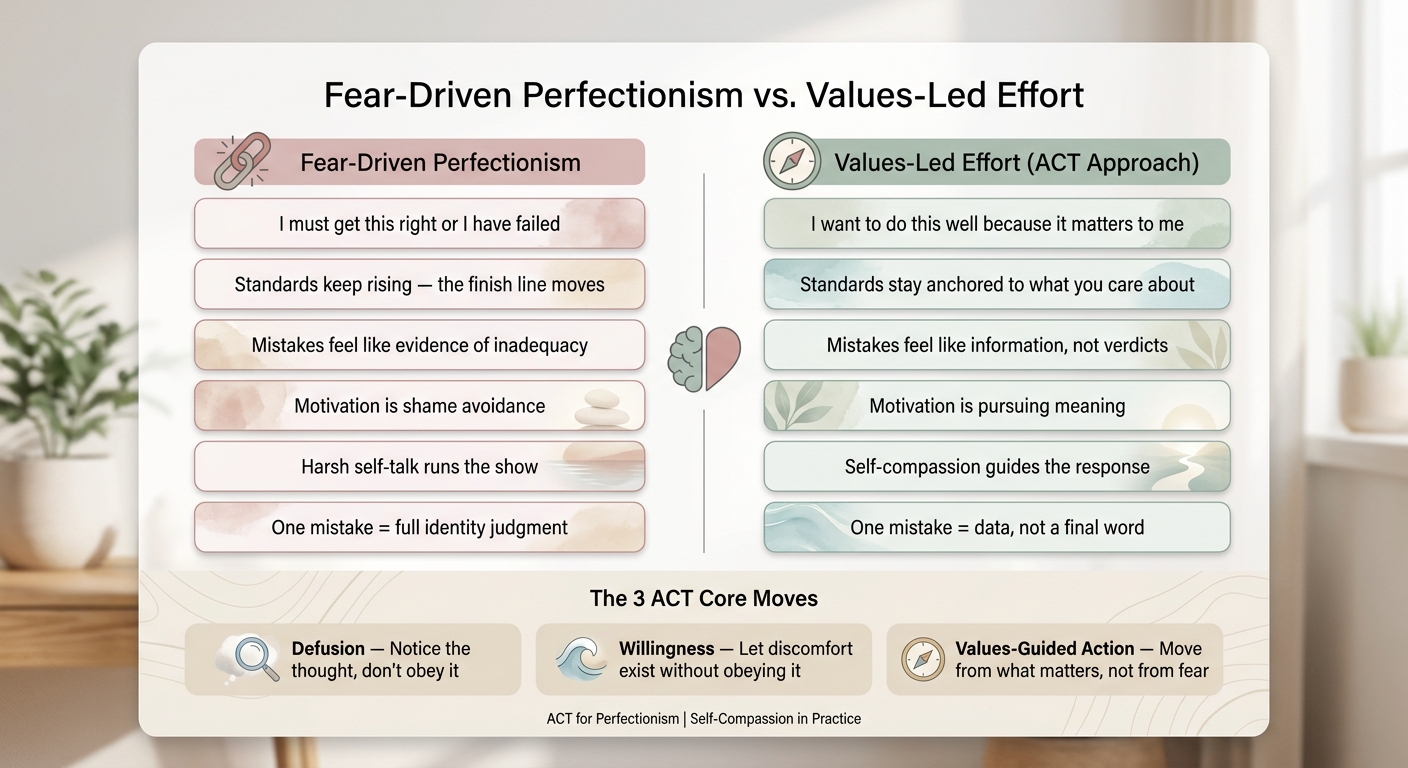
Fear-Driven Perfectionism vs. Values-Led Effort: ACT Framework
You already know this voice. It says, I’m not good enough, and if you hook into it, the whole day starts bending around that sentence. You try to prove it wrong. Or you try to keep anyone from seeing it. So you over-prepare, over-check, or avoid the task altogether.
The critic can sound like it’s trying to help. In practice, it often leaves shame and fear in charge. It does not have to be correct. It only has to be believed. Once that clicks, ACT starts to make more sense, especially its three core moves: defusion, willingness, and values-guided action.
Painful feelings often work the same way. If shame, self-doubt, or the fear of seeming ordinary feels intolerable, the reflex is to outrun it. Work later. Fix one more sentence. Recheck the email again. But fighting those feelings can make the critic sound more convincing, because all that effort tells your nervous system that something threatening must be close by.
ACT for perfectionism: from fusion to flexibility
ACT rests on a simple idea: self-compassion helps you keep going with steadier effort. It does not ask you to silence the critic. It does not ask you to swap hard thoughts for cheerful ones. It asks for a different relationship with those thoughts. The aim is psychological flexibility: noticing what your mind is doing, making space for discomfort, and moving in the direction of what matters to you.
That shift usually happens in three parts.
Defusion means stepping back from a thought so it stops acting like a final ruling. Instead of I am failing, you practice noticing, I am having the thought that I am failing. It sounds small. It is not small. That bit of space can be enough to help you choose what comes next.
Willingness means letting feelings like shame, fear, or vulnerability be present without handing them the steering wheel. You do not have to like the feeling. You do not have to get rid of it first.
Values-guided action means choosing your next move from what you care about, not from what the critic is barking at you to do. A student might turn in the paper before it feels perfect because waiting for perfect often means never turning it in at all.
Perfectionism driven by fear
Values-driven striving
“I must get this right or I have failed”
“I want to do this well because it matters to me”
Standards keep rising
Standards stay anchored to what you care about
Mistakes feel like evidence of inadequacy
Mistakes feel like information
Motivation is shame avoidance
Motivation is pursuing meaning
This is where self-compassion comes in. It helps you stay with the feeling without turning the feeling into a verdict about who you are.
Why self-compassion does not lower your standards
Self-compassion is not what happens when you stop caring. It is often what makes steady effort possible in the first place. Jennifer Kemp notes:
“Failure will always feel unbearable when you criticise yourself harshly for any tiny mistake. You can learn to treat yourself with more kindness… and this means that mistakes are not so painful.”
Self-compassion looks plain up close. You treat yourself with basic decency. You remember that mistakes are part of being human. You stay present long enough to learn something from what happened.
None of that asks you to care less. What it changes is the shame spiral that turns one mistake into a whole identity. Self-compassion interrupts that loop without giving up care, effort, or discipline. You see it in ordinary moments: right after a mistake, in the hour before a deadline, or when the critic insists on one more round of proof.
Why your mind uses harshness as protection
Harsh self-talk can feel like proof that something is off in you. ACT treats it differently. It treats harshness as a signal, not a fact. In many cases, the inner critic is a habit your mind built around high standards and a plain human wish to do well. Perfectionism often starts as a bid for safety: if I’m flawless, I won’t be rejected. The pressure ramps up because, at some point, good enough did not feel safe. Harshness became a form of protection, even if it now leaves you worn down.
Self-compassion begins here: not by treating the critic as the enemy, but by seeing it as a protector with poor aim.
Jennifer Kemp puts it this way, describing the critic as a passenger on a bus with good intentions and rough tactics:
“You can also explore the good intentions behind the passenger – it’s trying to help you succeed or keep you safe – and this opens the door for self-compassion.”
That changes the task. You are not trying to silence the critic or win a fight with it. You are learning to keep driving without handing it the wheel.
How to defuse from the inner critic without debating it
Most people know the reflex. A harsh thought lands, and you rush to argue with it, explain yourself, or prove it false. That often keeps you tied to the same loop. ACT offers another move: defusion. Instead of taking the thought as a verdict, you notice it as a mental event. I am a failure hits one way. I am having the thought that I am a failure hits another. The thought may still sting, but there is a little air in the room. That gap matters.
Sometimes it helps to name the pattern as it shows up: There goes The Judge again. Then return to what you were doing. The point is not to make the critic disappear. The point is to stop treating its words like marching orders.
Once there is some space around the thought, you can start to notice what sits under it.
How to make room for shame and fear without obeying them
Willingness is the part that meets the feeling under the thought. Shame, anxiety, and the fear of being seen as ordinary are often what the critic is trying to outrun. If those feelings seem unbearable, the mind looks for a fix: one more edit, one more check, one more delay. Anything to stay ahead of the discomfort.
Willingness means letting the feeling exist without treating it like a stop sign. You do not have to like it. You do not have to invite it in. You let it be there while you do what matters. In daily life, that might mean opening the door while the house still looks imperfect before guests arrive. The fear of judgment does not need to vanish first. You can notice where the feeling lands in your body and say, quietly, This is shame. It is uncomfortable, not dangerous. Sometimes that small pause is enough.
And that is the space where values-guided action starts to become possible in ordinary life.
sbb-itb-92e3c8f
What this change looks like day to day
The shift often looks plain from the outside. You start the task before you feel fully set. You send the email without reading it twelve more times. You let the house be a little lived-in when friends come over. Small moments, but they carry weight. Once there is room for shame and fear, you can act from what matters instead of waiting until you feel safe enough to begin.
That is where values-guided action starts. Defusion and willingness help make that move possible. Fear may still be in the room. It just doesn’t get the final vote.
Let values guide your next step instead of perfectionist rules
Values answer what matters. Perfectionist rules answer what feels safest.
That shift changes the question at the start. Instead of How do I make sure this is perfect? the question becomes What do I actually care about here? The aim is no longer a flawless result. The aim is effort that means something.
You can feel the difference most clearly after a mistake. That is usually where old rules rush back in.
How to respond with self-compassion after a mistake
When something goes wrong, the perfectionist voice is fast and familiar: I should have known better. How did I get here? A self-compassion response tends to move more slowly. It makes space. It helps you stay in contact with what happened without turning one moment into a full judgment about who you are.
A simple way to do that:
Notice the critic:I am having the thought that I failed.
Name the feeling:Here is shame. It is uncomfortable, not dangerous.
Choose the next action:What is the next right step?
This is not excuse-making. A mistake can still ask something of you. You may need to repair, apologize, change course, or learn a skill. But mistakes are data, not verdicts. Harsh self-attack usually keeps you frozen in the very pattern you are trying to leave.
Perfectionism uses fear to chase certainty. Values use self-compassion to help you keep going, even when certainty is out of reach. You can still care about quality. You can still work hard. The difference is that one misstep no longer gets to decide what the whole effort means.
How therapy supports this shift over time
You can care deeply about your work, your people, and your standards without turning on yourself every time something goes sideways. That’s the shift. Not less care. Less punishment.
It usually doesn’t happen all at once. Old habits tend to come back hardest in the moments that matter most: after a mistake, during a stretch of pressure, or in the quiet hour after you’ve done everything “right” and still can’t settle. Therapy gives you a place to practice a different response until it starts to hold under strain.
How ACT-oriented therapy helps you move from self-attack to steadier effort
Often, the first change is small and easy to miss. You notice the familiar hit of shame, the instant urge to fix, overwork, or brace, and instead of obeying it on autopilot, you pause. That pause matters.
ACT-oriented therapy helps self-compassion become something you do, not just something you agree with in theory. A therapist works with your actual patterns, your pressure points, and the places where self-attack shows up fastest. Defusion, willingness, and values work aren’t used in the abstract. They’re shaped around your stressors, your season of life, and the moments that hook you most.
ACT treatment for perfectionism typically runs 6 to 16 sessions, though long-standing patterns may take longer to shift. If perfectionism is tied to earlier experiences, EMDR can support that work alongside ACT. If the inner critic feels dug in and hard to reach, IFS can help you work with that part more directly. Therapy can also help you define achievement in a broader way, so goals still matter, but you have more room to move. That’s often how the shift starts to feel usable outside the therapy room.
If you’re in Alabama, Empower Counseling is a women-led private practice in Birmingham, Alabama, offering ACT, EMDR, and IFS for perfectionism, anxiety, trauma, and related concerns. Sessions are available in person in Birmingham and by telehealth across Alabama on a private-pay basis.
Sometimes the next step comes before the feeling of readiness does. Therapy can help you take that step anyway.
Key takeaways
You may know this feeling before you have a name for it: If I can just get this exactly right, maybe no one will see what feels lacking underneath. Perfectionism often works like that. It is not vanity or laziness in disguise. It is a protection strategy, the mind’s attempt to keep you safe from shame, judgment, and the ache of not feeling like enough. The pattern is blunt: the inner critic promises safety, but it usually hands you more strain.
The shift tends to come through two moves. ACT helps change your relationship to that inner critic. Defusion helps you notice harsh self-talk as thoughts, not facts and not orders you must follow. Willingness helps you make room for shame and fear without letting them run the show. Your standards do not have to disappear for this to work. What changes is the self-punishment.
Once the critic is no longer steering, values can lead. Then effort can serve creativity, connection, and contribution instead of fear. Mistakes still sting, but they become less paralyzing when they do not set off a full round of self-attack. That is part of what makes self-compassion hold up under pressure.
These skills often take root faster with support, because therapy gives you a place to practice them in the exact moments that tend to trigger self-attack. ACT for perfectionism often takes 6 to 16 sessions, with longer work for deeply embedded patterns.
The idea is simple. The practice takes time. You can care deeply and still treat yourself with steadiness.
FAQs
How is perfectionism different from caring deeply?
The difference often shows up in why you’re pushing so hard, and what happens when things don’t go as planned.
Healthy striving usually comes from care. You want to do good work because creativity matters to you, or growth matters, or being of use matters. There is effort in it, sometimes a lot of effort, but there is still room to be human. A mistake can sting without becoming a verdict. It can still be folded into learning.
Perfectionism is different. It is usually less about care and more about fear. Fear of shame. Fear of not being enough. Fear of being seen and judged. That kind of pressure turns rigid fast. Anything short of flawless starts to feel like failure, and the cost can be steep: your peace, your well-being, even your capacity for joy.
What if self-compassion makes me less productive?
Self-compassion doesn’t make you do less. It changes why you keep going.
A lot of people learned to move through life with an inner threat system running the show: If I ease up, I’ll fall behind. If I’m not hard on myself, I’ll get sloppy. If I make a mistake, I need to pay for it so I don’t do it again. That logic can look productive from the outside. Inside, it’s draining. It turns effort into self-surveillance.
Self-compassion shifts motivation away from fear and back toward your own values. You’re still accountable. You still care. But the engine changes. Instead of pushing yourself with shame, you’re more able to respond to setbacks, think clearly, and keep moving without burning through all your energy.
That matters after mistakes. Harsh self-criticism tends to trap people in rumination and paralysis, especially when perfectionism is already in the room. Self-compassion makes it easier to recover, solve the problem in front of you, and take responsibility without collapsing into self-attack. The point isn’t to lower your standards. It’s to stop turning every hard moment into proof that you’ve failed.
For many women, that shift can feel almost suspicious at first. If fear has been the fuel for years, kindness may seem too soft to work. But softer is not the same as weaker. In practice, it often supports steadier effort, less avoidance, and a way of working that asks less from your nervous system while asking no less of your values.
How do I know when perfectionism needs therapy?
You may benefit from therapy if this feels less like “I have high standards” and more like a loop you cannot shut off. You push hard, then freeze. You tell yourself you should start, should know better, should do more, and the voice in your head gets sharper the more worn down you feel. What often gets called perfectionism can look like chronic overwork, procrastination, avoiding anything where you might not do well right away, or an inner critic so harsh that shame starts shaping your days, your relationships, and your sense of self.
That pattern is not a character flaw. It is often a mind trying to protect you from failure, rejection, or not feeling like enough. But protection can get costly.
Therapy can help when self-compassion does not feel soft or comforting, but exposed, unnatural, or almost impossible. It can also help when obsessive loops, second-guessing, and indecision keep you stuck in place long after a choice needs to be made. In ACT, the goal is not to lower your standards into indifference. It is to help you loosen the grip of performance so your worth is not on trial every time you work, decide, or try.
Where to Find Eating Disorder Treatment in Alabama: What Exists, What Doesn’t, and How to Choose I don’t even know what I’m supposed to be looking for. That is close to the exact sentence women say when they finally start searching. It is eleven at...
Whatever you are carrying right now — the worry that never quiets, the “not enough” that won’t go away, the grief that has no name, the exhaustion of holding it all together, the unfulfilling relationships — you do not have to manage it alone. You reached out. That matters.

 If you’re in Alabama, Empower Counseling is a women-led private practice in Birmingham, Alabama, offering ACT, EMDR, and IFS for perfectionism, anxiety, trauma, and related concerns. Sessions are available in person in Birmingham and by telehealth across Alabama on a private-pay basis.
Sometimes the next step comes before the feeling of readiness does. Therapy can help you take that step anyway.
If you’re in Alabama, Empower Counseling is a women-led private practice in Birmingham, Alabama, offering ACT, EMDR, and IFS for perfectionism, anxiety, trauma, and related concerns. Sessions are available in person in Birmingham and by telehealth across Alabama on a private-pay basis.
Sometimes the next step comes before the feeling of readiness does. Therapy can help you take that step anyway.