“I care about my friend, but I still haven’t answered her text.” I want to understand that gap without turning it into a judgment about who I am. In Acceptance and Commitment Therapy (ACT), values describe how I want to act; goals are specific steps I can complete. This article explains how I can choose a smaller step when depression limits my energy, without treating a missed goal as <u>proof that I don’t care</u>.
Values vs Goals in ACT for Depression
Providing Patients with Psychoeducation Increases Resilience | Mental Health Professional Webinar
sbb-itb-92e3c8f
The Difference Between Values and Goals in ACT
“I know what matters to me, but I can’t get myself to do it.” Depression can make action feel impossible. Acceptance and Commitment Therapy (ACT) separates what matters to you from what you can do today, helping you make room for painful thoughts and feelings while choosing actions that reflect what you care about.
Values: How You Want to Act
Values are chosen ways of acting, such as caring or honesty. They aren’t feelings you need to produce or tasks you can finish. When you feel numb or pull away from others, a value still asks how you want to act, rather than how guilt or pressure says you should act.
Goals: Steps You Can Complete
Goals turn a value into a specific result you can work toward, often by a set time. In ACT, taking these steps is the action part of change.
Those steps can shift with your energy and circumstances. Missing one says something about that day and its limits, not your worth.
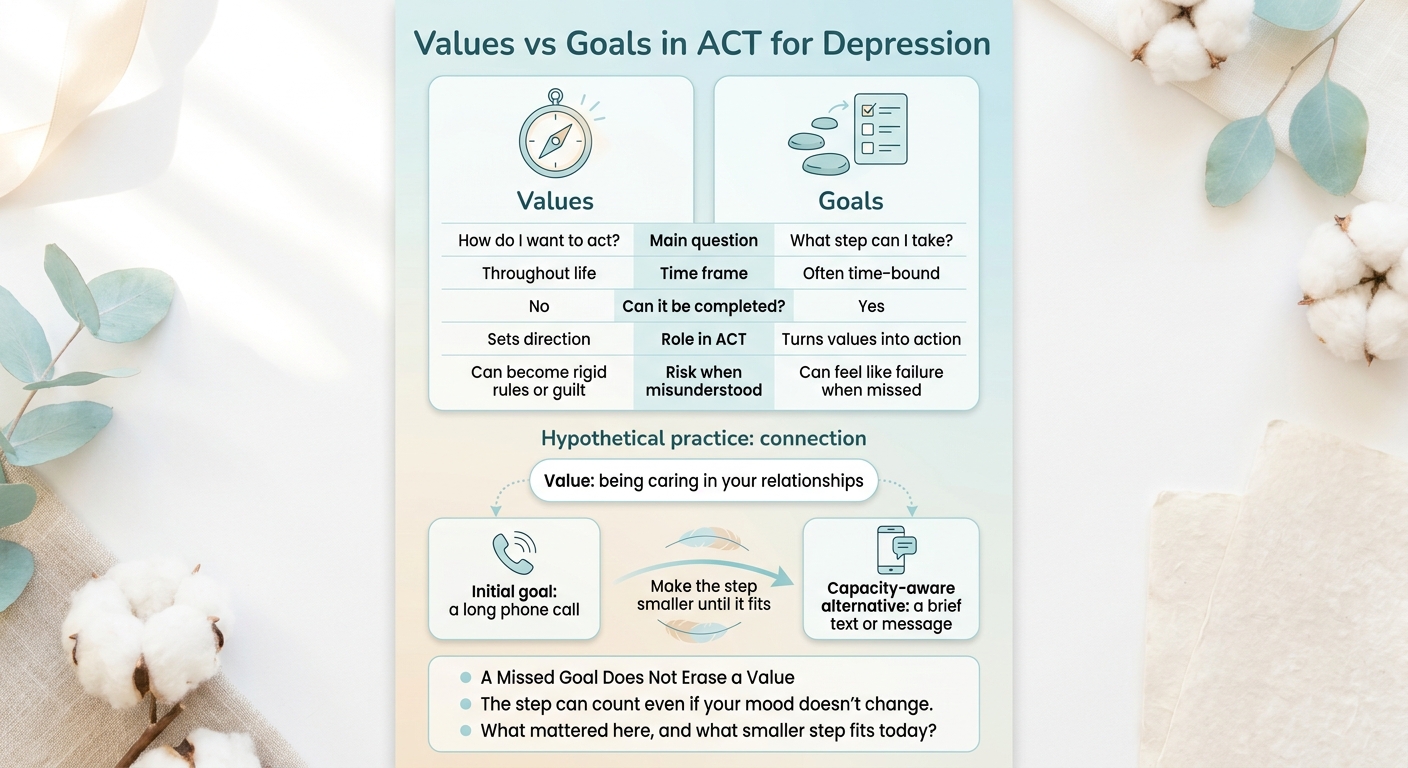
Values vs Goals at a Glance
The distinction is between a direction you choose and a step you can finish.
Concept
Main question
Time frame
Can it be completed?
Role in ACT
Risk when misunderstood
Values
How do I want to act?
Throughout life
No
Sets direction
Can become rigid rules or guilt
Goals
What step can I take?
Often time-bound
Yes
Turns values into action
Can feel like failure when missed
Write: The way I want to show up is ____. The next step I can take is ____. If I miss it, look for barriers or limits – not proof that the value is gone.
When values and goals blur together, “I missed a step” can become “I failed at being the person I want to be.” That shift turns an unfinished goal into a judgment about yourself and can lead to shame.
Why Missed Goals Can Lead to Shame
“I’m lazy” or “I failed” can become the story you tell yourself when depression prevents a planned step. But a missed goal is not an accurate measure of your effort or character. Shame can make the next step harder, turning a limit in what you can do into a judgment about who you are.
Hypothetical Example: Missing a Family Outing
A hypothetical parent with depression cannot go on a planned family outing. The outing was the goal; caring is the value. When the goal is missed, shame can turn a capacity issue into a character judgment. She can notice the thought “I do not care” without treating it as true and acknowledge her child’s disappointment. A five-minute quiet conversation, if it fits her capacity, can still express caring. In ACT terms, the goal changed; the value did not.
Self-Judgment vs Flexible Goals
Goals are not the problem. The difficulty comes from treating completion as proof of your worth or how much you care. Values-based flexibility lets you keep the same direction while changing the step to fit what you can do.
When considering…
Rigid self-judgment
Values-based flexibility
Success criteria
Only the full outing counts.
An act of caring within my capacity counts, too.
Setbacks
This proves I’m a bad parent, so why try again?
What did my energy, timing, or support allow, and how can I adjust?
Difficult emotions
I must stop feeling guilty before connecting.
I can make room for guilt while choosing an action within my capacity.
After a missed goal, ask yourself: What made this step too big, and what support would make it smaller? Use the answer to choose a smaller goal based on your capacity, rather than shame.
Choose Goals That Fit Your Capacity
“I didn’t do what I planned, and I don’t have much energy today.” After a missed goal, start with what you can do now, not what you think you should be able to do. Make the step smaller until it fits. Committed action means taking one doable step while hard thoughts or feelings are still present.
Name a Value and Pick One Small Step
If you feel disconnected, name the value behind your wish for connection: being caring in your relationships. Then notice what stands between you and that action, whether it’s a difficult thought, a feeling, or a practical limit. You can step back from self-judgment without dismissing those limits.
Hypothetical practice: connection. If a long phone call feels beyond your capacity today, choose a brief text or message instead. A short step can still move you toward connection.
Check Barriers and Adjust Your Goal
If you miss the goal, ask what got in the way and what helped. Use those answers to adjust the next step, making it smaller if needed.
The step can count even if your mood doesn’t change. A small action may reflect what matters to you without helping you feel better right away. You don’t have to feel better before you act.
How ACT-Based Therapy Supports Depression Care
“I know this matters to me, but it still feels like too much.” Therapy can help you make a goal smaller without losing what it means to you. An ACT therapist helps you separate your values from the pressure to seem fine, naming what matters to you and noticing when the pursuit of approval pulls you away from it.
In therapy, you can consider whether you would act differently if nobody were grading your effort. Your therapist can help you clarify your values, identify the areas of life that matter most, and find a small next step that fits.
That step needs to account for what you’re facing. Together, you can identify barriers such as self-critical thoughts, low energy, and disrupted sleep, then adjust daily actions to fit your current capacity.
If trauma or other stressors complicate depression, ACT can be part of a broader treatment plan. When trauma is involved, that plan may combine ACT with EMDR.
You may know what matters to you and still feel unable to act on it. Therapy offers support in that gap.
Empower Counseling is a women-led private practice offering ACT for depression in person in Birmingham and through telehealth across Alabama. Select clinicians also offer care in Tennessee.
Conclusion: A Missed Goal Does Not Erase a Value
“I didn’t follow through” does not have to mean “I don’t care.” In ACT, values give you a direction; goals define the next step. Depression can limit what you’re able to do without changing what matters to you.
Treat the missed step as a signal to adjust, not a reason to stop. Ask yourself:
What mattered here, and what smaller step fits today?
You can change the size or timing of the step without losing its purpose. If barriers keep getting in the way, therapy can help you make the step smaller and continue toward what matters. Values stay steady; goals can change.
FAQs
How do I tell my values apart from others’ expectations?
“I should have it all together” can leave little room to ask what matters to you. Pause to separate what you care about from what other people or society expect of you.
Values guide how you want to act and what you stand for, whether that means making something new, acting with integrity, or building connection. Expectations often center on outcomes or “having it all together.”
Notice what’s driving your next choice. If you’re acting mainly to avoid discomfort or judgment, you may be responding to expectations rather than following your values.
How can I tell if a smaller goal is avoidance?
“I can handle a smaller step” can mean making room for what matters, or finding a way around something painful. Ask whether the smaller goal moves you toward your values or mainly helps you escape discomfort. In Acceptance and Commitment Therapy (ACT), values give you a direction; goals are steps you take in that direction.
A smaller goal may be avoidance if it mainly helps you dodge difficult emotions, skip a tough conversation, or put off a task that needs your attention to avoid short-term discomfort.
What if even my smallest goal feels impossible?
“I can’t do this” may be the thought that comes up when a goal feels out of reach. In Acceptance and Commitment Therapy (ACT), values guide your direction; goals are steps toward what matters to you, not demands to be productive. Try breaking the goal into smaller commitments that take 5 to 10 minutes.
If you still feel stuck, make room for frustration or heaviness without judging yourself for feeling it. Rather than waiting for your mood to improve, try saying:
How to Set Boundaries With Family During the Holidays (Without Feeling Like the Bad Guy) "I already know what she's going to say about my plate." "If we leave early, I'll hear about it until March." "Why do I turn back into a fifteen-year-old the minute I walk through...
Learn how perfectionism and masking affect anxiety in neurodivergent teens, plus ways to support them through self-compassion, breathwork, and school support.
Whatever you are carrying right now — the worry that never quiets, the “not enough” that won’t go away, the grief that has no name, the exhaustion of holding it all together, the unfulfilling relationships — you do not have to manage it alone. You reached out. That matters.