“I want to say something, but I keep waiting until I’m sure it won’t sound wrong.” Values work in Acceptance and Commitment Therapy (ACT) can help guide social choices while anxiety is present, but trials have not established its effects apart from the rest of ACT. Here, I’ll look at what the findings can tell us and how <u>what matters to me</u> can become a reason to participate, rather than another demand to feel confident.
Depression and Anxiety with Acceptance and Commitment Therapy | Mental Health Webinar
sbb-itb-92e3c8f
How Avoidance Relates to Social Anxiety
“I don’t want to say the wrong thing” can become a reason to stay silent, rehearse sentences, or keep answers short. You might avoid eye contact or monitor how you sound while speaking. These safety behaviors are attempts to protect yourself from judgment. They can feel protective in the moment while limiting opportunities for connection and social learning.
The problem is not that you want protection. It is what that protection may cost over time. Acceptance and commitment therapy (ACT) shifts the focus from reducing fear to changing your relationship with it. Your values give you a reason to approach a conversation even when fear comes along.
Key ACT Concepts and Social Behaviors
ACT helps you notice when managing discomfort starts to keep you from participating. Coping can help when it remains flexible; experiential avoidance becomes limiting when escaping feelings repeatedly takes priority over what matters to you. Value-led action means choosing behavior that reflects your priorities, not behavior that guarantees calm. These processes take shape in everyday social choices.
| Concept | Definition | Behavioral pattern | Relevance to social anxiety |
|---|---|---|---|
| Experiential avoidance | Rigid efforts to escape or suppress internal experiences | Skipping events or seeking repeated reassurance | Can maintain fear and restrict social learning |
| Psychological flexibility | Adjusting behavior to the situation and chosen values | Participating while anxiety is present | Supports engagement without requiring calm |
| Acceptance | Making room for discomfort while staying engaged | Allowing blushing or tension during conversation | Does not mean liking harm or giving up boundaries |
| Cognitive defusion | Seeing thoughts as thoughts rather than facts | Recognizing anticipated rejection as a prediction | Loosens the influence of catastrophic predictions |
| Present-moment awareness | Paying open attention to current experience | Listening rather than monitoring performance | Reduces self-focused attention |
| Self-as-context | Observing experience without treating it as your identity | Noticing anxiety without defining yourself by it | Supports a less restrictive view of yourself |
| Values clarification | Identifying chosen directions, such as friendship, learning, or honesty | Choosing which priority matters in an interaction | Provides the decision point between flexibility and action |
| Committed action | Taking specific steps toward chosen directions | Greeting a peer or asking a question | Turns priorities into observable behavior |
Start by naming what you are trying to prevent and what that protection is costing you. Then choose one behavior to reconsider, rather than removing every coping strategy at once. Flexibility leaves room for boundaries: leaving an unsafe situation, accommodating a disability, or preparing for a difficult conversation is not a failure of acceptance.
Researchers have also examined whether these patterns unfold over time.
Adolescent Studies and Changes Over Time
A longitudinal study followed 21 adolescents with a primary diagnosis of social anxiety disorder across three assessments. Their average age was 16.19. Self-report measures assessed acceptance, committed action, psychological inflexibility, and social anxiety. Acceptance and committed action were associated with lower inflexibility after 10 weeks; inflexibility, in turn, predicted higher social anxiety 12 weeks later. This pattern was consistent with mediation, but the study was observational and too small to establish cause and effect.
A separate two-wave study followed 2,481 Chinese adolescents and young adults ages 13–21, with a mean age of 16.48. At baseline, participants completed the Acceptance and Action Questionnaire-II, the Avoidance and Fusion Questionnaire for Youth, and the Social Anxiety Scale for Adolescents. Researchers assessed social anxiety again three months later. Baseline experiential avoidance mediated associations between empathy-related experiences and later symptoms. The findings support a process model, but this was not a treatment trial, and they do not prove causation.
Treatment studies address the next question: whether changing these patterns improves social anxiety.
What ACT Treatment Research Shows
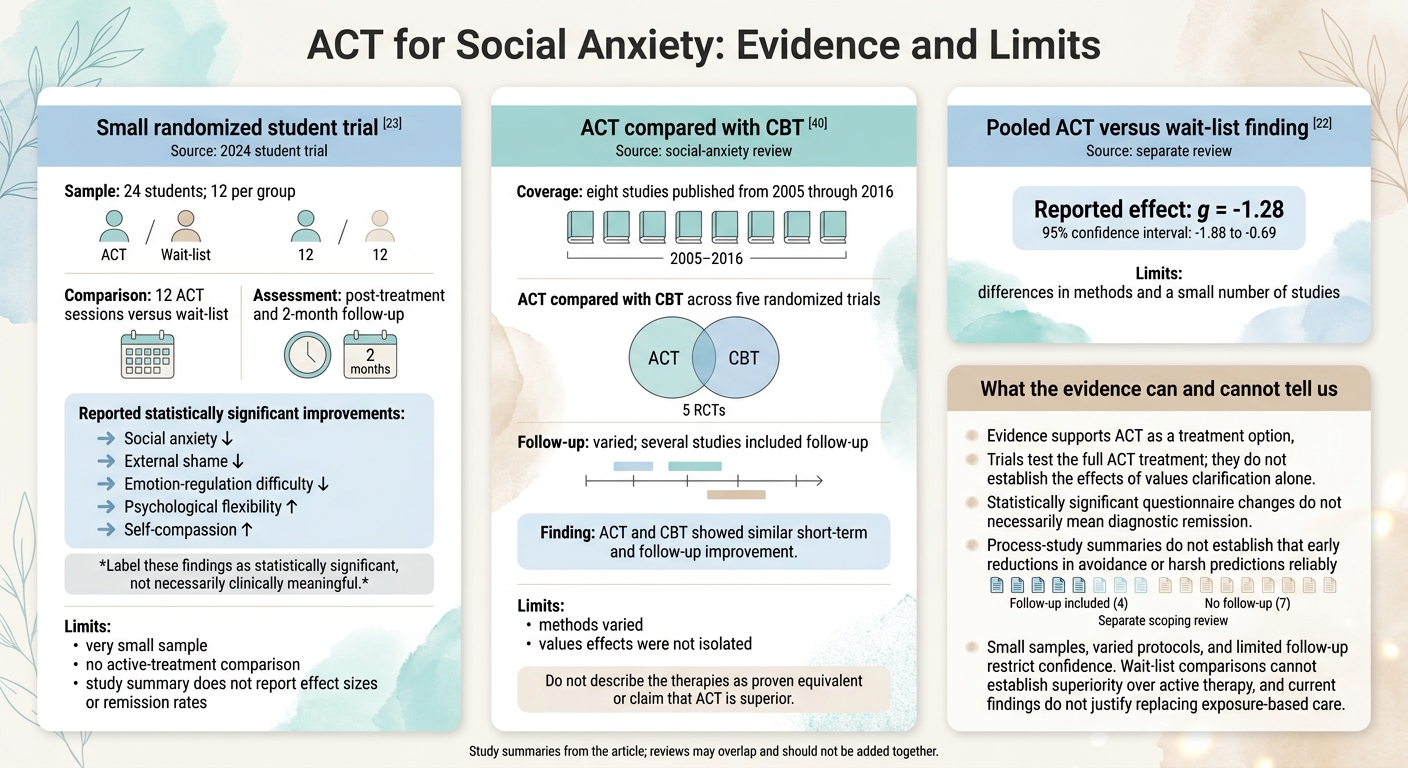
ACT for Social Anxiety: Evidence and Limits
“I want to join the conversation, even if I still feel nervous.” That is the kind of change worth looking for alongside lower symptom scores. Research on acceptance and commitment therapy (ACT) points to possible improvement in social anxiety, but most trials test the full treatment, not values clarification alone. For values-led behavior change, the question is whether people participate more in social life, not only whether they score differently on a questionnaire.
Trial Methods, Results, and Follow-Up
A 2024 randomized student trial offers preliminary support. Researchers assigned 24 students with social anxiety to either 12 ACT sessions or a wait-list. At post-treatment and the 2-month follow-up, the ACT group showed statistically significant improvements in social anxiety, external shame, emotion-regulation difficulty, psychological flexibility, and self-compassion. The study summary does not report effect sizes or remission rates, so it cannot tell us whether those changes made a clinically meaningful difference.
| Study | Design and sample | Treatment and comparison | Follow-up | Outcomes and limits |
|---|---|---|---|---|
| Student trial, 2024 report | Randomized trial; 24 students, 12 per group | 12 ACT sessions versus wait-list | 2 months | Social anxiety, external shame, and emotion-regulation difficulty decreased; psychological flexibility and self-compassion increased. Very small sample and no active-treatment comparison. |
| Social-anxiety review | Review of eight studies published from 2005 through 2016 | ACT compared with CBT across five randomized trials | Varied; several studies included follow-up | ACT and CBT showed similar short-term and follow-up improvement, but methods varied and values effects were not isolated. |
A separate review reported a pooled ACT-versus-wait-list effect of g = -1.28 (95% CI -1.88 to -0.69), while noting differences in methods and a small number of studies. These findings support ACT as a treatment option. They do not establish that it works better than CBT or that values clarification drives improvement. A statistically significant questionnaire change also does not necessarily mean someone no longer meets diagnostic criteria.
The next question concerns how change happens: whether less avoidance predicts better outcomes.
Does Reduced Avoidance Predict Improvement?
Process-study summaries do not establish that early reductions in avoidance or harsh predictions about social situations reliably predict later improvement. They also do not isolate values clarification as the mechanism of change.
Research Strengths and Gaps
Randomized comparisons give these findings more weight, but small samples, differences in treatment protocols, and limited follow-up restrict confidence. One scoping review reported follow-up in only four of 11 included studies. Wait-list comparisons cannot establish that ACT works better than active therapy, and the current findings do not justify replacing exposure-based care.
For values-led work, symptom scores are only part of what needs tracking. Participation matters too: whether someone is making more room for the social choices that matter to them.
Putting Values Into Social Action
“I want to join in, but I keep holding back.” ACT turns that tension into a small social step: notice anxiety, make room for it, and choose an action that fits what matters to you. When avoidance helps keep social anxiety in place, the task is to turn a value into one concrete move.
Values, Goals, and Others’ Expectations
A small step should serve your values, not someone else’s expectations. Values are directions you keep choosing; goals are steps you can complete. Consider whether you would still choose the action if no one were judging you.
The issue is not whether you are introverted or appear confident. It is whether the action moves you toward what you care about. Sociability and courage do not need to become new demands.
Hypothetical Case: Asking a Question in Class
A student may write down questions but never raise a hand. A student who values learning could work with a therapist to prepare one clarification question for the next class. When self-criticism appears, the student could notice the thought that everyone will judge them, feel their feet on the floor, and choose whether to ask. Staying silent may reflect avoidance, not a flaw.
Afterward, they would review whether the question served learning, not whether it felt calm. They could repeat the step or try asking privately. Willingness is not pressure; sensory needs, accessibility, and safety can justify changing or skipping the exercise. The example shows the process; it does not prove effectiveness.
ACT Support Tailored to the Person
Practice should fit the person doing it. A clinician can adjust exercises to your symptoms, preferences, background, and co-occurring needs, including trauma, depression, ADHD, or sensory differences.
Key Findings and Limits
“I want to take part, even if I still feel anxious” describes the goal here. A randomized study of 30 adults found lower social-anxiety symptoms and better quality of life with ACT than with wait-list care. A longitudinal study of adolescents also linked greater psychological inflexibility with later social anxiety. That finding supports flexibility as a possible process of change, but it does not prove causation.
These findings point to possible gains, not one clear explanation for how change happens. Evidence for ACT does not establish that values clarification alone works, because the studies do not separate values work from the rest of ACT. Small samples, student-heavy populations, and short follow-up periods also leave questions about whether the gains last.
In practice, values can help you move from understanding avoidance to choosing more flexible actions, without requiring anxiety to disappear. Record what mattered to you, what you did, and how distressed you felt, then review those notes with your clinician. Values can guide care alongside attention to symptoms, safety, and participation. Rather than measuring progress by calm alone, you and your clinician can also track your willingness to take part in what matters.
FAQs
How can I tell avoidance from a healthy boundary?
“I just want this feeling to stop” and “I need to protect what matters to me” can lead to the same outward action. In Acceptance and Commitment Therapy (ACT), the distinction rests on what your behavior is meant to do and what happens afterward. Avoidance aims to remove discomfort or fear, but it can reinforce anxiety and pull you away from what matters.
A healthy boundary is a deliberate choice guided by your values. It protects your well-being or helps you live in line with what matters, without requiring discomfort to disappear. You can hold a boundary and still be willing to feel uneasy.
What if my values pull me in different social directions?
“I want to connect, but I don’t want to pretend” can leave you pulled in two social directions. In Acceptance and Commitment Therapy (ACT), psychological flexibility means staying present and responding with openness instead of falling into rigid patterns. The focus is on what you can control and which value matters most in that moment: connection, perhaps, or being honest about who you are.
ACT calls observing your thoughts without judging them cognitive defusion. It’s a way to step back from the pressure those thoughts create, leaving room to choose what fits your values, even when that choice feels uncomfortable.
How can I track progress if I still feel anxious?
“I still feel anxious, but I’m doing what matters to me.” In Acceptance and Commitment Therapy (ACT), that counts as progress. The goal isn’t to eliminate anxiety. It’s to live in line with your values, even when anxiety comes along.
What you’re tracking is psychological flexibility: your ability to stay present and take meaningful action while feeling anxious. You might notice an anxious thought without getting pulled into it, take a small step toward something you care about, or follow through on plans you once would have avoided for temporary relief.