
Acceptance and Commitment Therapy (ACT) helps couples navigate tough emotions and rebuild their connection by focusing on six core principles: cognitive defusion, acceptance, present-moment awareness, self-as-context, values, and committed action. Instead of avoiding or suppressing emotions, ACT encourages partners to face challenges together, guided by shared values and intentional actions.
Key Takeaways:
- Cognitive Defusion: Recognize negative thoughts during conflicts as thoughts, not facts, to prevent reactive responses.
- Acceptance: Allow room for difficult emotions like anger or sadness without suppressing them.
- Mindfulness: Stay present and fully engaged during interactions to strengthen emotional bonds.
- Shared Values: Identify and align on shared values to guide relationship goals and decisions.
- Committed Action: Take small, consistent steps that reflect shared values to build trust and connection.
Research supports ACT’s effectiveness. Studies show it improves communication, intimacy, and marital satisfaction, even in cases involving infidelity or significant conflict. For couples seeking support, ACT-based counseling – like that offered by Empower Counseling in Birmingham, Alabama – can provide tools to rebuild trust and foster lasting connection.
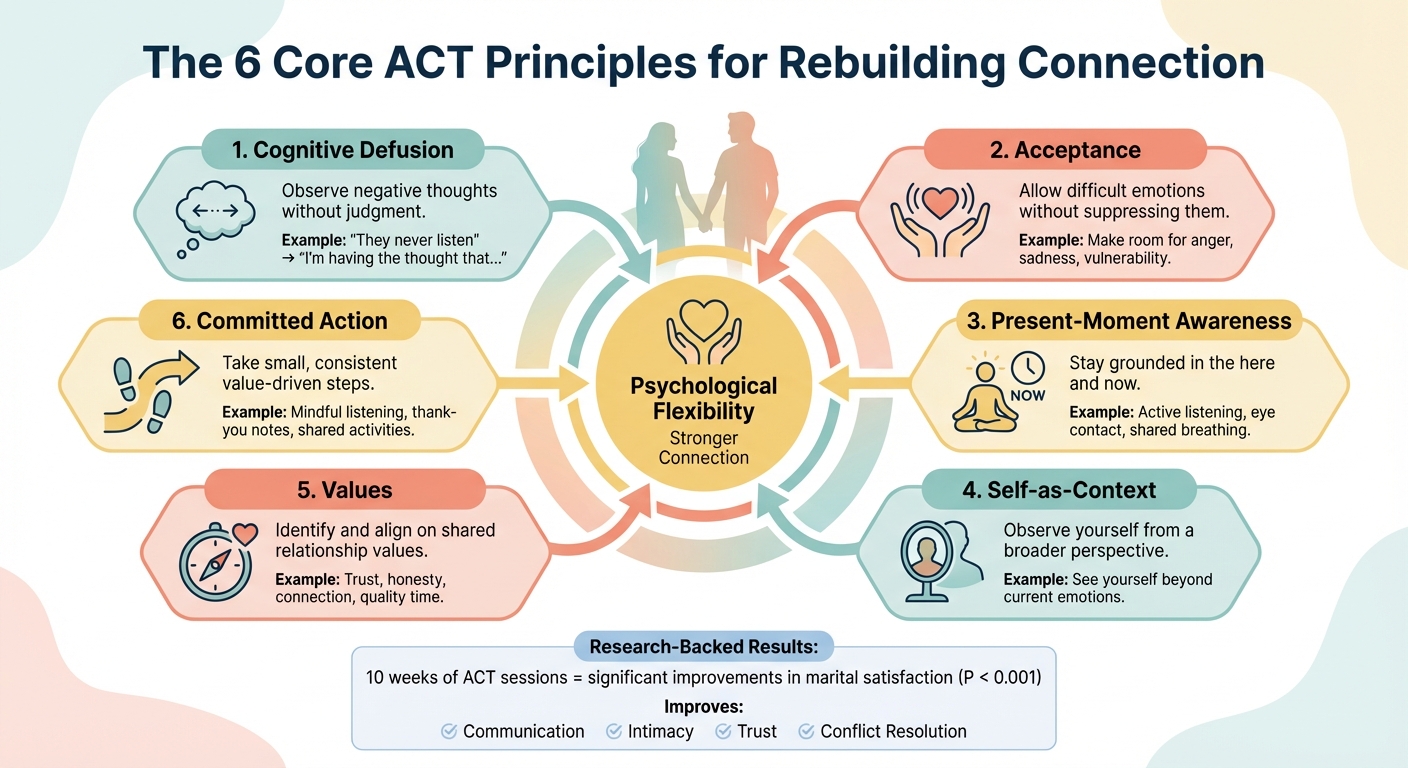
6 Core ACT Principles for Couples: A Visual Guide to Rebuilding Connection
Act for Couples: Repairing and Enriching Relationships (#4)
sbb-itb-92e3c8f
The 6 Core Principles of ACT for Couples
ACT (Acceptance and Commitment Therapy) is built around six key principles designed to promote psychological flexibility. These principles – cognitive defusion, acceptance, present-moment awareness, self-as-context, values, and committed action – work in unison to help couples address and resolve relationship challenges. Let’s start with cognitive defusion, a concept that reshapes how we handle negative thoughts during conflicts.
Cognitive Defusion: Observing Negative Thoughts Without Judgment
Conflict often brings up thoughts like, "They never listen" or "This relationship is hopeless", which can feel like undeniable truths. Cognitive defusion encourages partners to see these thoughts as just that – thoughts, not facts that demand immediate reaction. This approach creates breathing room, helping to keep disagreements from spiraling.
"Cognitive defusion involves distancing oneself from unhelpful thoughts, preventing them from dictating responses."
- Rubin Khoddam, PhD, COPE Psychological Center
Research supports this approach. In April 2024, a study by Sofia Khaneghahi and Mansoure Poorjanebollahi Firoozabadi in Meybod, Iran, examined 20 married couples who struggled with infidelity and poor communication. The results showed that ACT significantly improved communication and reduced instances of infidelity among participants.
A practical way to apply cognitive defusion is by labeling your thoughts during disagreements. For example, instead of thinking, "You don’t care about my feelings", try reframing it internally as, "I’m having the thought that my partner doesn’t care." You can also visualize negative thoughts as passing clouds or observe physical sensations – like a tight chest or lump in your throat – with curiosity rather than reacting defensively.
Acceptance: Allowing Difficult Emotions
Acceptance involves making room for tough emotions – like anger, sadness, or vulnerability – without trying to suppress or escape them. When partners stop resisting their feelings, they can redirect their energy toward empathy and understanding.
"By opening up and allowing [unpleasant feelings] to come and go without struggling with them, running from them, or giving them undue attention, we find that they bother us much less."
Numerous studies have shown that ACT can enhance marital intimacy and satisfaction. This principle becomes especially critical when trust has been damaged. For instance, the Expansion exercise encourages partners to focus on the physical sensations tied to their emotions. Locate where the feeling is most intense – perhaps a heavy chest or a knot in your stomach – then breathe into it, observing its texture and weight. This practice helps acknowledge emotions without judgment, creating a path toward reconciliation.
Present-Moment Awareness: Staying Connected Through Mindfulness
Present-moment awareness helps couples avoid being stuck in the past or worrying about the future, instead grounding them in the here and now. This mindfulness fosters deeper connection and understanding.
"Mindfulness in relationships means actively listening and responding in the present moment, a powerful way to strengthen connection."
- Rubin Khoddam, PhD, COPE Psychological Center
To practice this, focus fully on your partner during conversations – listen to their words, tone, and body language without planning a counterargument. Shared breathing exercises, where both partners synchronize their breath for a few minutes, can also help restore balance during tense moments. Even small actions, like holding eye contact, can enhance mindfulness and emotional connection. When tensions arise, redirect your focus from past grievances or future worries to the immediate emotions and needs in the moment.
For couples looking to explore these ACT principles further, professional guidance from Empower Counseling in Birmingham, Alabama, offers tailored tools to strengthen relationships and rebuild trust.
Identifying Shared Values to Align Relationship Goals
In Acceptance and Commitment Therapy (ACT), shared values play a key role in helping couples rebuild intimacy and trust. While values explain why you act, goals serve as milestones along the way. For example, planning regular Friday date nights might reflect values like connection, quality time, or trying new experiences together.
"Everyone has their own set of values, and every couple has a set of shared values that help guide them towards goals."
- Emma Carpenter, Philadelphia Therapist, A Better Life Therapy
The process starts with each partner identifying their personal values – things like trust, honesty, compassion, or growth. Using a list as a guide can help. Once individual values are clear, have an open conversation to discover where your values align. This shared understanding becomes the foundation of your relationship vision, often articulated as a joint values statement. This statement acts as a compass, helping with decision-making and resolving conflicts. Research backs this approach, showing that focusing on shared values strengthens relationships.
One study from 2015 involving 50 couples in Kashan, Iran, found that participating in 10 weekly 90-minute ACT sessions – centered on mindfulness and values-based behaviors – resulted in a significant increase in marital satisfaction and quality of life (P < 0.001). This highlights how values-driven changes can effectively address relationship challenges.
ACT also encourages flexibility by shifting focus away from rigid rules. For instance, instead of insisting on dinner at 6:00 PM, recognize that the true value might be connection or quality time. This intention can be honored through alternatives like sharing morning coffee or taking an evening walk when schedules don’t align. By prioritizing values over strict expectations, couples can develop practical strategies for compromise and mutual validation. Keeping your shared values statement visible can also serve as a helpful reminder during tough moments or big decisions.
Aligning on values doesn’t just clarify relationship goals – it strengthens the bond and reinforces a lasting commitment. Couples interested in exploring these ACT-based methods can seek professional support from Empower Counseling in Birmingham, Alabama.
Taking Committed Action for Lasting Change
Acceptance and Commitment Therapy (ACT) doesn’t stop at mindfulness and acceptance – it pushes for action. Committed action takes the insights gained and turns them into consistent, value-driven behaviors. For couples, this means identifying shared values and taking small, intentional steps that align with those values. Even when emotional discomfort arises, these actions help build trust and emotional security through repeated efforts that reinforce connection.
"Committed action means taking intentional steps towards one’s values… actively engaging in behaviors that promote the growth and well-being of the relationship." – Olivia Hayes
Psychological flexibility plays a big role here. It allows partners to experience emotional pain without veering away from their core values. This flexibility is what enables couples to make choices that nurture their relationship daily. For instance, if emotional intimacy is a shared value, you might commit to mindful listening each evening – making eye contact and truly focusing on your partner’s words without planning your response. Other practices could include writing thank-you notes or engaging in formal forgiveness exercises, both of which foster acceptance and appreciation.
Let’s look at some examples of how these small actions can replace reactive habits with intentional, value-aligned behaviors.
Examples of Committed Actions in Relationships
Here’s a quick comparison of common relationship challenges and how ACT-inspired actions can transform responses:
| Relationship Challenge | Reactive/Avoidant Response | ACT-Based Committed Action |
|---|---|---|
| Heated Argument | Escalating the conflict or withdrawing | Taking a mindful pause and naming the unhelpful thought or emotional "hook" |
| Feeling Ignored | Aggressively pursuing your partner or retreating in fear | Sharing deeper vulnerabilities, like the fear of being unloved |
| Negative Labeling | Thinking, "They always ignore my feelings" | Practicing cognitive defusion – observing the thought without judgment |
| Routine/Stagnation | Falling into passive routines or separate activities | Planning shared activities that align with mutual goals |
These actions help couples break out of repetitive conflict cycles – like the pursue-withdraw dynamic – by addressing the vulnerabilities beneath surface-level disagreements. Consistently practicing value-driven behaviors strengthens emotional bonds and improves communication over time.
For couples in Birmingham, Alabama, Empower Counseling offers specialized support in ACT-based couples and marriage counseling. These strategies can help you rebuild and sustain a deeper, more connected relationship.
How ACT Improves Relationships
ACT (Acceptance and Commitment Therapy) takes relationship improvement a step further by addressing communication and emotional regulation. A 2025 meta-analysis of 17 trials revealed that ACT significantly enhances communication, intimacy, and overall satisfaction. Additionally, a study involving 50 couples highlighted improvements in personality dynamics, communication, and conflict resolution.
One of ACT’s core strengths lies in helping partners manage emotions while staying aligned with shared values. Abdollah Omidi, Associate Professor at Kashan University of Medical Sciences, explains:
"ACT for couples aims to create a balance between change and acceptance, and a compassionate relationship in couples" – Abdollah Omidi
This method builds on earlier techniques like cognitive defusion and acceptance, making it especially helpful for couples stuck in demand/withdrawal cycles – where one partner pursues while the other pulls away.
ACT also addresses alexithymia, a condition where individuals struggle to identify and express emotions, which often leads to misunderstandings and resentment. Research further shows that ACT not only improves communication but also helps prevent marital infidelity. Typically conducted over 10–14 sessions, ACT focuses on long-term coping strategies rather than quick fixes.
For couples in Birmingham, Alabama, Empower Counseling provides both in-person and online ACT sessions, helping relationships shift from reactive conflict to a connection rooted in shared values.
Conclusion
Rebuilding connection in a relationship means facing conflict and difficult emotions head-on, but doing so with care and purpose. ACT equips couples with practical tools to step away from unhelpful thought patterns, embrace challenging emotions without judgment, and take actions that align with what truly matters to both partners. These skills help create room for genuine understanding rather than falling into defensive reactions. And the best part? These strategies are backed by solid research.
For instance, a 2015 study found that couples who participated in 10 weeks of ACT sessions experienced significant improvements in marital satisfaction (P < 0.001). These aren’t quick fixes – they’re meaningful changes that reinforce the foundation of a relationship.
What sets ACT apart is its emphasis on values-based action. Instead of simply focusing on reducing conflict, couples learn to identify shared values – such as honesty, emotional safety, or adventure – and use these as a guide for making everyday decisions. By consistently acting in ways that reflect these values, couples build trust and shift from reactive patterns to intentional, thoughtful interactions.
Professional guidance can make applying these principles even more effective. A certified ACT therapist can adapt the approach to address your specific challenges, whether you’re navigating communication struggles, rebuilding trust, or working through deeper issues like trauma or infidelity. For those in Birmingham, Alabama, Empower Counseling offers both in-person and online ACT sessions with certified therapists. With professional support, ACT’s methods can lead to lasting improvements in your relationship.
Every journey toward a healthier relationship begins with a single step. Whether it’s scheduling a therapy session, practicing mindful listening, or simply acknowledging a tough emotion, each action counts. ACT provides the framework, and with professional guidance, you can turn these steps into meaningful, lasting change.
FAQs
What makes ACT different from traditional couples therapy?
Acceptance and Commitment Therapy (ACT) takes a different path compared to traditional couples therapy. Instead of centering on conflict resolution or refining communication, ACT prioritizes psychological flexibility and actions guided by shared values.
The focus isn’t on "fixing" problems or erasing struggles. Instead, ACT encourages couples to accept challenging emotions, stay present through mindfulness, and make choices that reflect their mutual values. This creates space for a stronger bond, helping partners face difficulties together with greater understanding and emotional strength.
How can couples use ACT to strengthen their relationship?
Couples can use principles from Acceptance and Commitment Therapy (ACT) to strengthen their relationship through a few practical steps.
One important practice is learning to accept difficult emotions without judgment. Every relationship has its ups and downs, and acknowledging tough feelings as a normal part of the journey can bring partners closer. Trying to avoid or suppress these emotions often creates barriers, while accepting them encourages empathy and understanding.
Another key element is mindfulness. By staying present during conversations and interactions, couples can improve how they communicate. Simple techniques like deep breathing or truly listening to each other can foster emotional intimacy and make everyday moments feel more meaningful.
Lastly, couples can focus on identifying and committing to shared values. When both partners agree on what truly matters to them, they can use those values to guide their relationship decisions and goals. Aligning actions with these priorities creates a deeper, more purposeful connection. Together, these practices can help couples rebuild trust and nurture a stronger bond.
How does ACT help couples rebuild trust after infidelity?
Acceptance and Commitment Therapy (ACT) offers a way for couples to rebuild trust after infidelity by tackling tough emotions like anger, guilt, and betrayal. Using mindfulness and emotional acceptance, ACT helps partners face these feelings without judgment, opening the door to honest conversations and deeper vulnerability.
Another key aspect of ACT is guiding couples to align their actions with shared values. This approach strengthens emotional connections and encourages healing. By promoting emotional regulation and patience, ACT provides couples with the tools to rebuild trust and develop a stronger foundation of mutual understanding over time.