“I know I’m overthinking it, but I still can’t let it go.” If that sounds like me, this is the part ACT speaks to: the space between what I feel and what I choose next. ACT helps build emotional flexibility by teaching me to make room for hard thoughts and feelings, step back from them, and keep moving toward what matters even when discomfort is still there.
What often looks like overthinking, perfectionism, people-pleasing, or shutdown is not a character flaw. It is usually an old way my mind learned to keep me safe, and this piece helps me see how therapy can loosen that pattern without pretending pain will disappear.
ACT does not ask me to win an argument with my mind. It teaches me to notice the argument, hold it more lightly, and make one next choice on purpose. That shift matters.
One large meta-analysis of 9,000+ participants found that ACT reduced psychological inflexibility and increased flexibility, and those changes tracked with lower distress. That is the aim here: not feeling perfect, but living less ruled by fear.
You can look steady on the outside and still feel like you’re spending half your life bracing. You keep busy so you don’t have to feel too much. You replay conversations, trying to think your way into relief. You grip the outcome because the alternative feels too exposed. For a moment, that can help. Then the pressure comes back.
ACT names this pattern plainly: the harder you fight inner pain, the more room it tends to take up. As Empower Counseling puts it, “Psychological flexibility means bending not breaking when times get hard.” ACT is built to help with that. The aim is not to erase hard feelings. The aim is to help you stay here, make room for what hurts, and still move toward what matters.
Emotional flexibility is not numbness. It is the ability to let fear, shame, grief, or doubt be present without handing them the steering wheel.
How ACT Explains Feeling Stuck
Two patterns show up again and again in people who feel flooded, even when they’re still getting things done and others have no idea how hard it feels.
The first is avoidance. That can mean pushing down feelings, staying busy enough not to think, dodging places or people that stir something up, or talking yourself out of what you know needs attention. In the short term, avoidance often works. A hard conversation delayed is one less thing to face today. A packed schedule can keep grief at arm’s length. The relief is real.
But the cost builds. Over time, life starts to organize itself around not feeling. The trigger gets avoided, then the place connected to it, then the person, then the part of yourself that feels too raw to face. What started as protection can leave life smaller than it was before. This pattern shows up in anxiety, perfectionism, trauma responses, life transitions, and depression, not as a character flaw, but as the mind’s attempt to keep pain contained.
The second is fusion. In ACT, that means getting so tangled up with a thought that it stops feeling like a thought and starts feeling like the truth. One mistake happens, and “I’m a fraud” lands with the force of fact. A person who cares deeply, holds high standards, and already leans toward self-criticism can get pulled into that loop fast. The thought appears. It feels true. Behavior tightens around it.
Then values can slip out of view. If most of your energy is going toward managing discomfort or meeting what other people seem to expect, it gets harder to hear your own inner compass. ACT works on that problem through six linked processes.
The Six ACT Processes Therapists Use
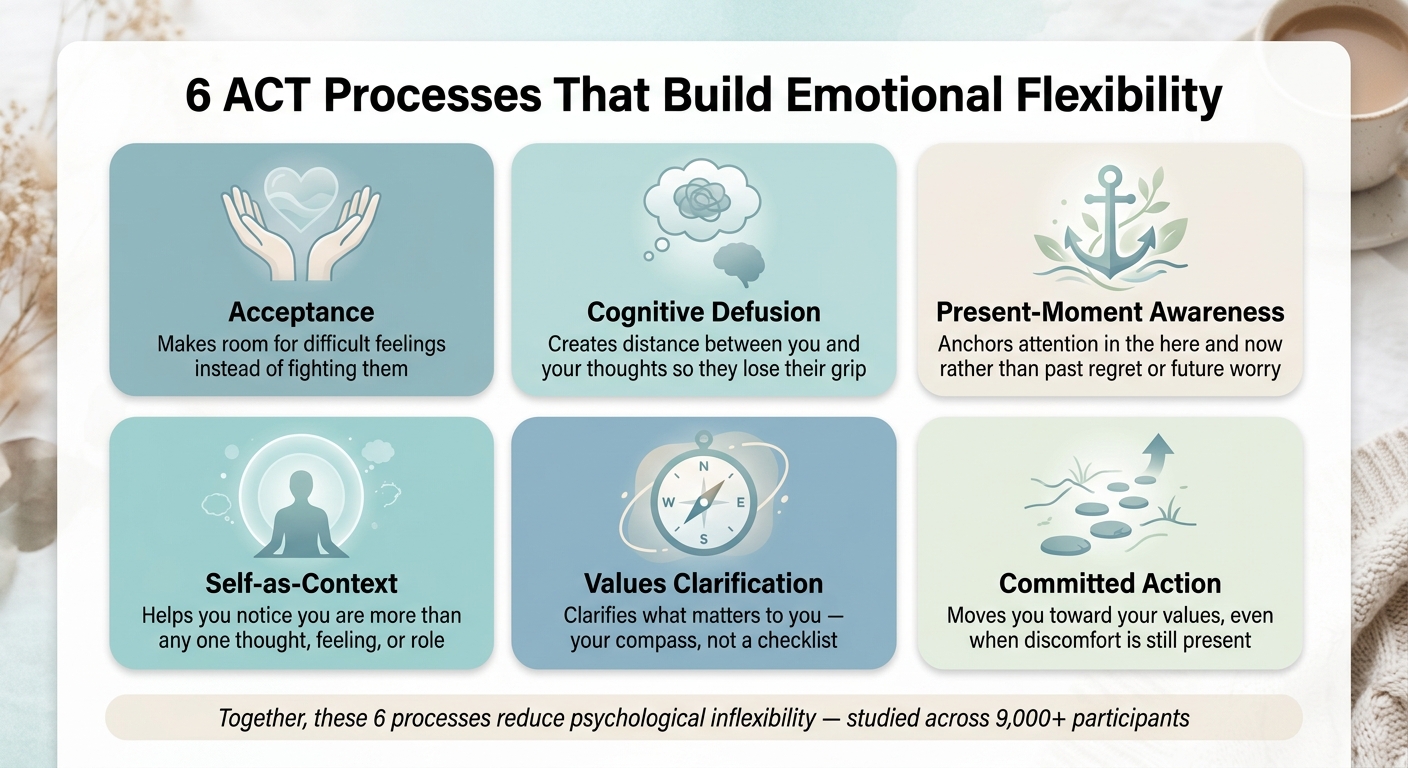
ACT works on emotional rigidity from six angles that support each other:
ACT Process
What It Does
Acceptance
Makes room for difficult feelings instead of fighting them
Cognitive Defusion
Creates distance between you and your thoughts, so they lose their grip
Present-Moment Awareness
Anchors attention in the here and now rather than past regret or future worry
Self-as-Context
Helps clients notice they are more than any one thought, feeling, or role
Values Clarification
Clarifies what matters to you – your compass, not a checklist
Committed Action
Moves you toward those values, even when discomfort is still present
Taken together, these processes help a person stay with discomfort long enough to choose a different response. That is often the shift. Not getting rid of the feeling, but no longer letting an old protective habit make every decision.
Why Protective Patterns Can Become Rigid
What feels like a wall now often began as a way through. Over-preparing may have lowered the risk of criticism or failure. Saying yes may have kept the peace. Shutting down may have made overwhelm bearable. These were not errors. Your nervous system learned them for a reason.
The trouble starts when those moves begin to run on their own, in every setting, even after the first threat has passed. As Kathryn Ely, LPC, NCC, JD, of Empower Counseling & Coaching, put it: “When we try to control outcomes and we are only one variable in the equation, we will experience ongoing anxiety.” Control, preparation, and self-monitoring can help, until they harden into rules you no longer get to question. ACT does not treat those strategies as proof that something is wrong with you. It helps clients loosen the grip.
ACT makes a useful distinction between clean pain and dirty pain. Clean pain is the ordinary hurt that comes with being human: loss, uncertainty, disappointment. Dirty pain is the extra suffering that gets layered on when you fight that ordinary hurt, when the mind treats discomfort like an emergency and starts building a whole second struggle around it. The harder you work to keep a feeling out, the more room it seems to take up. In therapy, ACT helps clients catch that pattern in real time instead of living on autopilot.
Why Capable People Can Still Feel Stuck
From the outside, this kind of rigidity can look like competence. A woman may keep everyone around her comfortable while privately feeling resentful and drained. She looks fine. Inside, her coping system is working overtime just to hold steady.
Insight, by itself, usually isn’t enough to shift that pattern. Plenty of people can name exactly what they do and still find themselves doing it again under stress. Change tends to happen more slowly and more concretely than that. You notice the urge. You stay with the discomfort. You make a different choice, even if it feels unfamiliar at first. In ACT, the goal is not more control. It is more choice. That is where ACT exercises begin to turn insight into action.
How ACT Works in Therapy Sessions
ACT is practical. It takes what you understand in your head and brings it into the room, where you can try it in real time. The goal is not to sit with a good idea and hope it sticks. The goal is to practice a different response while the feeling, thought, or urge is actually there.
In session, that often means slowing down enough to notice what is happening inside you, then making room for it without letting it run the whole show. The therapist is not there to talk you out of your experience. She helps you build the skill to stay with it, name it, and choose your next step with more care.
Exercises That Help Clients Stay Present with Emotions
Many people come to therapy saying some version of, “I know I shouldn’t feel this way, but I do,” or “The minute I feel it, I try to shut it down.” ACT begins there. It treats emotional pain as part of being human, then looks at what happens when the mind adds a second layer of struggle by fighting that pain.
A therapist might start with a brief body scan and ask you to name what is here right now: a feeling, a body sensation, a thought. You might notice tightness in your chest, a wave of dread, or the thought I can’t handle this. Then the work becomes more specific. Where is the pain itself, and where is the extra strain that comes from bracing against it?
From there, clients practice allowing discomfort instead of pushing it away. That may look simple from the outside, but it can feel like learning to stand still in surf that usually knocks you sideways. You notice the urge to escape. You track it. And, for a moment, you choose not to obey it.
Between sessions, that practice often gets smaller and more concrete. A client may stay with one avoided task, use mindful breathing, and notice what shows up before, during, and after. Not to make the feeling vanish. Just to learn, through experience, I can stay here, and I can still act.
Exercises That Reduce Self-Critical Thoughts
Once a person can stay with discomfort a little more steadily, ACT turns toward the thoughts that make that discomfort hit harder. A harsh thought can land like a verdict. It can sound final, as if the mind has handed down a sentence and there is nothing left to argue.
ACT does not ask clients to debate every thought or replace it with a nicer one. Instead, it teaches distance. If the thought is “I’m a failure,” the practice is to shift to “I’m having the thought that I’m a failure,” and then to “I notice I’m having the thought that I’m a failure.” That small change matters. The thought may still be there, but it is no longer sitting in the judge’s chair.
This can be especially useful with perfectionism. If a client knows the same old script shows up every time she begins something that matters, a therapist may help her name it as the perfectionism story and then return to the task in front of her. With shame or fear in close relationships, metaphors can help clients notice thoughts without following their orders.
The point is not to feel sure of yourself every minute. It is not to win some inner argument. The point is to make one choice that lines up with a value, even while the mind is still talking.
How Values and Committed Action Create Change
After emotion feels a little less overpowering and self-criticism has a little less pull, therapy shifts toward direction. Relief matters, but direction matters too. Once the struggle loosens, values help answer the next question: What do I want my life to lean toward from here?
A therapist may ask you to picture your 80th birthday or to describe someone you admire. Those moments are not about performance. They help pull your attention away from panic, shame, or numbness long enough to ask what kind of person you want to be in the middle of an ordinary week. From there, clients turn reflection into plainspoken value statements like “I value being present with my family” or “I value learning and growth.”
Then the work gets concrete. A person who values connection might text a sibling once this week. A person who values health might schedule a five-minute walk three days in a row. Small steps matter here because they are doable, and because doing them while anxiety or sadness is still present changes the pattern. You stop waiting to feel ready before you begin.
Therapist and client look at what worked, what did not, and what to try next. Over time, that practice in session starts to show up outside the office too, in the shape of steadier choices on regular days.
How Emotional Flexibility Shows Up in Real Life
What happens in session should show up in the rest of your life. Not all at once. Usually in small, ordinary moments that would be easy to miss if you were only looking for a dramatic change.
You go to the dinner you would have canceled last month. You notice the rush of self-doubt before a meeting, and you walk into the room anyway. You catch the perfectionism story in the act and send the email instead of rewriting it for the fourth time. That’s often how change looks at first. Quiet. Concrete. A little less ruled by old protective habits.
Those habits didn’t come from nowhere. They were your mind’s way of trying to keep you safe. But over time, they can make life smaller. Emotional flexibility is what it looks like when those patterns start to loosen in daily life.
How Progress Is Measured in ACT Therapy
This is the kind of shift therapists pay attention to in ACT. Progress is less about having a good week emotionally and more about what you do when a hard feeling shows up. Are you avoiding less? Are you here for your own life a little more? Are your choices starting to line up with what matters to you, instead of what fear is trying to prevent?
A client who used to cancel plans every time worry spiked might begin saying, “I’m anxious and I’m still going.” That change matters. The point is not to feel better every day. The point is to choose differently, even on the days that still feel hard.
Therapists watch for these shifts through shared check-ins and, when it helps, validated flexibility measures. In a large meta-analytic review covering more than 9,000 participants, ACT was found to reduce psychological inflexibility and increase flexibility, and those shifts were linked with lower psychological distress. In the room, though, the markers that matter most are often plainspoken and personal: Am I avoiding less? Are my choices guided more by values than fear?
A Next Step If This Sounds Familiar
Sometimes the next step is simply admitting, even to yourself, that this sounds a little too familiar. The bracing. The self-criticism. The stuck feeling that hangs on even though you’re trying hard.
If that’s where you are, a consultation can be a reasonable next step. Not a big declaration. Just a first conversation about whether ACT fits what you need.
If you want help practicing this shift, Empower Counseling in Birmingham, Alabama offers ACT-informed therapy for individuals, teens, college students, and couples, and integrates EMDR when trauma or specific memories are driving avoidance. Sessions are available in person and through online counseling across Alabama.
FAQs
How long does ACT take to help?
ACT often works a little differently than people expect. If part of you is thinking, I just want this feeling to stop, that makes sense. Most of us reach for relief first. But ACT is not built around quick symptom relief. It helps over time by building psychological flexibility and helping you live in closer contact with your values, even when your inner world feels loud.
That slower pace does not mean nothing happens early on.
From the first session, many people begin to notice a shift in how they relate to thoughts, feelings, and stress. The experience itself may not vanish right away, but the struggle with it can start to loosen. That shift can make room for steadier coping and more resilience over time.
Is ACT helpful for anxiety and perfectionism?
Yes. Acceptance and Commitment Therapy (ACT) can help when your mind is always scanning for what might go wrong, or when “good enough” never feels safe enough to stop. If anxiety keeps you on high alert, or perfectionism keeps moving the finish line, ACT offers a different path. Not by trying to erase hard thoughts, but by changing your relationship to them.
ACT helps build psychological flexibility. That means learning to notice difficult thoughts without judging yourself for having them, making room for them as passing mental events, staying in the present, and choosing actions that line up with your values. The goal is not to force anxiety away. It’s to loosen its grip so it gets less say over how you live.
For perfectionism, that shift can be quiet but powerful. The thought If I don’t do this perfectly, I’ve failed may still show up. ACT helps you see it as a thought, not a command. For anxiety, the same idea applies. Fear can still be there, and you can still move toward what matters to you.
Do I have to talk about past trauma in ACT?
Not always. ACT keeps the focus on this moment and on building the kind of mental flexibility that helps you stay steady, even when old pain gets stirred up, instead of getting pulled under by it.
You don’t have to spend session after session going back through past trauma. Those experiences may be named and given space, but without judgment and without pushing them away. At times, therapy may look at how earlier events are shaping what feels hard now, with the aim of helping you move toward your values and the life you want to live.
How to Journal for Mental Health: A 10-Minute Practice to Quiet Your Inner Critic When the replay will not stop: Journal for Mental Health “Why did I say that?” “I should have caught that mistake. Anyone else would have.” “I know it’s not a big deal. I still can’t let...
Whatever you are carrying right now — the worry that never quiets, the “not enough” that won’t go away, the grief that has no name, the exhaustion of holding it all together, the unfulfilling relationships — you do not have to manage it alone. You reached out. That matters.