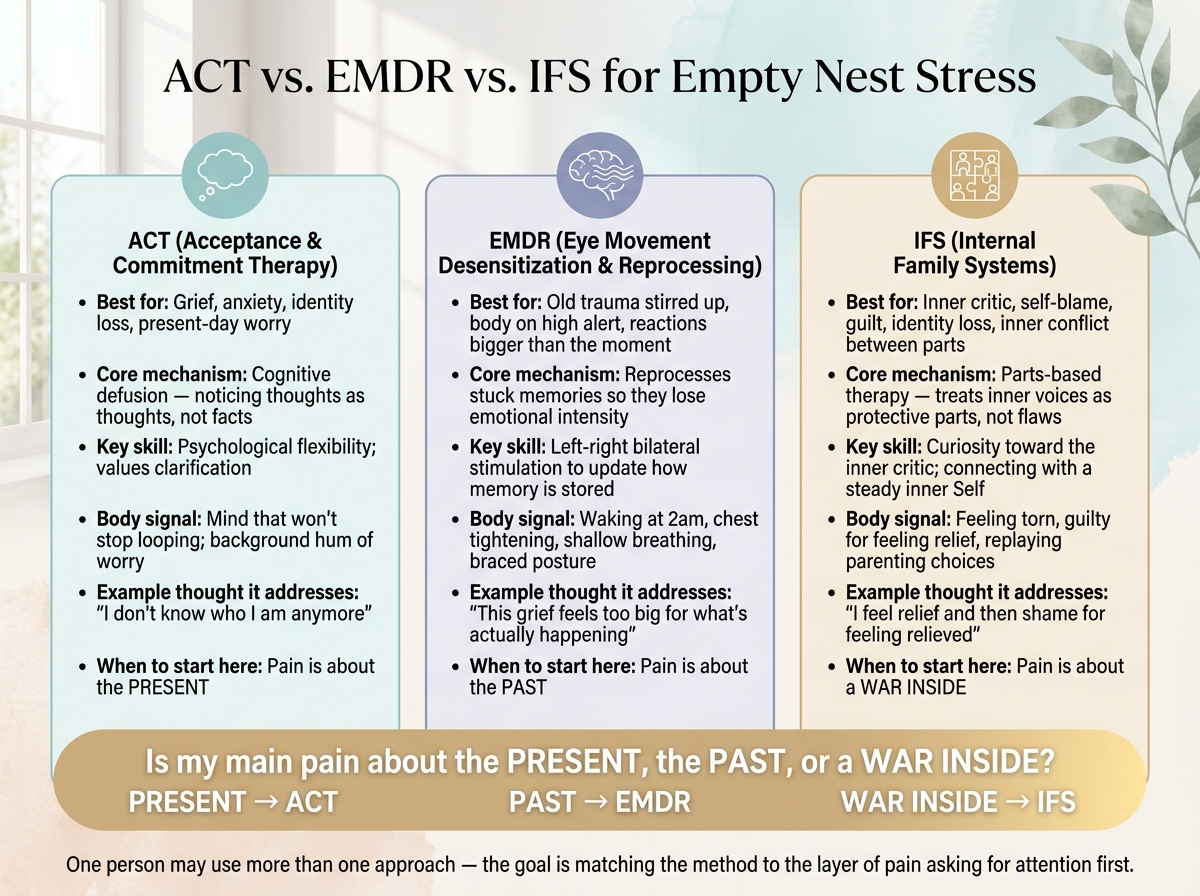
I thought I’d feel proud, and I do, but I also keep walking past that bedroom and feeling a drop in my chest I can’t explain. If that sounds like me, the question is not whether I should be handling this better. It is where the pain is coming from, so I can choose support that fits it. For empty nest stress, ACT often helps with present-day worry and identity drift, EMDR often helps when older loss gets stirred up, and IFS often helps when grief turns into guilt, self-blame, or inner conflict.
What stood out to me in this piece is that it treats empty nest distress as a life shift, not a flaw. A 2024 concept analysis found that this period often starts when the last child leaves home and may unfold over months, with grief, adjustment, and some relief all showing up in turn. That mix matters. So does the kind of therapy I pick.
ACT seems like the clearest starting point when my mind keeps looping on thoughts like Who am I now? or What am I supposed to do with my days? The point is not to talk myself out of pain. It is to notice a thought as a thought, then take one small step toward what still matters. If my struggle is more about rumination, uncertainty, or role loss in the present, ACT makes sense.
EMDR fits a different pattern. If my reaction feels bigger than the moment, if I am losing sleep, feeling on edge, or getting hit with panic that does not match the facts in front of me, the empty nest may be touching older pain. That can happen after earlier abandonment, medical crises, divorce, or past loss. EMDR works on how those memories are stored, so the body can stop reacting as if the old danger is happening now.
IFS speaks to the part of this season that can feel like an argument inside me. One part misses my child. Another feels relief. Then another comes in and says I should feel ashamed for that relief. IFS treats those reactions as parts with jobs, not proof that I am falling apart. If the loudest issue is my inner critic, guilt, or not knowing who I am outside caregiving, this approach may be the better door.
The comparison is plain enough to use:
If this sounds most like me…
The approach that may fit first
My mind will not stop, and I feel lost in the present
ACT
This feels older than the moment, and my body is on alarm
EMDR
I am fighting with myself and blaming myself
IFS
What I find most useful here is the framing: the first step does not have to solve every layer at once. Some people start with ACT to steady day-to-day life, then use EMDR later for older pain. Others start with IFS because the self-attack is what hurts most. The point is not picking the “best” therapy in the abstract. It is matching the method to the part of me that is asking for attention first.
If I were using one question from this article, it would be this: <u>Is my main pain about the present, the past, or a war inside?</u> That gets me closer to the right next step than any label does.
EMDR Therapy for Grief and Mourning (546 Session Preview)
sbb-itb-92e3c8f
ACT: When your mind will not stop and you need a steadier place to start
You drive home on autopilot, buy his favorite cereal, and somewhere between the checkout line and your driveway, the same thought shows up again: I don’t know who I am anymore. In ACT, that thought is treated as a thought, not a fact. That is the knot ACT works on.
ACT is a therapy for the moments when your mind will not let go. It helps you notice painful thoughts without getting dragged by them. The goal is not to erase stress. It is to stop spending so much energy fighting painful thoughts and feelings that you lose contact with your own life. That can make ACT a good fit when the distress is tied to present-day worry, not only old pain.
Where ACT fits: grief, worry, and not knowing what your life is about now
ACT can fit empty nest stress when the hard part is identity drift, grief, and the kind of worry that hums in the background all day. It works with values clarification, which means naming who you want to be in parts of life beyond parenting.
That matters because worry often sounds persuasive. It can come across like a warning, a verdict, even a plan. ACT does not try to debate every anxious thought or talk you out of it line by line. Instead, it teaches cognitive defusion: the skill of noticing a thought as a thought, not as a final truth.
“The goal isn’t to feel happy all the time or eliminate stress from your life. Instead, ACT teaches psychological flexibility – the ability to stay present with whatever you’re experiencing while still moving toward what matters most to you.”
What ACT work can look like day to day
A thought like I am useless now can hit with a lot of force. In ACT, one of the first shifts is simple but not small: I am having the thought that I am useless now. Nothing has been denied. Nothing has been polished over. But the thought is no longer sitting in the judge’s chair. There is a little room to breathe.
From there, ACT turns toward action that comes from values rather than fear or old habit. If connection matters to you, the next step is not some huge reinvention. It might be texting a friend, signing up for a class, or sitting outside for 20 minutes this week. Small on purpose. Real enough to count. ACT uses these modest, values-based steps to help you build movement before your mind feels fully settled.
If what hurts feels less like daily worry and more like an old wound, EMDR may fit better.
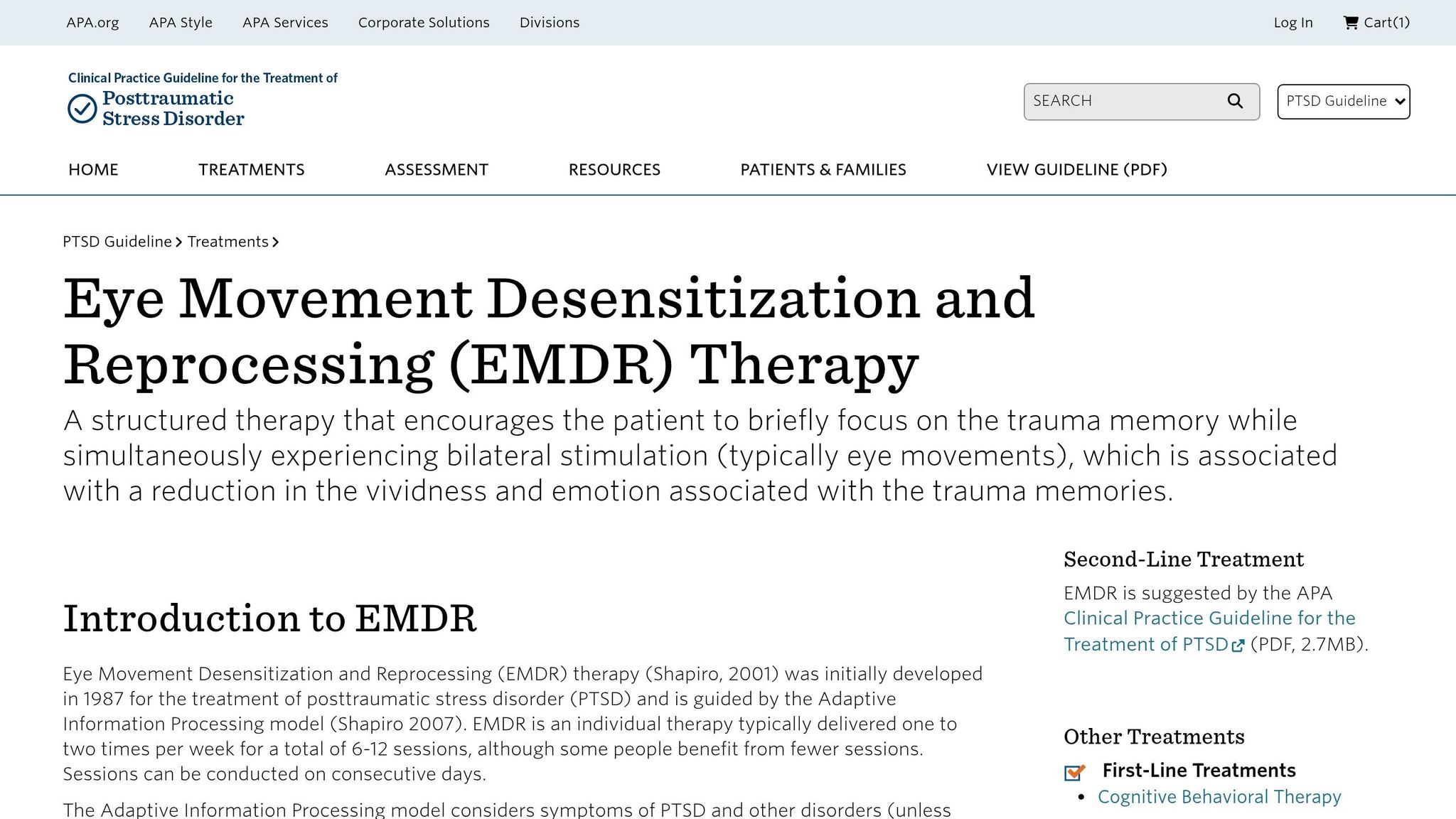
EMDR: When this transition is waking up older pain
You may know, on paper, that your child is okay. They made it to campus. They text back. They sound fine. And still, you are awake at 2:14 a.m., staring at the ceiling, heart pounding as if something is wrong. You pass the empty bedroom and your chest tightens. The grief feels too big for the facts in front of you. Not because you are overreacting, but because this moment may be touching something older.
That is where EMDR can help.
If ACT is a fit for present-day worry, EMDR often fits when the reaction feels older than the event itself. A child leaving home can stir up earlier loss: a parent who left, a child’s hospitalization, a breakup that carried abandonment, a season when love did not feel steady or safe. In those moments, the nervous system can react as if the old danger is happening now. EMDR was built for that kind of stuck alarm.
Signs that empty nest feelings are touching a much older wound
Usually, the first clue is scale. The reaction feels bigger than the moment. There may be despair that drops fast and hard, panic that seems to come out of nowhere, intrusive memories, numbness, or a body that will not stand down from high alert. Some people start seeing images of earlier separations without warning. Some have nightmares about losing someone. Some go quiet and blank, detached from themselves, as if the mind pulled the emergency brake.
As Empower Counseling describes it:
“Trauma rarely announces itself as trauma. More often, it shows up as a reaction that feels bigger than the moment that triggered it, and you are left wondering why.”
The body often says it first. Your shoulders creep toward your ears when you think about your child being on their own. You feel wiped out in a way that does not match the day you actually had. Your muscles stay tight. Your breathing stays shallow. There is a braced quality in you, like you are still waiting for bad news.
At that point, the empty nest may be acting less like a life transition and more like a trigger for stored loss.
What EMDR helps the brain do
EMDR, or Eye Movement Desensitization and Reprocessing, works differently from most talk therapy. It does not spend most sessions pulling the past apart piece by piece. Instead, it works with how distressing memories are stored in the brain and body.
When a memory is stuck, it can feel current. Not remembered. Current. EMDR uses left-right stimulation, often side-to-side eye movements, alternating taps, or sounds, while you briefly focus on a memory and the belief tied to it. Over time, the brain starts linking that stuck material with present-day information: the danger is over; this moment is different; my child leaving home is not the same as being left.
Marti Burton, MA, LPC, NCC, EMDR-T at Empower Counseling, puts it plainly:
“EMDR does not erase what happened. It changes how it is stored.”
That shift shows up in ordinary moments. You may still feel grief when you walk past the empty bedroom. You may still miss your child. But the room does not have to set off a full-body alarm every time. If what hurts most is self-blame, or a feeling that part of you is at war with another part, IFS may be a better fit.
IFS: When part of you is grieving and another part is attacking you
You miss them. You also feel relief. Then the guilt hits for feeling relieved at all. One part tells you that you should have done more, noticed more, stayed more present. Another part says you gave what you had, day after day, for a long time. In the quiet that follows a role change, all of those voices can get loud at once. IFS understands that split as parts in conflict, not as proof that you are failing. It helps you hear each part without handing the whole story over to the inner critic.
When your role shifts, the parts that once kept you steady can start pulling against each other.
IFS is a parts-based therapy that helps you make sense of the different reactions inside you. Some parts carry grief and loneliness, especially when you are no longer needed in the same caregiving role. When that pain gets close, other parts may move in fast to numb it, shut it down, or keep it at arm’s length.
In empty nest stress, that often looks like guilt, self-blame, and the uneasy feeling that you no longer know who you are outside the role you held for so long.
Where IFS fits: inner critic, self-blame, and identity loss
If your mind keeps replaying parenting choices like a case against you, IFS does not treat that as a flaw. It sees the inner critic as a protective part, one that learned to stay on guard to try to stop more hurt. As Empower Counseling puts it:
“IFS does not ask you to eliminate the difficult parts of yourself. It asks you to understand them – because every part of you, even the ones causing the most pain, developed for a reason.”
IFS can also help when caregiving has taken up so much room that the empty nest feels less like extra space and more like losing contact with yourself. In that frame, the caregiver is not your whole identity. It is one part of your system. Underneath the conflict, IFS points to a steadier, kinder center that can lead, instead of getting drowned out by all the noise.
What change can look like with parts work
IFS does not try to mute the critic. It asks you to get curious about it. A therapist might invite you to turn toward the part that keeps insisting you should have done more and ask, “What are you afraid would happen if you stopped?” Sometimes that question opens a door. The critic stops sounding like an enemy and starts to make sense as a part that has worked hard for a long time to protect something more tender underneath.
Britni Higginbotham, IFS & EMDR Therapist, describes it this way:
“The feeling of IFS is the feeling of coming home to yourself. It is reconnecting with all the parts of you – especially the ones you abandoned, silenced, or feared.”
Many people describe a little more calm, less fighting inside, and a stronger sense of being at home in themselves.
ACT vs. EMDR vs. IFS for empty nest stress: a direct comparison
ACT vs EMDR vs IFS for Empty Nest Stress: Which Therapy Fits You?
The house is quieter than it used to be, but inside, things may feel louder. You might find yourself thinking, Why am I this upset? Or, I should be handling this better. That does not mean you’re doing this wrong. It usually means the pain has more than one layer.
That is where the differences between these approaches start to matter. ACT tends to help when the hard part is living with painful thoughts and feelings without getting pulled under by them. EMDR tends to help when old memories have been stirred up and still carry too much charge. IFS tends to help when one part of you wants to move forward and another part digs in, criticizes, or shuts down.
A side-by-side look at what each approach helps most
When the house feels quiet and your mind feels loud, the clearest place to start is the part that hurts most right now. This side-by-side view can help sort that out.
Concern
Best Fit
Why It Fits
Grief and anxiety
ACT
Staying present with hard feelings instead of fighting them
Identity loss
ACT and IFS
ACT clarifies what matters now; IFS integrates the parent part with other neglected parts
Old trauma stirred up
EMDR
Reprocesses stuck memories so they lose their emotional intensity
Inner critic and self-blame
IFS
Treats the critic as a protector that can be understood, not silenced
Body on guard
EMDR
Helps the body learn that what was true then is not true now
Inner conflict
IFS
Helps the steadier self lead the parts pulling against each other
When one person may use more than one approach
Some people need one tool. Others need a sequence.
Many people use more than one approach because the pain is not all coming from the same place. ACT can steady the present. EMDR can help loosen old pain that still feels close. IFS can soften the fight between parts of you that want different things.
One person may begin with ACT because daily life feels hard to carry, then move into EMDR once there is enough steadiness to touch old memories. Someone else may start with IFS because the loudest problem is self-blame or an inner critic that never lets up. Some people use one modality. Others use two or three in sequence.
How to choose a next step and find support
Once the differences are clearer, the next step is simpler than it first seems. You are not trying to find the perfect therapy. You are trying to find the best place to begin, based on the layer of pain that feels most active right now.
That matters because the same person can carry more than one kind of hurt at once. You might be dealing with grief that is fresh, an older wound that still lights up your whole body, and a harsh inner voice that never seems to let up. The question is not which approach is best in general. It is which one meets the pain that is asking for attention first.
Questions to ask before choosing between ACT, EMDR, and IFS
Start by putting plain words to the main pattern. Does this feel like present-day grief and worry? Does it feel like older pain that still lands with force? Or does it feel like conflict inside, where one part of you is pushing and another part is pulling back?
That first pass can help:
ACT often fits grief, worry, and identity loss.
EMDR often fits older wounds that still feel intense now.
IFS often fits self-blame and conflict between parts of you.
Once you can name the main pattern, a consultation can help sort out fit and timing. You do not need to walk in knowing the answer. You can ask the therapist directly whether they have specific training in the approach you are considering and what sessions would look like for your concern. You can also ask how they decide whether to use ACT, EMDR, IFS, or a mix over time.
Sometimes the first good question is simple: What are you listening for when you decide where to start? A solid answer should help you feel more grounded, not more confused.
Main takeaways
A useful question to carry with you is this: Is my main pain about the present, the past, or a war inside? That question tends to point toward the right door more reliably than a comparison chart.
ACT helps steady the present. EMDR helps old pain feel less close. IFS helps soften the fight between parts that want different things.
Empower Counseling offers ACT, EMDR, and IFS-informed therapy for women in midlife, with in-person care in Birmingham and telehealth across Alabama. A free 10-minute consultation can give you room to ask questions and see whether the fit feels right.
FAQs
How do I know which therapy to start with?
You do not have to sort through this on your own. Finding a therapy that fits is a shared process. A good therapist pays attention to what feels hard, what your nervous system can hold, and how slowly or how gently the work needs to move.
Sometimes the fit becomes clearer once you have words for the pattern you are living inside.
ACT can help when anxiety keeps running the show, when perfectionism starts to feel like the price of caring so much, or when you want to move toward what matters even with fear in the room.
IFS can help when part of you wants rest and another part will not let you stop, or when old protective patterns keep taking over before you can think.
EMDR can help when painful memories still feel close, vivid, or charged, as if your body has not gotten the message that the moment is over.
At Empower Counseling, your first session is a conversation about what feels hard and what you hope for.
Can ACT, EMDR, and IFS be used together?
Yes. ACT, EMDR, and IFS can work well together in therapy.
If part of you wants relief, part of you feels wary, and your body seems to hit the brakes before your mind can catch up, that makes sense. Good therapy often means moving at the speed your nervous system can handle, not forcing change before you feel steady enough for it.
A therapist may combine these approaches with care, based on your pace and what feels workable for you. ACT helps you build psychological flexibility, so you can make room for hard thoughts and feelings without letting them run the whole show. IFS helps you get to know the inner parts of you that formed through life experience, often for good reasons. EMDR helps process the way traumatic memories are held in the brain and body.
Used together, they can support healing from more than one angle, with each approach doing a different kind of work.
What if my empty nest feelings seem bigger than they should?
If your empty nest feelings hit with more force than you expected, that doesn’t mean you’re falling apart or making too much of this. Sometimes the mind and body turn the volume up because they’re trying to guard you from older pain. What looks like an outsized reaction can be a form of protection, especially when this season stirs old wounds or past experiences that never got much room.
That matters. Because self-judgment tends to miss the point.
Instead of treating these reactions like a problem to shut down, it can help to read them as information. They may be telling you what your system has learned to watch for, what it fears losing, or what it has had to carry for a long time. In IFS, those reactions are understood as protective parts, not character flaws. In ACT, the goal is not to get rid of hard feelings on command, but to notice them, make space for them, and keep them from running the whole show.
How to Journal for Mental Health: A 10-Minute Practice to Quiet Your Inner Critic When the replay will not stop: Journal for Mental Health “Why did I say that?” “I should have caught that mistake. Anyone else would have.” “I know it’s not a big deal. I still can’t let...
Whatever you are carrying right now — the worry that never quiets, the “not enough” that won’t go away, the grief that has no name, the exhaustion of holding it all together, the unfulfilling relationships — you do not have to manage it alone. You reached out. That matters.

 You drive home on autopilot, buy his favorite cereal, and somewhere between the checkout line and your driveway, the same thought shows up again: I don’t know who I am anymore. In ACT, that thought is treated as a thought, not a fact. That is the knot ACT works on.
ACT is a therapy for the moments when your mind will not let go. It helps you notice painful thoughts without getting dragged by them. The goal is not to erase stress. It is to stop spending so much energy fighting painful thoughts and feelings that you lose contact with your own life. That can make ACT a good fit when the distress is tied to present-day worry, not only old pain.
You drive home on autopilot, buy his favorite cereal, and somewhere between the checkout line and your driveway, the same thought shows up again: I don’t know who I am anymore. In ACT, that thought is treated as a thought, not a fact. That is the knot ACT works on.
ACT is a therapy for the moments when your mind will not let go. It helps you notice painful thoughts without getting dragged by them. The goal is not to erase stress. It is to stop spending so much energy fighting painful thoughts and feelings that you lose contact with your own life. That can make ACT a good fit when the distress is tied to present-day worry, not only old pain.
 You miss them. You also feel relief. Then the guilt hits for feeling relieved at all. One part tells you that you should have done more, noticed more, stayed more present. Another part says you gave what you had, day after day, for a long time. In the quiet that follows a role change, all of those voices can get loud at once. IFS understands that split as parts in conflict, not as proof that you are failing. It helps you hear each part without handing the whole story over to the inner critic.
When your role shifts, the parts that once kept you steady can start pulling against each other.
IFS is a parts-based therapy that helps you make sense of the different reactions inside you. Some parts carry grief and loneliness, especially when you are no longer needed in the same caregiving role. When that pain gets close, other parts may move in fast to numb it, shut it down, or keep it at arm’s length.
In empty nest stress, that often looks like guilt, self-blame, and the uneasy feeling that you no longer know who you are outside the role you held for so long.
You miss them. You also feel relief. Then the guilt hits for feeling relieved at all. One part tells you that you should have done more, noticed more, stayed more present. Another part says you gave what you had, day after day, for a long time. In the quiet that follows a role change, all of those voices can get loud at once. IFS understands that split as parts in conflict, not as proof that you are failing. It helps you hear each part without handing the whole story over to the inner critic.
When your role shifts, the parts that once kept you steady can start pulling against each other.
IFS is a parts-based therapy that helps you make sense of the different reactions inside you. Some parts carry grief and loneliness, especially when you are no longer needed in the same caregiving role. When that pain gets close, other parts may move in fast to numb it, shut it down, or keep it at arm’s length.
In empty nest stress, that often looks like guilt, self-blame, and the uneasy feeling that you no longer know who you are outside the role you held for so long.