
I check the email one more time, replay the meeting on the drive home, and feel my whole body tense over a mistake that other people might not even notice. If that feels familiar, this is often not about being “too hard” on myself. Perfectionism after trauma can become a way my nervous system tries to keep me safe, and understanding that can help me relate to the pattern with less shame and more choice.
What often looks like high standards is, in many cases, a survival pattern. This article explains why trauma can wire mistakes to feel dangerous, how that keeps self-monitoring in place, and what can help the grip loosen over time.
When fear and perfection get linked, the goal stops being doing well and starts becoming not getting hurt again.
One fact helps put this in context: about 70% of adults in the U.S. report at least one traumatic event in their lifetime, according to the National Council for Mental Wellbeing. Trauma exposure is common, and the ways people learn to cope with it can be easy to miss when they look like overpreparing, staying polished, or never letting anything drop.
I can care deeply and still see that the pattern may be costing me more than it once saved.
The Voice Inside: Healing Our Inner Dialogue To Reconnect | Sandra Stein | TEDxUWS
sbb-itb-92e3c8f
How the nervous system links control with safety
A small mistake can feel much bigger than it looks from the outside. You miss a detail in an email, say the wrong thing in a meeting, or notice a shift in someone’s face, and your whole body reacts as if something bad is about to happen. That response can make no sense on the surface. But it usually has a history.
When a mistake once led to yelling, criticism, or rejection, the nervous system learned that mistakes were not small. They were dangerous. The brain stores that danger in a way that can feel immediate, almost as if the old moment is happening again, and the body responds with alarm, scanning, and preparation. That is why even minor errors can feel so outsized.
This is threat detection. Trauma can keep the body on alert long after the original danger is gone. The result is a nervous system that stays activated, watching for tiny facial shifts, changes in tone, or silence that suddenly feels loaded. Once the body is braced like that, the mind often moves toward control.
Why control, hypervigilance, and self-monitoring increase after trauma
If mistakes start to feel dangerous, perfectionism can begin to look like a way out. Not vanity. Not overachievement for its own sake. More like an attempt to avoid criticism, rejection, or conflict. If flawless behavior once seemed to prevent harm, then perfectionism can start to feel required. The nervous system learns to link being perfect with being safe.
That is where hypervigilance and self-monitoring often take hold. You scan the room. You replay what you said. You adjust your tone, your face, your timing. You try to stay one step ahead of anything that could go wrong. In Internal Family Systems (IFS), this is described as a Manager part: a protective inner role that works tirelessly to keep you good enough or careful enough so that older pain never gets triggered.
How this pattern helps at first and causes harm over time
In the short term, this system does its job. You check your email one more time. You overprepare for the presentation. You stay quiet when part of you wants to speak. Anxiety drops for a moment. That relief matters, and the relief teaches the brain to keep using the same pattern.
Over time, though, that constant vigilance asks a high price. Life gets smaller. Rest is harder. Spontaneity starts to feel risky. There is less room for error, and often less room for you.
This is not a failure of willpower or insight. It is a nervous system still running an old survival pattern in a present-day situation that no longer calls for it.
What looks like perfectionism is often protection that never got turned off.
Perfectionism is an adaptation, not a character flaw
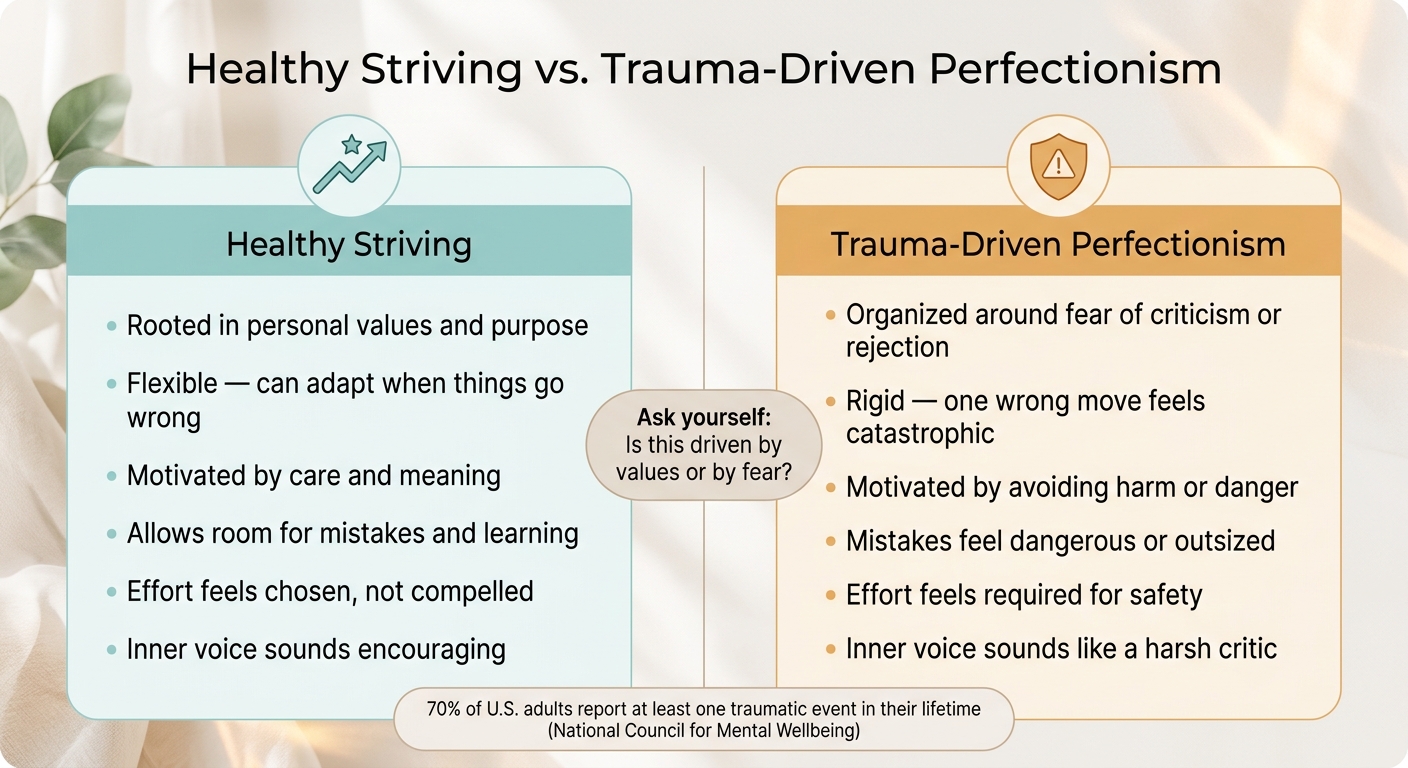
Healthy Striving vs. Trauma-Driven Perfectionism: Key Differences
For some people, staying safe once meant scanning a face before speaking, guessing what someone needed before they asked, and shrinking yourself before anyone could react. That was not weakness. It was a way your mind and body learned to get through.
Perfectionism often took shape because, at one point, it worked. As Empower Counseling puts it:
"Every part of you that feels overwhelming or impossible was doing something useful once."
So the perfectionistic pattern did not begin as a flaw. It began as protection.
The feedback loop that keeps fear in place
A small mistake can feel loaded, as if the stakes are far higher than they look from the outside. That fear sparks checking, fixing, re-reading, and second-guessing. For a moment, anxiety drops. Your nervous system registers that drop as proof: see, staying on guard helped. And that brief relief trains the pattern to repeat, even if the danger that shaped it is no longer here.
This is part of why slowing down can feel so hard. The pattern is not just a habit. It is a form of self-protection your system still trusts.
Before it can shift, it usually has to be seen clearly for what it is. Not identity. Protection.
Healthy striving vs. trauma-driven perfectionism
Not every high standard comes from trauma. Some effort grows from care, purpose, and a wish to do something well. The harder question is what is driving the effort in this moment.
Healthy striving tends to be grounded in values and able to bend. Trauma-driven perfectionism tends to be organized around fear and held tightly, as if one wrong move could cost you more than it should.
A useful question here is simple: is this action guided by values, or by fear?
What helps loosen trauma-driven perfectionism
Knowing the pattern and living inside it are two different things. You may understand, with painful clarity, why you overcheck the email, rehearse the conversation, or replay one small mistake at 2:00 a.m. And still, your body reacts as if the stakes are life-altering. That gap matters. Insight can name the pattern. It does not, by itself, settle the alarm underneath it.
EMDR for fear around mistakes and criticism
For many people, the fear is not just about this mistake or that piece of feedback. It is older than that. EMDR helps the nervous system reprocess memories that still fire like an active threat, so a missed detail or critical comment does not pull the whole body into an old survival response. When a memory has not been fully processed, present-day errors can land with the force of past danger, even when the current situation does not call for that level of alarm. EMDR helps the brain sort past from present, which can ease the constant self-monitoring perfectionism leans on.
Once the alarm softens, even a little, something shifts. You can begin to relate to the part trying so hard to keep you safe instead of staying trapped inside its rules.
Parts work for the perfectionistic inner protector
In IFS, the perfectionistic part is often understood as a Manager, a protector that tries to prevent rejection, humiliation, or chaos. That framing can feel like a relief. The part is not trying to ruin your life. It is trying to keep it from falling apart.
The work changes when you meet that part with curiosity instead of piling on more self-judgment. As Empower Counseling describes it:
"The inner critic loses its authority… not because it disappears, but because you understand it – and you stop having to obey it."
Underneath that protector, there is often a younger and more vulnerable part still carrying the first fear. Parts work helps make contact with that fear without flooding you. In practice, this often looks less dramatic than people expect. The shift may begin in a quiet moment, a small pause, the second before you obey the old rule.
What day-to-day change can look like
Day-to-day change is often subtle at first. Not glamorous. Just different enough that you notice it.
A comment from your boss still stings, but it does not hijack the next three days. You hear the harsh inner voice, but it no longer sounds like the final word. It starts to sound more like a scared part doing a job it once had to do alone. That is often how change begins. Not with the voice gone, but with your relationship to it changing.
Between sessions, grounding tools can help your body register safety while the deeper work keeps unfolding. A physiological sigh is one example. Small things like that can create just enough space for a new response to take hold.
You do not have to keep earning safety through perfection
There comes a point when the body stops treating perfection like a security system. That is where the work starts to change. Healing from trauma-driven perfectionism is not about caring less or lowering your standards. It is about no longer living as if safety has to be earned first.
For many people, perfectionism began as protection. The mind found a way to stay alert, polished, prepared, and hard to criticize because, at some earlier point, that felt safer than being seen as messy, needy, or wrong. What once helped you get through can start to run your life. The problem is not that you care too much. It is that your body may still be acting like the danger is current.
As fear begins to loosen, the inner critic often loses some of its force. Not because you suddenly become carefree, but because the body no longer treats perfection as the thing standing between you and harm.
That is also why nervous system work matters. As the body learns, slowly and repeatedly, that the original danger has passed, the perfectionistic pattern can begin to ease. You may still want to do things well. You may still care deeply. But more room opens up between the feeling and the reaction. More room to choose.
That shift is the work of treatment: less fear, more choice. Empower Counseling offers trauma-informed therapy in Birmingham and via telehealth throughout Alabama, including EMDR, Internal Family Systems (IFS)-informed care, and ACT.
You do not have to earn safety through perfection.
FAQs
How do I know if my perfectionism is trauma-related?
Perfectionism often starts as a way to stay safe, not as a simple personality trait. If your drive to get everything right, stay in control, or watch yourself nonstop feels tied to avoiding harm, rejection, or chaos, there may be a trauma piece underneath it.
For many people, this pattern grows out of a nervous system that learned mistakes could cost you something. Maybe criticism felt sharp. Maybe unpredictability made you stay on guard. Maybe being easy, careful, or almost invisible felt safer than taking up space. In that context, perfectionism is not vanity or overachievement. It is the mind and body trying to prevent pain.
That is also why “just relax” tends to fall flat. If your body still reads imperfection as danger, it will keep reacting like a threat is near, even when part of you knows you are safe.
Can trauma-driven perfectionism get better without lowering my standards?
Yes. Trauma-driven perfectionism often starts as protection. Somewhere along the way, your mind learned that getting it exactly right helped you stay safe, keep the peace, or avoid the sting of rejection. What looks from the outside like “high standards” can be a nervous system working hard to prevent pain before it happens.
That pattern is not a character flaw. It is a survival strategy.
Healing does not mean you stop caring, aim lower, or become less capable. It means your nervous system no longer has to treat every mistake, conflict, or disappointed look like danger. With approaches like IFS and EMDR, people can begin to notice that the old threat is not here now. As that lands in the body, the parts that rely on perfectionism for protection can ease up, and more room opens for choice, rest, and flexibility.
What does healing this pattern look like day to day?
Day to day, healing often looks less dramatic than people expect. It can feel like catching yourself mid-spiral instead of ten minutes later. It can mean noticing, I’m doing that thing again where I tighten up, aim for flawless, and act like one mistake will cost me everything. That reaction did not come out of nowhere. In many cases, perfectionism started as a way to stay safe, stay liked, or stay in control when life felt uncertain.
So the work is not to bully that part of you into disappearing. It is to recognize it for what it is: a protective strategy. One that may have helped before, even if it is wearing you out now.
In practice, that might mean brief mindfulness check-ins during the day. It might mean naming a harsh inner comment as a thought, not a fact. It might mean choosing one small action that matches your values, even while anxiety is still in the room. Over time, those small moments help you build more flexibility and stay grounded in the present.