
I keep answering the thought, and it still comes back louder. If that feels familiar, this article is about the two tools people often use with anxious thinking: thought challenging and ACT defusion, and how to tell which one fits the kind of thought you’re dealing with. The short answer is this: thought challenging helps when a fear is specific and testable; ACT defusion helps when the thought is sticky, repetitive, and hard to settle with proof.
Anxiety affects about 40 million U.S. adults, or 18.1% of the population, and part of what makes it so tiring is how fast a thought can start to feel like fact. I’d frame the choice simply: do I need to check this thought, or do I need some space from it? Both tools can help, but they help in different ways.
‘“Overcoming Anxiety One Thought at a Time” | Mackenna Minehan | TEDxLagunaBlancaSchool
sbb-itb-92e3c8f
When the problem is how hooked you feel by the thought
Sometimes the hard part isn’t whether a thought is true. It’s how fast it grabs you. One second you’re moving through your day, and the next you’re inside the thought, reacting to it as if it were an alarm you have to obey. In ACT, that pull is called cognitive fusion. The thought feels urgent. Solid. Hard to set down. And once that happens, what comes next often shifts too.
What ACT defusion is and how it helps anxiety
Acceptance and Commitment Therapy (ACT) offers a distinction that tends to land right away: having a thought is not the same as needing to act on it. Defusion is the skill of noticing a thought as a mental event that is happening, not as an order, a fact, or a forecast. The aim is psychological flexibility, meaning the ability to stay in contact with the present moment, make room for discomfort, and still move toward what matters. In day-to-day life, that can look like noticing the thought without automatically obeying it.
That matters because anxiety often lives in what you do next. You check. You avoid. You ask for reassurance. You go down the spiral. Defusion can loosen that chain. As Kathryn Ely, Founder of Empower Counseling & Coaching, notes:
"Instead of looking at anxiety as something you must rid yourself of before taking action, let it come along for the ride. By accepting how you feel and being willing to take it with you, anxiety begins to lose its power over you."
Anxiety may come along. It doesn’t have to drive.
What defusion looks like day to day
Often, defusion looks almost too simple to matter. You say, "I’m having the thought that I’m going to fail," instead of, "I’m going to fail." Or you answer the mind with, "Thank you, mind." That small shift creates a little room between you and the thought. Not a huge gap. Just enough to notice it instead of becoming it.
Some people also find it useful to name a repeated pattern, like the "I’m not enough" story. Then, when it shows up, the response becomes, "Oh, there it is again," instead of treating it like brand-new proof.
Why defusion can help chronic worriers and perfectionists
This can be a good fit for people who have spent years debating with anxiety. If your mind is always building a case, trying to argue each thought into submission can keep the whole thing going. Defusion softens the urge to treat every worry like a problem that has to be disproved right now.
For chronic worriers and perfectionists, that shift can feel like a relief. Anxiety stops being framed as proof that something is wrong with you. It starts to make more sense as a sign that something matters to you, something you care about enough to fear losing, doing badly, or getting wrong. You can carry that signal without letting it steer. And when the main question is less about getting unstuck from the thought and more about whether the thought is accurate, thought challenging may be the better tool.
When it helps to slow down and test whether a thought is true
Some thoughts arrive with the force of fact. Your chest tightens, your mind speeds up, and before you know it, you are treating a prediction like proof. In that kind of moment, the question is not how stuck you feel to the thought. The question is simpler, and harder: is it true? When a thought is specific enough to check, slowing down and testing it can help.
What thought challenging is and how it helps anxiety
Thought challenging, often called cognitive restructuring in CBT, asks you to measure a thought against evidence instead of swapping it out for forced positivity. That matters. The goal is not to talk yourself into feeling fine. The goal is to get closer to what is accurate.
The process usually starts with the automatic thought itself. Then you look for thinking patterns that may be shaping it, like catastrophizing, mind-reading, or all-or-nothing thinking. From there, you weigh the evidence for and against the thought and work toward an alternative that fits the facts better.
So instead of staying inside a thought like Everyone will think I am incompetent during this presentation, you might end up here: I may feel nervous, but I have prepared well and I have handled similar situations before. Some people might notice my anxiety, but that does not make me incompetent. The shift is small but meaningful. The thought no longer feels quite so certain.
When thought challenging works best
This approach fits best when a thought is specific, concrete, and testable. In other words, there has to be something you can actually check.
- Mind-reading: Check actual feedback instead of letting fear fill in the blanks.
- Catastrophizing: Bring the feared outcome back down to a realistic worst case.
- Overestimating risk: Compare the fear to actual risk, not the image your mind keeps replaying.
These are the kinds of thoughts that point toward facts, odds, or observable evidence. Once you look at them more closely, the feared outcome often stops looking so certain. Not harmless. Not impossible. Just less absolute.
Where thought challenging can fall short
The limit tends to show up with repetitive what if worry. This is the kind of anxiety that does not stay in one lane. You answer one fear, and another takes its place. Then another. The topic shifts, but the engine stays the same.
In that state, evidence-based answers often do not land for long. The mind produces a new what if before the last one has even settled. Thought challenging can start to feel less like clarity and more like an argument you cannot win. Or a hunt for reassurance. Or one more loop of rumination.
What is happening there is not a failure of effort. It is your mind trying to get complete certainty before you act, rest, or let go. And for diffuse worry, that standard is brutal. When that is the pattern, it often helps more to change your relationship to the thought than to keep debating its content. That is the point where ACT defusion becomes a better fit.
ACT defusion vs. thought challenging: a direct comparison
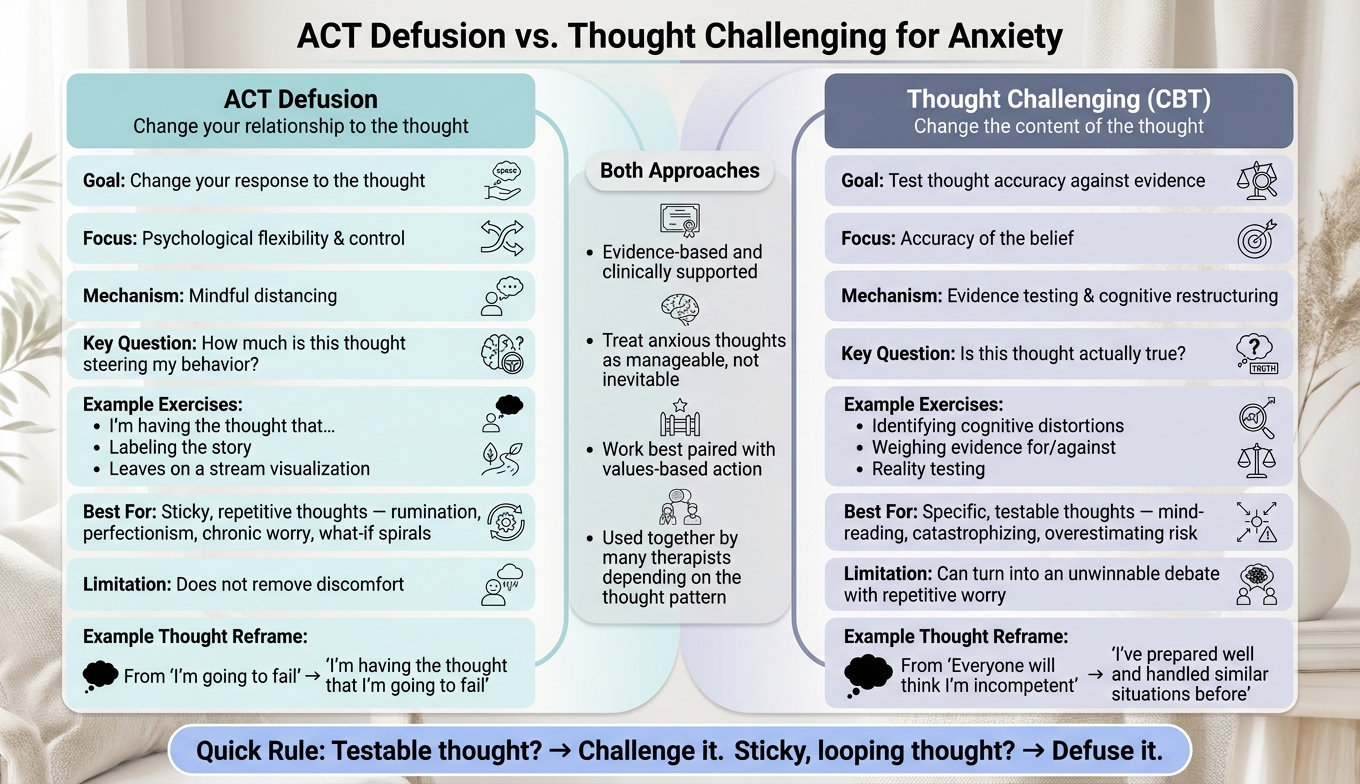
ACT Defusion vs Thought Challenging: Which Tool Fits Your Anxiety?
The core difference: changing the thought vs. changing your relationship to it
Sometimes the hard part is not the thought itself. It’s the way it takes over the next hour, the next choice, the whole tone of your day. One thought lands, and suddenly you’re bracing, checking, replaying, or trying to argue with your own mind.
Thought challenging asks a plain question: is this thought true? It looks at the claim, checks it against evidence, and tests whether the conclusion holds up. ACT defusion asks a different question: how much is this thought steering your behavior? Instead of debating the thought, defusion helps you notice it, name it, and make room for it without obeying it on autopilot.
That’s the split. One tool works on the content of the thought. The other works on your relationship to it.
ACT leans on mindfulness and values to put a little space between a thought and your next move. You notice, I’m having the thought that I’m going to mess this up, rather than sliding straight into panic or avoidance. That shift can sound small on paper. In practice, it often changes what happens next.
That difference helps a therapist sort out which tool fits the pattern in front of you.
| Thought Challenging (CBT) | ACT Defusion | |
|---|---|---|
| Goal | Change thought content | Change your response |
| Focus | Accuracy | Control |
| Mechanism | Evidence testing | Mindful distancing |
| Common exercises | Identifying distortions, weighing evidence, reality testing | "I’m having the thought that…", labeling the story, leaves on a stream |
| Strengths | Best for testable distortions | Best for sticky, repetitive thoughts |
| Limitations | Can turn into debate | Doesn’t remove discomfort |
| Best fit | Specific, checkable beliefs | Rumination, perfectionism, chronic worry |
Which approach may fit better depending on your anxiety pattern
If the thought is specific and checkable, thought challenging often makes more sense. If your mind says, My boss is upset because she used a period in that email, you can slow down and test the evidence. Is there proof? Are there other explanations? Does the thought hold up?
Defusion tends to fit better when the thought is repetitive, sticky, or impossible to settle with proof. Things like What if I never get this right? or What if something goes wrong and I can’t handle it? can keep going no matter how much analysis you throw at them. That’s where stepping back from the thought, instead of trying to win an argument with it, can help.
What both approaches have in common
Both are evidence-based and aimed at reducing anxiety-driven behavior. Both treat fearful thinking as something you can answer with skill, not something that has to run the show. In therapy, the day-to-day question is usually simpler than it sounds: what tool fits the pattern you’re dealing with right now?
What change can look like in therapy
How a therapist helps you choose the right tool
Sometimes the hard part is not that you’re missing effort. It’s that you keep using the same mental move on a thought that won’t budge.
After comparing the two tools, the next question is how a therapist uses them in real sessions.
If a thought is checkable, a therapist may test it with evidence. If it keeps looping, the work shifts to noticing it without getting pulled in. ACT aims for psychological flexibility: staying present and acting on values even when anxiety shows up.
A therapist is also paying attention to something quieter: the part of you that wants to do therapy right. That can show up as perfectionism, where even healing starts to feel like one more place to earn a gold star or avoid getting it wrong.
How Empower Counseling offers therapy for anxiety in Birmingham and across Alabama
That same ACT-informed approach guides care at Empower Counseling in Birmingham and across Alabama.
Empower Counseling is a Birmingham, Alabama, therapy practice offering ACT-informed care for anxiety, perfectionism, OCD, trauma, ADHD, perinatal mental health, and life transitions, with in-person and telehealth sessions across Alabama. The practice uses ACT, EMDR, and Internal Family Systems (IFS).
A practical next step
If you keep testing the same thought and getting nowhere, the issue may be the tool, not your effort. A first therapy conversation can clarify what fits.
Key takeaways
Sometimes the hard part is not having a thought. It is knowing what to do with it once it lands.
The choice often comes down to this: does the thought need to be tested, or do you need a little space from it?
Thought challenging fits specific, testable thoughts. If your mind is making a clear prediction, you can slow down and look at whether the claim holds up. It helps because the thought is making a statement you can examine.
ACT defusion fits sticky, repetitive thoughts you’ve already argued with many times. Thoughts like "I’m not enough" or "something bad is going to happen" do not always have a clean, tidy answer. Defusion treats thoughts as mental events, not facts.
Use thought challenging for testable claims; use defusion for sticky stories that keep looping.
In practice, the best tool depends on the shape of the thought. Many people use both at different times. Both tend to work best when paired with values-based action.
FAQs
How do I know which tool to use?
Choose ACT defusion for the moments when your mind grabs hold of a thought and won’t let go. You might know the feeling: one mistake turns into I’m a failure, or one unfinished task turns into If I can’t do this perfectly, I shouldn’t do it at all. Defusion does not ask you to argue with the thought. It helps you step back from it. The shift is small, but it changes the whole feel of the moment: from “I’m a failure” to “I’m having the thought that I’m a failure.” That bit of space can make it easier to move toward what matters, even with the thought still there.
Choose classic thought challenging when you need to look more closely at anxious thinking patterns and test how accurate or useful they are. Sometimes that kind of work is clear on paper and much harder in real life, especially when anxiety is loud or perfectionism has started to sound like common sense. If doing this on your own feels like too much, a therapist trained in ACT can help.
Can I use defusion and thought challenging together?
Yes. You do not have to choose one over the other.
You can use thought challenging for those moments when a thought is asking to be checked closely, especially if it keeps pulling you toward the same painful pattern. You can use defusion when you need a little space from a thought, so you can notice it without letting it run the whole scene. Used together, these approaches can help you see a situation with more clarity while staying flexible and moving in line with your values.
Why doesn’t thought challenging always calm anxiety?
There’s a kind of exhaustion that comes from trying to win an argument inside your own head. You notice the thought, try to talk yourself out of it, swap it for a better one, maybe even build a whole case against it. For a moment, that can feel like doing something useful. But if the goal becomes controlling or getting rid of your inner experience, thought challenging can start to work against you.
Debating or replacing anxious thoughts can make them seem more dangerous than they are, as if each one is a threat that has to be beaten back.
That can create a struggle trap: the more energy you spend fighting or suppressing thoughts, the more power they seem to have, and the more distress they can stir up instead of settling down.