
“My chest tightens when someone’s voice changes, even when I don’t feel threatened.” I can understand that reaction as an alarm learned for protection, not a personal failing. EMDR reprocessing works with distressing memories and their linked body responses to help reduce distress, as described by the VA National Center for PTSD. Here, I can learn what body memory means, how treatment is paced, and why <u>I don’t need to force a memory connection</u> to ask for help.
EMDR Reprocessing: Preparation, Processing, and Safety
General Session 102 Transforming Traumatic Memory with EMDR: Insights into how and why EMDR may work
sbb-itb-92e3c8f
Understanding triggers and checking current safety
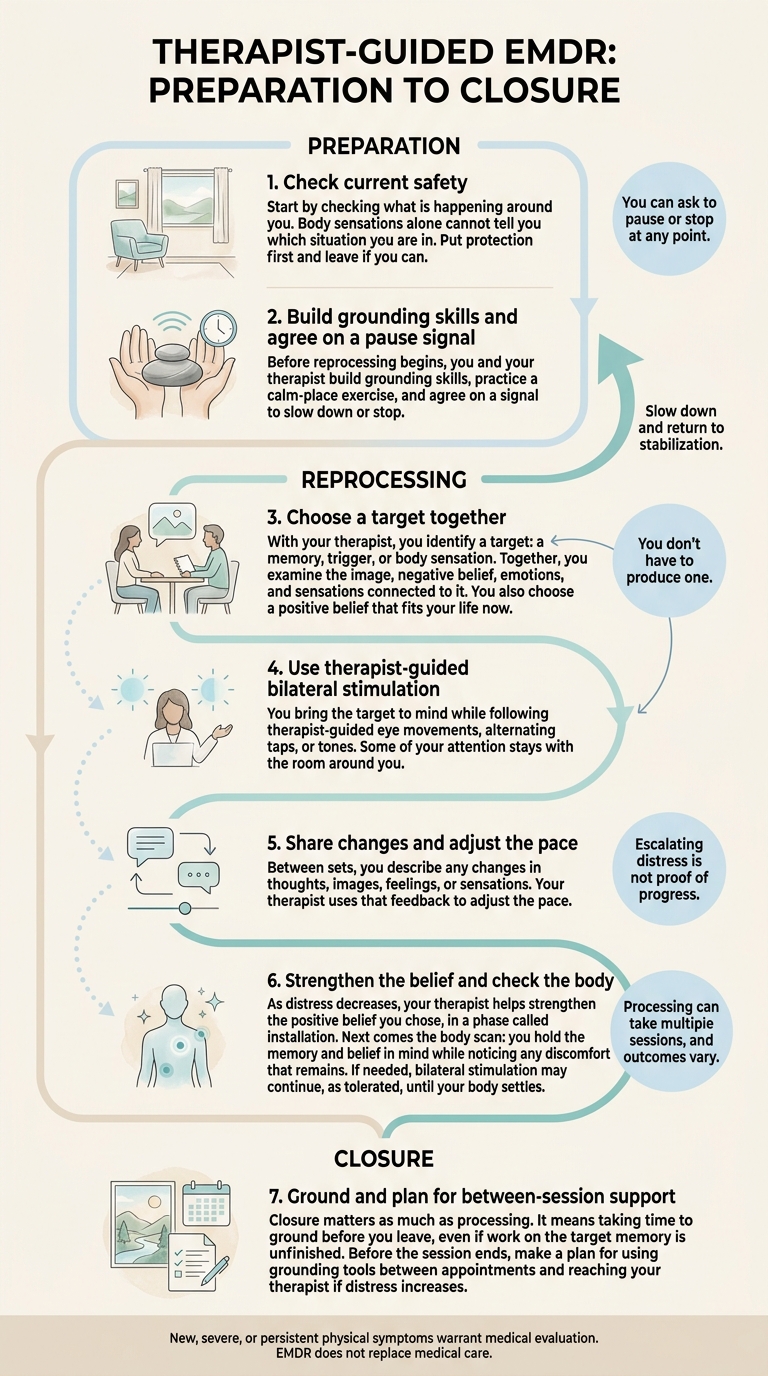
Your heart races, or you go still before you know why. Start by checking what is happening around you. This can help you separate a threat happening now from a body response learned in the past. Scanning for danger, sometimes called hypervigilance, or shutting down may have begun as ways to survive.
Current danger, trauma reminders, and everyday stress
Use the check below to choose your next step, not to diagnose yourself. The task is to decide whether you need protection, grounding, or help with ordinary stress.
| Experience | Possible cues | Possible reactions | What to do now |
|---|---|---|---|
| Present danger | Physical threats, assault, or an accident | Racing heart or freezing | Put protection first and leave if you can. |
| Trauma reminder | A familiar smell, tone, or facial expression | Tensing up, nausea, or feeling like you are back then | Check the room, people, and situation around you before grounding yourself. |
| Everyday stress | Deadlines, traffic, or daily pressures | Tension, irritability, or worry | Take a break, set a boundary, or use practical coping skills. |
Body sensations alone cannot tell you which situation you are in. A trauma reminder can happen during actual danger, and everyday stress can make an old alarm louder. Use the pattern to guide your response rather than label the experience. Do not assume chest tightness, dizziness, or shallow breathing come from trauma; get a medical evaluation.
How current cues connect to past experiences
A critical comment, someone standing close, or a medical setting can set off an old body alarm before you have had time to understand what is happening now. That reaction is not proof of trauma. Context and clinical assessment still matter.
If you are safe, name one choice you have in the present:
“I can ask for a pause,” or “I can choose whether to continue.”
Feel your feet against the floor and look around the room. You do not need to find or recall a memory in that moment.
If you are safe, the next step is to work with the memory, belief, and body response together.
How EMDR works with memories, beliefs, and body sensations
“I know it’s over, but my body still reacts.” That gap between what you know and what you feel is one way to understand the work of EMDR. A structured, evidence-based treatment for PTSD, EMDR can reduce distress tied to a memory without erasing it.
Treatment addresses the memory, the belief connected to it, and your body’s response. The intended change is that the memory no longer feels like danger happening now. The work begins with one target, not everything at once.
Choosing a memory to work on
You don’t need a complete explanation for your reactions before you begin. With your therapist, you identify a target: a memory, trigger, or body sensation. Together, you examine the image, negative belief, emotions, and sensations connected to it. You also choose a positive belief that fits your life now.
Current triggers can help guide that choice, but there’s no need to force a connection or process everything at once. If no clear memory comes to mind, tell your therapist. You don’t have to produce one.
Reprocessing with bilateral stimulation
You bring the target to mind while following therapist-guided eye movements, alternating taps, or tones. Some of your attention stays with the room around you. The aim is not simply to talk about what happened, but to reduce the distress attached to it, including your body’s alarm response.
Between sets, you describe any changes in thoughts, images, feelings, or sensations. Your therapist uses that feedback to adjust the pace. You aren’t asked to push through distress.
Strengthening a positive belief and checking the body
As distress decreases, your therapist helps strengthen the positive belief you chose, in a phase called installation. Next comes the body scan: you hold the memory and belief in mind while noticing any discomfort that remains. If needed, bilateral stimulation may continue, as tolerated, until your body settles.
Processing can take multiple sessions, and outcomes vary. What feels true in your mind and body helps guide the next step. Preparation and safety come before processing; if distress increases, your therapist slows the work and helps you stay present.
EMDR preparation, pacing, and safety
“I know I’m safe, but my body is still on alert.” Body reactions can surge during EMDR reprocessing, which is why treatment begins with grounding, a pace you can tolerate, and a plan for staying present. You can ask to pause or stop at any point.
Preparing to stay present
Before reprocessing begins, you and your therapist build grounding skills, practice a calm-place exercise, and agree on a signal to slow down or stop. If you feel overwhelmed, the next step is to slow down and return to stabilization together, rather than push through.
Ending sessions and planning for reactions afterward
Closure matters as much as processing. It means taking time to ground before you leave, even if work on the target memory is unfinished. Before the session ends, make a plan for using grounding tools between appointments and reaching your therapist if distress increases.
For temporary distress, use the grounding skills you’ve practiced. If distress persists, escalates, or includes severe dissociation or crisis symptoms, contact your therapist. Escalating distress is not proof of progress.
Noting triggers without forcing memory connections
A daily trigger can give you something concrete to bring to therapy. Note the cue, how your body responded, and any thought or feeling that followed. You don’t need to make it connect to a memory. What happened around you, in your body, and in your emotions can help guide treatment; the purpose is not to search for hidden memories or reprocess trauma on your own.
Use grounding skills if they help you stay oriented to the present, and stop tracking if your discomfort increases.
Key takeaways and finding EMDR care
“I know I’m safe, but my body hasn’t caught up.” That gap can help explain body memory: a learned alarm that can reactivate in response to present-day cues. EMDR works with the memories and body sensations linked to that alarm. Progress may look like fewer spikes, faster recovery, and more choice in how you respond, rather than never being triggered.
What to ask an EMDR therapist
You can ask how a therapist would work with your body’s reactions before deciding whether to begin. Ask about their formal EMDR training and experience with body sensations, how they assess readiness and dissociation, and how they close sessions when memory processing remains unfinished. Discuss when they would pause or adjust treatment, then agree on goals and how you’ll review progress together.
New, severe, or persistent physical symptoms warrant medical evaluation. Don’t assume they are trauma reactions. EMDR does not replace medical care.
EMDR care in Birmingham and online
A consultation gives you space to ask about care without having to commit to treatment. Empower Counseling, a private therapy practice, offers EMDR at its offices in Birmingham’s Mountain Brook area and through telehealth throughout Alabama. Select clinicians also serve Tennessee.
During a complimentary 15-minute consultation, ask how the clinician works with triggers and body reactions at a pace you can tolerate. You can also check current EMDR availability, clinician fit, fees, and telehealth eligibility. Services are private pay and out-of-network.
FAQs
Can EMDR help if I don’t have PTSD?
You may understand why you feel on edge or struggle to say no, yet still feel the same pull. EMDR can help even without a PTSD diagnosis. It aims to help you process memories and stress that may still feel unresolved after talk therapy.
Beyond PTSD, EMDR is used for anxiety, panic, phobias, grief, perfectionism, people-pleasing, chronic shame, and burnout, though the evidence varies by concern. Patterns such as keeping others happy or trying to get everything right may have started as ways to feel safe, not as flaws.
If your emotional or physical reactions feel out of step with what’s happening now, EMDR may help you work through earlier experiences that contribute to those reactions, with the goal of lasting relief.
How can I tell healing from emotional numbness?
“I can stay here, even when this is hard.” Healing may feel like being able to stay present instead of shutting down or checking out when life gets difficult. During EMDR, you may find you can feel emotions without becoming overwhelmed, and letting people in may feel safer. These shifts can be signs that your nervous system is settling, giving you more room to connect with your feelings and the world around you rather than automatically disconnecting.
How long does EMDR take to reduce body triggers?
How soon you notice a change depends on what you’ve experienced and how severe its effects have been. Many people notice improvement after a few sessions. The claim that a high percentage of people affected by trauma see marked results after six sessions needs a specific research citation; it should not be treated as a promise about your timeline.
EMDR is a gradual process. Before and during reprocessing, your therapist will focus on helping your nervous system feel steadier, supporting a pace you can tolerate.


