
What is Acceptance and Commitment Therapy (ACT)?
sbb-itb-92e3c8f
Why ACT Skills Matter in Recovery
In recovery, a craving can feel loud fast. Shame can hit just as hard. ACT helps you meet those moments without letting them run the whole show. The goal is not to get rid of cravings or anxiety on command. It is to change your relationship to them. That matters because fighting hard feelings often gives them more heat, and avoidance is often what keeps the cycle in motion. For many people, substance use began as a way to get some relief from pain, not as a character flaw. ACT starts there. It helps you notice the pull to escape discomfort, then build the capacity to stay with what hurts without acting on that urge. That can sound simple on paper. In a real moment, it is hard work. It is also learnable. Relapse is common in recovery, with research estimating rates in the 40% to 60% range. That fact does not mean change is out of reach. It means recovery asks for skills that hold up under stress. Skills for the moment when your chest tightens, your mind starts bargaining, and part of you wants out of the feeling as fast as possible. This is where values matter. When emotions spike, values can stay steady. If you know what matters most to you, maybe family, honesty, health, or growth, you have something firmer than the feeling of the hour. Emotions move. Values give direction. These seven skills help build that kind of flexibility. First: acceptance, the foundation for handling cravings without panic.1. Acceptance of Cravings and Difficult Emotions
What Acceptance Actually Means in ACT
A craving can feel bossy. It can show up in your chest, your jaw, your hands, and make everything inside you lean toward relief. In ACT, acceptance means making room for that discomfort instead of getting pulled into a fight with it. Not because you like it. Not because you’re giving up. Because you can let a hard feeling be there without handing it the steering wheel. Acceptance is not resignation. It means difficult thoughts, feelings, and body sensations can be present without deciding what you do next. The craving gets to exist. You still get to choose.Why This Builds Resilience in Recovery
For many people, relapse is not just about wanting a substance. It is about wanting out of shame, anxiety, anger, or pain as fast as possible. ACT calls that move experiential avoidance: the push to escape an inner state that feels too sharp or too heavy, with substances often serving as a short-term fix. That pattern makes sense. Your mind found a way to get relief. The problem is that relief does not last. And fighting inner experience often backfires. Suppression tends to make those feelings come back louder. If you’ve ever told yourself don’t think about it, don’t feel it, don’t want it, only to feel the urge swell, you already know this from the inside. When you stop burning energy on the battle, you have more of it for the next right choice. That is where recovery starts to look less like white-knuckling and more like staying present long enough to act on purpose.An Everyday Practice: Urge Surfing
One way to practice this is urge surfing. Treat the craving like a wave. Notice where it shows up in your body. Watch it rise. Watch it crest. Wait while it falls, without acting on it. A craving is a temporary inner event, not a command. Sometimes a small language shift opens up that space. Instead of “I need to get rid of this craving,” try: “I’m noticing a craving, and I can let it pass without acting.” That change matters. It separates the urge from the action. It gives you a little room to breathe. Once you can stay with the craving, even for a moment, you can start stepping back from the thoughts that feed it.When the Risk Is Highest
This skill matters most in the moments that hit fast. Shame after a mistake. Anger that floods your body before you can name it. Those are often the moments most tied to relapse risk. The pull to escape is strongest then, and the space for a conscious choice can feel very small. That is why practice during lower-stakes discomfort matters. You build the skill before the hardest moment asks for it. Sitting with a smaller wave teaches your mind and body that discomfort can move through without becoming action. Over time, that weakens the link between pain and use. That gap between feeling and action is small. It is also where recovery choices begin.2. Cognitive Defusion from Relapse-Driving Thoughts
What Cognitive Defusion Actually Means
A craving rarely shows up alone. It usually arrives with a sentence that sounds blunt, urgent, and hard to argue with: I can’t handle this without a drink. Sometimes it slips in more quietly: One won’t hurt. In the moment, that thought can land like a fact. Or like an order. In ACT, cognitive defusion means creating a little space between you and that thought, so you can see it as a mental event passing through, not a command you have to follow.Why This Builds Resilience in Recovery
Stress, shame, conflict, and exhaustion tend to bring the same relapse thoughts back around. Many people respond the way anyone would: they try to debate the thought, shut it down, or force it out of their mind. That move often adds fuel to the fire. ACT calls this the “struggle trap”. The mind is trying to solve pain fast. That does not mean it is helping. In recovery, defusion breaks the script that links discomfort to relapse. The thought may still be there, but it has less pull. That shift gives you a pause between urge and action. And in that pause, you can notice what is happening now instead of moving on autopilot.An Everyday Practice: The Language Shift
One of the simplest defusion tools is a small change in wording. When a relapse-driving thought shows up, try: “I’m having the thought that I can’t handle this.” Nothing magical happens. The thought does not vanish. But the relationship to it changes. You are noticing it, not merging with it. Another option is the Leaves on a Stream exercise: imagine each hard thought resting on a leaf floating down a stream. You watch it appear. You watch it pass. You do not have to jump in after it.When Relapse Risk Is Highest
The thoughts with the most relapse risk are often the ones that feel the most urgent and the most convincing. In a high-pressure moment, defusion helps create the pause that keeps the next step from becoming automatic. The craving is real. The thought may be loud. The goal is not to silence either one. The goal is to keep them from making the decision for you. Once you can notice the thought without obeying it, attention can come back to the present moment.3. Present-Moment Mindfulness
What It Means in ACT
After you step back from the thought, the next move is simple, though not always easy: come back to right now. In recovery, the mind can swing hard between what happened before and what might happen next. That kind of mental time travel can make a craving feel larger, louder, and more urgent than it is. In ACT, present-moment mindfulness means noticing what is here now: your breath, your body, your thoughts, and the room around you. The point is not to fix the moment. It is not to force calm. It is to notice clearly, without judging yourself for having the experience.Why This Builds Resilience in Recovery
A craving can hit with the force of an alarm. It can feel like something that needs an answer now. Mindfulness changes the relationship to that feeling. When you can notice a craving as a passing inner event, it starts to feel less like an order and more like an experience you can survive. That pause matters. It makes the urge less automatic. Green Hill Recovery notes that relapse risk decreases when people learn to stay present with discomfort without needing to escape it. That is the heart of this skill. Not comfort, but tolerance. Not getting rid of cravings, but learning you can let them move through without handing them the wheel.An Everyday Practice: Sensory Grounding
When a craving shows up, bring your attention to one concrete sensation. Maybe it is the tightness in your chest. Maybe it is tension in your jaw. Maybe it is the pace of your breathing. Name what you notice, then stay with it. That small act can pull you out of the mental spiral and back into the moment that is actually here, not the one your mind is predicting.“My chest is tight.” “My jaw is clenched.” “My breathing is fast.”Plain language helps. You are not telling a story about the feeling. You are just noticing it.
When Relapse Risk Is Highest
Relapse risk often goes up when distress rises and your ability to stay with that distress drops. In those high-stress moments, it is easy to slide into regret about the past or fear about the future. The mind reaches for escape because escape has felt like a fix before. A short pause can interrupt that pattern. Notice your breath. Feel your feet on the floor. Look around the room and name what is there. Stay with the moment long enough to choose your next step, instead of letting the urge choose for you. That steadier attention sets up the next skill: seeing yourself as more than the craving.4. Self-as-Context
What It Means in ACT
Sometimes the hardest part is not the hard moment itself. It is the way the mind turns that moment into a story about who you are. Mindfulness helps you notice what is happening. Self-as-context goes one step further. It helps you see that you are more than what is happening. In ACT, this is the observing self: the part of you that can notice a thought, an urge, or a wave of shame without becoming identical to it. That distinction matters most when a setback starts to feel like a name instead of an event.Why This Builds Resilience in Recovery
Recovery can get shaky fast when one slip starts to stand in for a whole identity. A slip is something you did, not who you are. That difference is small on paper and huge in practice. Self-as-context softens that grip by helping you recognize that you are more than one role, one moment, or one setback. For many people, that shift brings a little space back into the room. Enough space to think. Enough space to choose.An Everyday Practice: Observer Language
One way to practice this is through observer language. Instead of saying, “I am shame,” you might say, “I notice shame is here.” Instead of “I’m going to use,” you might say, “I notice the urge to use.” That is not wordplay. It is a change in position. You are not denying the moment or pretending it feels fine. You are noticing it from a steadier place, so a hard hour does not turn into a final sentence about who you are.“I notice shame is here”
“I notice the urge to use”
When Relapse Risk Is Highest
Setbacks tend to hit hardest when they collapse into identity. I used again can turn into I am a failure in a matter of seconds. Once that happens, the lapse often carries more weight than the event itself. Self-as-context interrupts that spiral by helping you see the lapse as a temporary thought, not a permanent verdict. From there, values can guide the next choice.5. Values Clarification
What It Means in ACT
After a setback, the first task is often to get a little space from the spiral. I messed up. I blew it. What’s the point now? Once that space opens, even slightly, values help answer the next question: What do I do from here? In ACT, values are not finish lines. They are directions. Empower Counseling describes values as the qualities and directions that guide how you want to live. A goal can be checked off or lost. Values keep pointing the same way. That is why they matter in recovery. If one plan falls apart, the direction can still hold.Why This Builds Resilience in Recovery
Stopping substance use answers one question: what needs to stop. Values clarification answers the harder one: what am I staying sober for? That question matters on the days when shame gets loud and the old pull starts to sound convincing. If recovery is tied to a clear reason, like connection, honesty, or being present for your kids, then a setback is more likely to feel like a detour than an ending. You may be off course for a moment. The map is still there. This is part of what helps a person recover their footing. Not perfection. Direction.An Everyday Practice: The Morning Values Check-In
A brief morning check-in can make values less abstract and more usable. Before the day gets moving, pause and ask:- What do I value?
- What is going to happen today that might test those values?
- What would acting against my values look like today?
When Relapse Risk Is Highest
Values tend to matter most when stress is high. That is often the exact moment they are hardest to remember. When shame peaks or exhaustion sets in, short-term relief can feel urgent. Fast. Almost automatic. Substances can imitate relief or closeness while moving you farther from the life you want. In that moment, the question is simple: Does this choice move me toward the life I want, or toward short-term relief? Values can steady you when anxiety starts driving the car. Clear values help most when they turn into one concrete step.6. Committed Action
What It Means in ACT
There’s a moment many people know well in recovery: I don’t want to do this, but I don’t want to lose myself either. That’s the ground committed action stands on. In ACT, committed action means taking effective steps that line up with your values even when anxiety, shame, or cravings are still in the room. It does not wait for calm. It does not depend on motivation feeling high. Willpower rises and falls. Committed action stays tied to what matters and turns that into the next move. When the pull to quit, numb out, or act out gets loud, this is the practice of letting your values decide what your feet do next.Why This Builds Resilience in Recovery
Recovery can start to feel steadier when discomfort no longer gets the final say. Committed action helps break the link between pain and use by making space for one intentional response. That space may be brief, but it matters. Instead of waiting until an urge passes, you act early. You choose something small and directed before the craving becomes behavior.An Everyday Practice: The Choice Point
One of the most practical tools in ACT is called the Choice Point. When a craving or hard emotion shows up, you pause and ask a single question: Does this action move me toward the person I want to be, or away from them? That question cuts through a lot of noise. Not perfectly, but often enough to help. A toward move is any small action that matches your values. It might look like texting your sponsor, stepping outside for air, putting your phone down, going to a meeting, or telling the truth instead of hiding. Small does not mean minor. In recovery, small steps are often the whole turning point.When Relapse Risk Is Highest
High-stress moments are usually when committed action matters most and feels hardest to reach. Your mind speeds up. Your body goes on alert. The old answer can start to look like the only answer. This is where the pause comes in: breathe, notice what is happening, and choose the next values-based step. That quick pause does not erase the craving. It gives you enough room to stay in recovery when emotions spike. And if you miss a step, that does not mean you’ve failed the work. The work is to return to your values quickly.7. Willingness to Start Again After Setbacks
What It Means in ACT
You slipped, and shame got loud fast. That moment matters. Not because it proves anything bad about you, but because it is often the exact point where a hard hour can turn into a hard week. In ACT, willingness means staying with discomfort long enough to choose your next step on purpose. A relapse is understood as a learned pattern, not proof that you failed. Your mind may rush in with blame, panic, or the urge to give up. Willingness asks for something else: face the discomfort, let it be there, and do not hand it the steering wheel.Why This Builds Resilience in Recovery
Shame tends to make everything smaller and harsher at the same time. It narrows the frame. One slip starts to feel like the whole story. Willingness interrupts that. It helps you treat a setback as information instead of a verdict. What happened? What set it off? What needs to change next time? That shift is small, but it changes the direction of the next hour. From there, the task is plain: reset as soon as you can and take the next right step.An Everyday Practice: The S.T.O.P. Method
After a slip or an emotionally hard moment, this four-step reset can slow the rush and give you a little room to choose.- S – Slow your breath.
- T – Name what you feel.
- O – Make room for it.
- P – Take one small step toward your values.
When Relapse Risk Is Highest
The time right after a setback is often the most tender. This is not the moment for a perfect plan. It is the moment for the shortest path back. Call support, attend a meeting, change your environment, or start the next sober task. Keep it simple. Keep it close. One grounded action can interrupt a whole chain of fear, shame, and retreat.Putting ACT Skills to Work in Daily Recovery
These skills show up where recovery is hardest and most ordinary: the late-night craving, the tense family text, the moment after a lapse when shame tries to tell the whole story. This is where ACT stops being an idea and starts being a practice. When a late-night craving hits, begin with what is happening right now in your body. Maybe your chest tightens. Maybe your hands feel restless. Maybe your mind starts bargaining. Notice the urge. Watch it rise, peak, and shift, without obeying it. Then pause long enough to ask a plain question: does my next move take me toward the life I am building, or away from it? That is acceptance and present-moment mindfulness under pressure. Not every trigger needs the same response. Family tension, for example, can light up old pain fast. Instead of getting pulled straight into They don’t respect me, try: I’m having the thought that they don’t respect me. That slight change creates space. From there, a better question can come forward: Does this text match who I want to be in this relationship? When values lead, anger and anxiety do not have to run the exchange. A lapse calls for a different kind of steadiness. In that moment, the task is no longer stopping something before it happens. The task is coming back. You are not the setback. A lapse gives information about a pattern; it does not hand down a verdict on your character. Make room for the discomfort that follows, then choose one small action that fits the person you want to be. Send the honest message. Go to the meeting. Pour out the bottle. Step back into the day you want, one move at a time. That is committed action.ACT Responses vs. Emotion-Driven Reactions
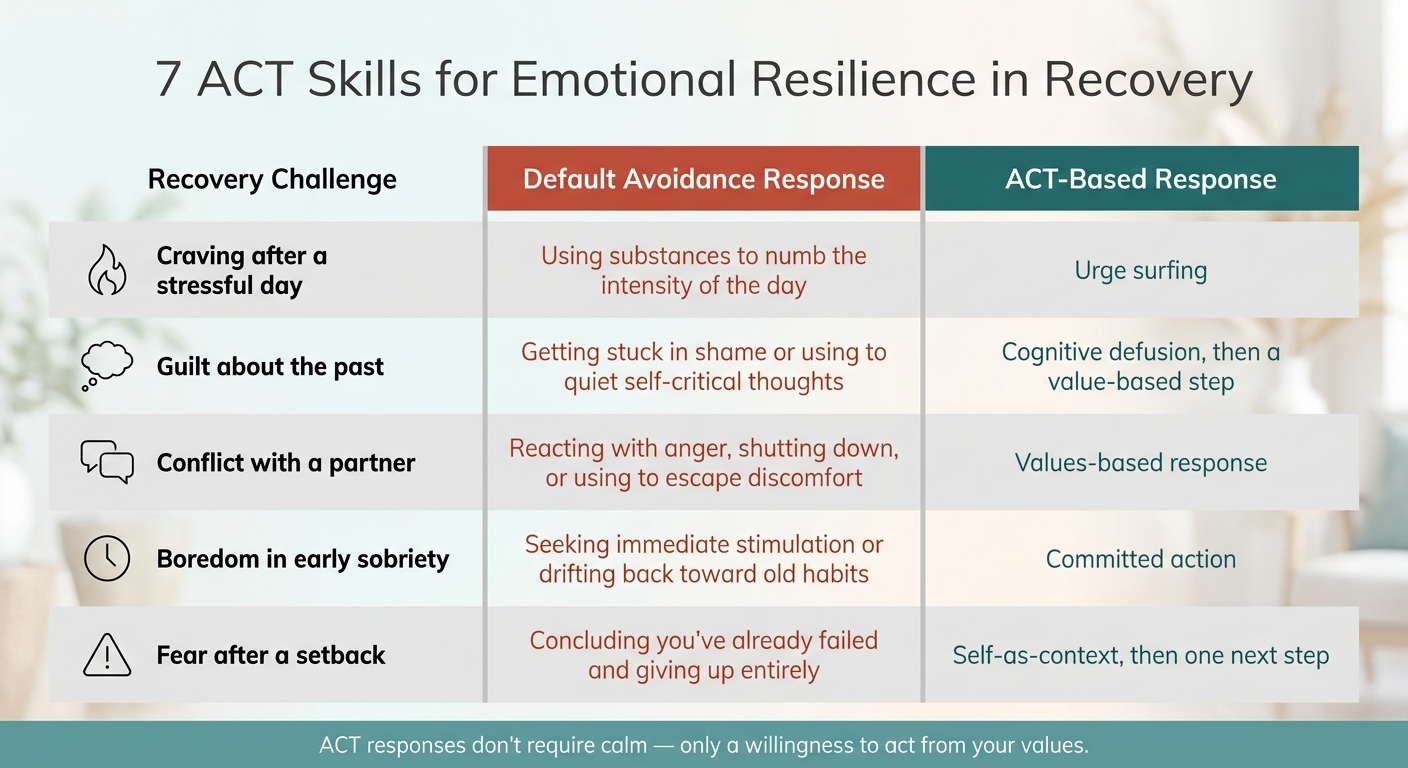
7 ACT Skills for Emotional Resilience in Recovery: ACT vs. Avoidance Responses
| Recovery Challenge | Default Avoidance Response | ACT-Based Response |
|---|---|---|
| Craving after a stressful day | Using substances to numb the intensity of the day. | Urge surfing. |
| Guilt about the past | Getting stuck in shame or using to quiet self-critical thoughts. | Cognitive defusion, then a value-based step. |
| Conflict with a partner | Reacting with anger, shutting down, or using to escape the discomfort of the argument. | Values-based response. |
| Boredom in early sobriety | Seeking immediate stimulation or drifting back toward old habits to fill the void. | Committed action. |
| Fear after a setback | Concluding that you’ve already failed and giving up entirely. | Self-as-context, then one next step. |


