
Ever feel trapped by your thoughts? Cognitive defusion, a concept from Acceptance and Commitment Therapy (ACT), offers practical ways to handle overwhelming mental chatter. Instead of battling or erasing thoughts, these techniques help you change how you relate to them – reducing their grip on your emotions and actions. Here’s a quick overview of five methods you can use:
- I Am Having The Thought That Practice: Reframe your thoughts by adding "I’m having the thought that…" to create distance and reduce their emotional weight.
- Thank Your Mind Technique: Acknowledge intrusive thoughts by saying, "Thank you, mind, for that thought", to separate yourself from them.
- Silly Voice or Singing The Thought: Lighten the impact of negative thoughts by repeating them in a playful tone or singing them to a familiar tune.
- Leaves On A Stream Visualization: Imagine placing each thought on a leaf and watching it float down a stream to let go of mental clutter.
- Labeling And Observing Thoughts: Identify recurring thought patterns and label them to recognize they are just mental events, not absolute truths.
These techniques take only seconds or minutes to practice and can be integrated into your daily routine. They are especially helpful for managing anxiety, stress, or negative self-talk. If you find these methods challenging, working with a therapist can provide additional guidance and support.
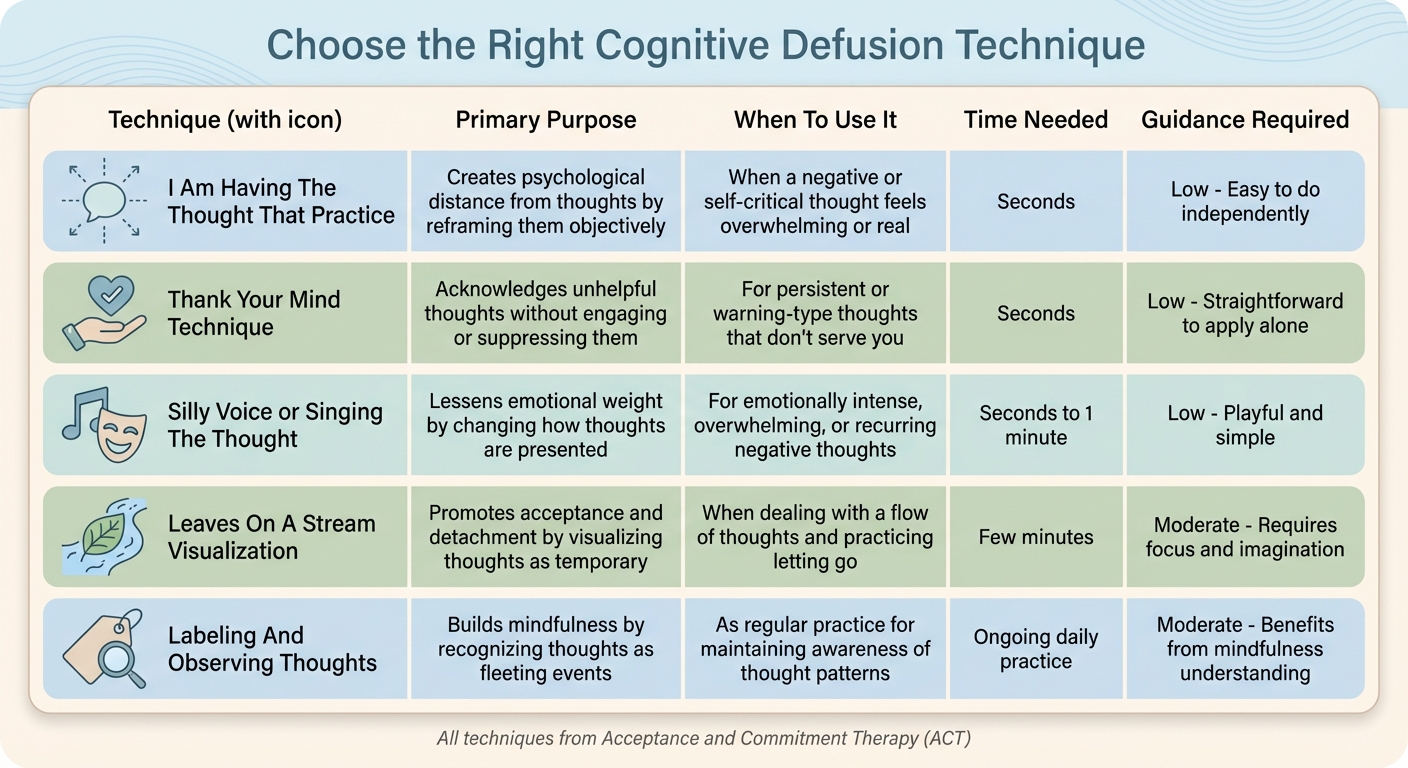
5 Cognitive Defusion Techniques Comparison Guide
Thoughts Are Not Facts: 4 ACT Techniques to Get Unhooked
How Cognitive Defusion Reduces Overwhelm
Dealing with overwhelming thoughts often begins with understanding how tightly clinging to them can limit your ability to adapt. This phenomenon, known as cognitive fusion, happens when you become so wrapped up in your thoughts that you treat them as undeniable truths rather than fleeting mental events. For instance, a thought like "I’m going to fail" might feel like a fact, shaping your emotions and actions.
When you’re fused with your thoughts, your psychological flexibility – the ability to adapt and respond to challenges – takes a hit. These thoughts can drive your behavior, even if they’re not accurate. This might mean avoiding tough conversations, passing up career opportunities, or pulling away from meaningful relationships.
Cognitive defusion offers a way out by helping you step back and see your thoughts for what they are: just thoughts, not commands. Instead of being consumed by "I’m a failure", you might reframe it as, "I’m noticing the thought that I might fail." This small shift can weaken the grip of unhelpful thoughts. While defusion doesn’t make those thoughts disappear, it allows you to act in line with your values despite their presence.
For example, you might feel nervous about giving a presentation but still deliver it effectively, or have self-critical thoughts yet continue to show up as a supportive parent. Cognitive defusion empowers you to take actions that align with your values, even when challenging thoughts arise. By seeing these thoughts as mental constructs rather than truths, you open the door to using defusion techniques in your everyday life.
1. I Am Having The Thought That Practice
Sometimes, a small tweak in how you phrase your thoughts can make a world of difference. For instance, instead of thinking, "I’m a failure", you could say, "I’m having the thought that I’m a failure." Want to take it a step further? Try, "I’m noticing that I’m having the thought that I’m a failure." These added layers help you see the thought for what it is – a passing mental event – rather than accepting it as an undeniable truth. By creating this mental distance, you can take back control over your emotions and soften the grip of those intrusive thoughts.
This simple adjustment sets the stage for reducing the emotional weight of challenging thoughts.
Primary Purpose
The main goal here is to loosen the hold that certain thoughts have over you. When you stop identifying so closely with a thought, you can avoid getting pulled into emotional spirals, anxiety, or self-doubt. Instead of focusing on the content of the thought, you shift your attention to the act of thinking itself. This subtle change can significantly reduce the thought’s power over your emotions and actions. As Russ Harris, a well-known expert in Acceptance and Commitment Therapy (ACT), puts it:
"Cognitive defusion is learning to ‘step back’ and separate or detach from our thoughts, images, and memories".
When It Is Most Useful
This technique is particularly handy when you’re stuck on a thought that feels impossible to shake. It’s great for managing intrusive or repetitive thoughts that tend to drag you down emotionally. Whether you’re dealing with obsessive patterns or just struggling to stay present, this approach can help you break free from the mental chatter that keeps pulling you into an emotional spiral.
Time Needed
The best part? This practice takes just seconds. All you have to do is pause and reframe the thought as it pops up.
For more tips on using ACT techniques, check out Empower Counseling.
2. Thank Your Mind Technique
The Thank Your Mind Technique is another practical way to step back from overwhelming or unhelpful thoughts. It’s a simple yet powerful method to create some mental breathing room.
Here’s how it works: when a troubling thought pops into your head, instead of wrestling with it or trying to push it away, you simply say, "Thank you, mind, for that thought." This small acknowledgment helps you separate yourself from the thought, making it easier to let it pass without getting caught up in it. It’s a way of recognizing that your brain is just doing its job – trying to protect you – even if its methods aren’t always helpful.
Experts emphasize the value of this approach. Cognitive Behavioral Therapy Los Angeles explains:
"Whenever an unhelpful thought rears its head, rather than getting hooked by it or trying to suppress it, thank your mind for having the thought. After all, negative thoughts are there to help you avoid problems; they’re just not always terribly effective at it."
Why It Works
The goal of the Thank Your Mind Technique is to acknowledge those nagging or intrusive thoughts without letting them dictate your emotions or actions. By treating these thoughts as passing mental events rather than truths you must act on, you loosen their hold on you. This mental distance makes it easier to refocus on what’s happening now and what truly matters to you.
When to Use It
This technique shines in moments when your thoughts feel overwhelming or when they’re pulling you away from the present. For example, if you’re feeling anxious about a project at work, you might say, "Thank you, mind, for your concern; let’s see how this unfolds." By doing this, you acknowledge the thought without letting it derail your focus, allowing you to gently return to your task.
How Long It Takes
The beauty of this practice is its simplicity – it only takes a few seconds. Pause, acknowledge the thought, and then shift your attention back to what you’re doing or to actions that align with your values. It’s a quick and effective way to regain your focus and stay grounded.
3. Silly Voice or Singing The Thought
The silly voice method is a playful way to take the sting out of intrusive thoughts. By using a silly voice or singing the thought to a familiar tune – like "Happy Birthday" – you can reframe how you perceive it. The idea is simple: when a troubling thought pops up, repeat it out loud in a ridiculous voice or sing it as if it’s part of a goofy song. You can also imagine the thought being spoken in a comical voice. This adds a dose of humor, making the thought feel less intimidating and easier to manage.
Primary Purpose
This approach is about creating space between you and your thoughts. Instead of letting an intrusive thought define you or dictate your emotions, this technique helps you see it for what it is: just a thought. The goal isn’t to eliminate the thought but to change how you relate to it, reducing its emotional grip.
When It Is Most Useful
The silly voice method shines when you’re caught in a loop of strong, repetitive thoughts that feel overwhelmingly real. For instance, if you’re thinking, "I’m going to fail" or "Everyone thinks I’m incompetent", try saying or singing those words in a ridiculous tone. This can help you recognize that these thoughts are just mental noise – not undeniable truths. It’s a quick way to interrupt the spiral, lighten the mood, and regain focus.
Level of Guidance Needed
This technique is simple enough for most people to try on their own after a bit of explanation. It doesn’t require any special tools or training – just a willingness to embrace a little silliness. That said, if your thoughts are particularly intense or distressing, working with a therapist can make it easier to feel comfortable using this method.
sbb-itb-92e3c8f
4. Leaves On A Stream Visualization
Imagine a gentle stream flowing steadily, with leaves floating on its surface. Each time a thought pops into your mind – whether it’s a worry, a judgment, or an intrusive idea – you place it on a leaf and watch it drift away with the current. The stream keeps flowing, and so do the leaves. The goal isn’t to get rid of the thoughts or cling to them but to simply observe them as they come and go, like passing clouds in the sky. This exercise sets the stage for more advanced defusion techniques that follow.
Primary Purpose
This practice aligns with the principles of Acceptance and Commitment Therapy (ACT), aiming to create a sense of distance from overwhelming thoughts. Instead of treating these thoughts as facts or getting caught up in them, you learn to step back and see them for what they are – just mental events passing through your mind.
When It Is Most Useful
The "Leaves on a Stream" exercise is particularly helpful when you’re overwhelmed by negative self-talk or intrusive thoughts. If you find yourself stuck in a cycle of overthinking or replaying painful memories, this technique can help you take a step back and ease the emotional burden these thoughts carry.
Time Needed
You only need a few minutes to practice this visualization. Taking 10 to 20 seconds at a time to focus on your thoughts and the stream can fit easily into a busy day. While it might feel difficult at first – especially when dealing with tough emotions – consistent practice makes it more natural over time. Plus, it pairs well with other defusion techniques, helping to build mental flexibility.
Level of Guidance Needed
You can try this exercise independently by following simple instructions, but it might feel a bit advanced if you’re new to mindfulness techniques. A counselor has described "Leaves on a Stream" as more of an intermediate to advanced mindfulness practice. If your thoughts feel overwhelming or persistent, working with a therapist can provide extra support and make the process more approachable.
5. Labeling And Observing Thoughts
When a thought like "I am worthless" pops into your mind, try rephrasing it as, "I’m having the thought that I am worthless." This small shift creates some distance, helping you see the thought for what it is – a passing mental event. Beyond rephrasing, labeling thoughts allows you to observe your inner dialogue more clearly.
This approach not only reduces the emotional weight of the thought but also strengthens your ability to step back and notice your internal narrative.
Primary Purpose
The goal of this technique is to remind yourself that thoughts are just thoughts – they aren’t facts or commands you have to act on. By creating space between yourself and your mental chatter, you can reduce the emotional intensity of difficult thoughts. It encourages a mindful approach, helping you watch these thoughts come and go without getting caught up in them. Instead of focusing on what the thought says, you shift your attention to the simple fact that you’re experiencing it.
When It Is Most Useful
Labeling is especially helpful when you’re stuck in cycles of negative self-talk or intrusive thoughts. It’s a great tool for managing challenges like anxiety, depression, obsessive-compulsive tendencies, or even chronic pain. If traditional methods of challenging thoughts feel like an endless mental tug-of-war, this technique offers a softer, more accepting alternative. For instance, if you’re feeling overwhelmed and think, "I can’t handle this stress", reframing it as, "I’m having the thought that I can’t handle this stress", can create a sense of relief and perspective.
Once you start recognizing recurring thought patterns, applying this technique can become second nature.
Time Needed
This practice is quick and simple – it takes just a moment to mentally add, "I’m having the thought that…" before a thought takes hold. You can use it anytime intrusive or distressing thoughts arise. While you might dedicate a minute or two to consciously labeling thoughts during a focused exercise, the real impact comes from weaving it into your daily routine whenever you notice your mind spiraling.
Level of Guidance Needed
You can start practicing this technique on your own, but working with a therapist skilled in cognitive defusion can make the process easier, especially when you’re just starting out. Labeling your inner critic can help you step back from its influence even further. If you’d like extra support, consider connecting with a professional. Empower Counseling in Birmingham, Alabama, specializes in Acceptance and Commitment Therapy (ACT) and can guide you in integrating this method into your daily life.
Using Defusion Techniques In Daily Life
Cognitive defusion becomes incredibly effective when you incorporate it into your daily routine. For instance, in the morning, when a thought pops into your mind, try saying, "I notice I’m having the thought that…". This small shift creates just enough distance between you and the thought to keep it from taking control. You can even thank your mind for the thought – acknowledge it without letting it steer your day. If certain negative patterns keep resurfacing, give them a label, like "the failure story", and observe them without judgment. These quick habits can set a calmer, more focused tone for your day.
Your work breaks are another great time to apply these techniques. When stress starts to creep in, try something playful, like repeating a distressing thought in a silly voice or singing it to the tune of "Happy Birthday." If that feels too out there, imagine placing each thought on a leaf and watching it float down a stream. These exercises take just a minute or two but can help you release tension and regain focus.
Evenings are perfect for reflection and resetting. As you wind down, ask yourself questions like, "Is this thought helping me? Does it align with my values?" If the answer is no, let the thought pass and redirect your attention to what truly matters. You can even practice a gentle half-smile to acknowledge unhelpful thoughts without engaging with them.
Making these techniques part of your daily routine strengthens your ability to practice cognitive defusion. While you can work on these skills independently, it’s worth noting that they take time to develop. If you’re feeling overwhelmed, reaching out to a therapist can be a game-changer. Empower Counseling in Birmingham, Alabama, specializes in Acceptance and Commitment Therapy (ACT). They offer both in-person and online sessions, creating personalized treatment plans that incorporate cognitive defusion techniques tailored to your needs.
With regular practice, you’ll start to see thoughts for what they are – just fleeting events – making it easier to let go of patterns that don’t serve you.
Comparison Table
Here’s a quick guide to help you choose the cognitive defusion technique that suits your needs. This table summarizes the purpose, ideal situations, time commitment, and level of guidance required for each method. Use it as a handy reference to make an informed choice.
| Technique | Primary Purpose | When It Is Most Useful | Time Needed | Guidance Required |
|---|---|---|---|---|
| I Am Having The Thought That Practice | Helps create psychological distance from a specific thought, allowing you to observe it more objectively | Ideal when a particular negative or self-critical thought feels overwhelming or real | Very brief (seconds) | Low – easy to do on your own with simple verbal reframing |
| Thank Your Mind Technique | Encourages acknowledgment of unhelpful thoughts without engaging or suppressing them, recognizing their intent to help | Best for persistent or warning-type thoughts that don’t serve you | Very brief (seconds) | Low – straightforward and easy to apply independently |
| Silly Voice or Singing The Thought | Lessens the emotional weight of distressing thoughts by changing how they are presented, altering your connection to them | Useful for emotionally intense, overwhelming, or recurring negative thoughts | Brief (seconds to a minute) | Low – playful and simple to try on your own |
| Leaves On A Stream Visualization | Promotes acceptance and detachment by visualizing thoughts as temporary entities that can float away | Effective when dealing with a flow of thoughts and practicing letting them go | Moderate (a few minutes) | Moderate – requires focus and some imagination |
| Labeling And Observing Thoughts | Builds mindfulness by recognizing thoughts as fleeting events, enhancing detachment and mental flexibility | Ideal as a regular practice for maintaining awareness and managing various thought patterns | Ongoing (integrated into daily mindfulness) | Moderate – benefits from a basic understanding of mindfulness principles |
This table can help you pick the approach that aligns with your situation and the time you have available.
Conclusion
Cognitive defusion techniques offer practical ways to handle overwhelming thoughts by changing how you relate to them. Instead of treating every thought as an absolute truth, you learn to step back and view them as fleeting mental events. As Emma McAdam, LMFT, puts it:
"It’s the difference between having a thought and buying a thought".
This perspective shift – from seeing thoughts as fixed truths to recognizing them as temporary experiences – reduces their emotional grip and influence on your behavior.
The five methods outlined – adding "I am having the thought that" before your thoughts, thanking your mind, using a silly voice or singing, imagining leaves floating down a stream, and identifying thought patterns – provide unique ways to create mental distance. With consistent practice, these techniques can help lessen the power and frequency of unhelpful thoughts.
However, if negative thinking starts to interfere with your daily life or well-being, professional support might be necessary. Acceptance and Commitment Therapy (ACT) has proven effective for challenges like anxiety, depression, OCD, PTSD, and addiction. A key part of ACT, cognitive defusion, helps you detach from unhelpful thoughts rather than battling them.
Empower Counseling, based in Birmingham, Alabama, offers specialized ACT and EMDR therapy for those dealing with anxiety, depression, and trauma. They provide both in-person and online counseling across Alabama, emphasizing the idea that shifting your relationship with your thoughts can lead to a more fulfilling, value-driven life. By applying these techniques and seeking support when needed, you can take meaningful steps toward regaining control over your mental and emotional well-being.
FAQs
What makes cognitive defusion different from suppressing unwanted thoughts?
Cognitive defusion and thought suppression tackle overwhelming thoughts in completely different ways. Cognitive defusion, a cornerstone of Acceptance and Commitment Therapy (ACT), encourages you to step back and view your thoughts as passing mental events, not as absolute truths. For instance, you might say, "I’m noticing the thought that…" or visualize placing the thought on a cloud and letting it drift away. This approach helps create emotional distance, weakening the grip those thoughts have on your feelings and actions.
On the flip side, thought suppression involves trying to push unwanted thoughts out of your mind – like telling yourself not to think about a pink elephant. The problem? This often backfires, making the thought even more persistent and harder to ignore. Cognitive defusion avoids this trap by reducing the intensity of the thought without triggering that frustrating rebound effect.
At Empower Counseling in Birmingham, Alabama, therapists use ACT-based techniques like cognitive defusion to guide clients through managing overwhelming thoughts. These methods promote mindfulness and acceptance, helping individuals break free from the suppression cycle and build emotional strength.
Are cognitive defusion techniques helpful for managing severe anxiety or depression?
Cognitive defusion techniques are designed to help you step back from intense and distressing thoughts, making them feel less overpowering. By creating some mental distance, these strategies can reduce the hold such thoughts have on you, which can be especially helpful for those dealing with severe anxiety or depression.
That said, these techniques often work best when paired with professional guidance. Empower Counseling offers support through evidence-based methods like Acceptance Commitment Therapy (ACT), tailored to help with anxiety, depression, and other mental health struggles. If you’re facing significant symptoms, reaching out to a licensed therapist can provide the personalized care and direction you need.
How can I use cognitive defusion techniques to manage overwhelming thoughts during a busy day?
Incorporating cognitive defusion techniques into your daily routine can be surprisingly simple. Start by labeling your thoughts briefly. For instance, when a stressful thought pops up, pause and say to yourself, “I’m having the thought that…” or “I notice I’m having the thought that…” This small adjustment helps you step back from the thought, making it feel less intense. The best part? You can do this anywhere – while waiting in line, during your commute, or even between meetings.
Another easy method is the “Zoom-Out” visualization. Imagine your thought as a tiny dot on a vast landscape, like you’re observing it from high above. This mental shift can make the thought seem far less daunting. For a lighter approach, try saying the thought in a funny voice or picturing it as a cartoon character. These playful tweaks can help your brain view the thought as less serious and easier to handle.
If you’re looking for tailored support, Empower Counseling in Birmingham, Alabama offers both in-person and online sessions. Their therapists can guide you in weaving these techniques into your daily life, even during your busiest weeks.


