
"I’m still replaying what I said, and I can’t tell if I’m learning anything or just beating myself up." If that sounds familiar, this is about the mental replay that can follow a social event and how ACT helps me handle it without getting pulled all the way back into the night. ACT handles post-event rumination by helping me notice the loop, get some space from the thought, make room for the feeling, and return to what I want to do now.
What helps me most is this shift: the replay is not proof that I failed. It is often my mind trying too hard to protect something I care about, and there is a different way to respond.
After a social event, many people with social anxiety get stuck in post-event processing, the repeated review of what they said, how they looked, and what other people might have thought. In the article, one estimate is that about 75% of people with social anxiety get pulled into this kind of rumination. A 2024 meta-analysis of 35 studies also found a moderate link between post-event rumination and social anxiety symptoms, with r = .45. That helps explain why one awkward moment can keep shaping the rest of the evening.
ACT looks at this pattern in a direct way. I do not have to win an argument with every thought in my head. I do not have to prove the event went fine. Instead, I learn to spot when my mind has fused with a thought like "I ruined that" and started treating it as fact. Then I can shift to a little distance: "I’m having the thought that I ruined that." That small wording change matters because it turns the thought back into a thought.
The article also draws a clean line between reflection and rumination. Reflection moves. It may end with one step, like sending a text or making a note for next time. Rumination stays stuck. It circles the same moment, lands on the same harsh story, and often turns into a judgment about me instead of a plain review of what happened. If I keep ending in the same verdict, I am probably not solving anything. I am looping.
One part I find useful is the reframe around values. The harsh inner review often points to something I care about. "I talked too much" may point to respect. "I think I hurt her feelings" may point to care. "I came off badly at work" may point to wanting to do well and be taken seriously. That does not mean the inner critic is right. It means the replay may be attaching itself to something that matters to me.
From there, ACT gives me a plain way to respond:
- Notice the loop: "My mind is replaying tonight."
- Step back from the thought: "I’m having the thought that I embarrassed myself."
- Make room for the feeling: notice the tight chest, the knot in the stomach, the heat in the face.
- Return to now: feet on the floor, the sound of the fan, the weight of the blanket.
- Choose my next move from values: sleep, send one kind text, put the phone down, or let the night end.
That is the point. Not to erase the thought, but to stop letting it run the whole evening.
The article also notes that ACT work in social anxiety has been linked with drops in external shame and fear of negative evaluation, along with gains in self-compassion that held at follow-up. In plain terms, that can mean I still have the thought, but it no longer gets final say over my night or the next social event.
The part worth holding onto is simple: post-event rumination is not a character flaw. It is a protection strategy that has started to cost too much. ACT helps me meet that strategy with more space, less struggle, and one grounded next step at a time.
If the replay keeps cutting into sleep, closeness, work, or my ability to move on after being with people, that can be a sign to get support. I do not need to have the pattern figured out first. I just need a place to slow it down and work with it more clearly.
Break the Cycle of Anxiety and Rumination That Keeps You Stuck | Mental Health Webinar
sbb-itb-92e3c8f
Why Your Mind Keeps Replaying Social Situations
You get home, put your keys down, and then it starts. A look on someone’s face. A sentence you wish you had said better. A pause that now feels loaded, even if it barely registered in the moment.
That replay is the mind’s threat scan, not proof that something terrible happened. After a social event, the mind scans for embarrassment, rejection, or criticism in an effort to prevent future pain. The logic is understandable. If the mind can spot the problem, maybe it can keep you safe next time. But the strategy often turns on you. Attention narrows around what felt off, and imagined judgment can start to sound louder than what actually took place.
Research on social anxiety describes this pattern as post-event rumination, or post-event processing (PEP), and it is a key reason anxiety can keep going after social situations. The mind may grab onto one awkward moment and replay it again and again. That tight focus can make the event seem worse in hindsight and build more anxiety about the next social situation. This is where ACT starts: not by arguing with the thought, but by changing how you relate to it.
How ACT Understands Rumination
ACT aims to build psychological flexibility: the ability to stay present and choose actions that fit your values even when uncomfortable thoughts show up.
In ACT, the replay tends to keep going through three processes: cognitive fusion, experiential avoidance, and loss of present-moment contact. Fusion is what happens when a thought like "I sounded so awkward" hooks you, and you begin to treat it like a settled fact instead of a mental event passing through. Avoidance can look sneaky here. The replay may feel like analysis, but it can also be an effort to get out of shame, anxiety, or uncertainty by mentally reviewing the situation over and over. Then present-moment contact starts to slip. Your attention leaves the room you are in now and gets pulled back into the conversation, the text, the facial expression, the pause.
ACT helps you notice the thought without climbing into it.
Once you can see the loop for what it is, a useful question follows: is this reflection, or is this rumination?
Rumination Is Not Problem-Solving
Part of what makes the replay hard to stop is that it can feel responsible. It has the tone of analysis. It can seem like you are doing a careful review so you can do better next time. But rumination and problem-solving are not the same thing, and that difference matters.
Rumination circles shame. It revisits the same scene and lands in the same harsh verdict.
Problem-solving is narrower and more grounded. It names one issue, looks at it plainly, and ends with one next step.
If your mind keeps returning to the same conclusion, it is not solving. It is looping.
This Is Not a Character Flaw – It Is Your Mind Overprotecting What Matters
You walk away from a conversation and your body has already left, but your mind is still there. Replaying the pause before you answered. The joke that landed oddly. The moment you felt yourself shift, just a little, and wondered if they noticed. Other people may seem able to move on. You keep circling it for the next two hours.
That gap does not mean something is wrong with you. It means your mind treats connection as high stakes. The replay sticks because it attaches itself to what matters most.
When connection matters, the mind searches harder for signs of rejection, embarrassment, or failure. It is not sorting out truth in any calm, clean way. It is staying alert because the bond, the impression, the belonging all feel like they count.
Rumination usually latches onto what matters.
The Harsh Inner Review Often Points to Your Values
If you slow down and listen to the exact thoughts that loop after a social event, there is often a value tucked inside each one. I talked too much points to respect. I came off as unprofessional points to competence. I think I hurt their feelings points to care.
That is a value signal, not a character defect.
The problem is not that you care. The problem is the harsh review your mind uses in an effort to protect what you care about. That distinction changes the next step. Instead of trying to beat the inner critic in an argument, or force it to go quiet, ACT asks you to notice what it is doing. It is an overprotective part trying to keep you from rejection or embarrassment. It is a protection strategy, not a verdict.
ACT does not argue with the alarm. It helps you notice it without handing it the wheel.
How ACT Helps You Break the Rumination Loop
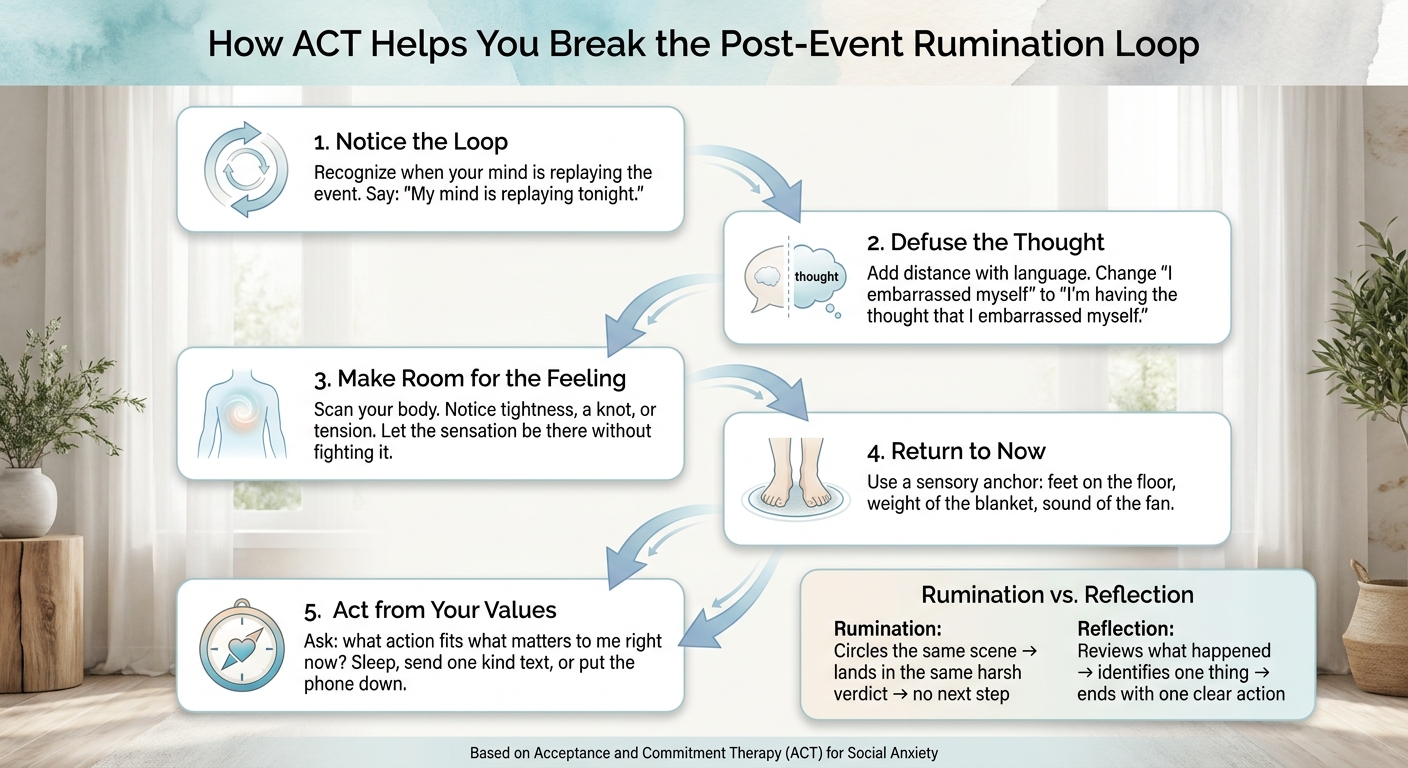
ACT Steps to Break Post-Event Rumination Loop
Once you can spot the loop, the next step is changing what you do while it is running. ACT offers a plain sequence for the moment the replay starts: notice it, step back, and come back to the present.
Step Back from the Thought Instead of Debating It
Most of the time, the thought is not only about one awkward moment. It becomes a hard judgment about who you are. The pull is to argue with it: It wasn’t that bad. They probably didn’t notice. Stop overthinking. But that fight keeps you inside the thought. You’re still treating it like a case to solve.
ACT takes a different path. Put "I’m having the thought that" in front of it. "I embarrassed myself" becomes "I’m having the thought that I embarrassed myself." That small shift creates space. The thought is still there, but it is no longer running the room. You can also name the pattern directly: "My mind is replaying tonight" or "This is rumination." The point is not to make the thought vanish. The point is to stop handing it the wheel.
After you name the thought, pause long enough to notice what feeling it may be covering.
Make Room for the Feeling and Return to Now
Usually, the urge is to shove the feeling away or fix it on the spot. ACT asks for the reverse. Let it be there without stiffening against it.
Scan your body. Notice where the feeling lands: tightness in your chest, a knot in your stomach, tension across your shoulders. Take one slow breath. Let the sensation be there without adding more strain to it. Then come back to one sensory anchor in the present, like the feel of your feet on the floor, the weight of the blanket, or the sound of the fan.
That move matters because rumination pulls you out of the room and back into the replay. A sensory anchor brings you back to now.
Once the feeling has a little space, the next question gets simpler: what action fits your values right now?
Choose Your Next Move Based on Values, Not the Spiral
The spiral usually asks for one more round of review, one more check, one more late-night text. It promises relief, but it keeps you circling. Values point in another direction. Maybe the next move is putting your phone down and going to bed. Maybe it’s sending one brief, genuine message to someone you liked talking with, not to manage their view of you, but because the connection mattered to you.
That difference is easy to miss in the moment. Anxiety-driven moves try to shrink uncertainty. Values-based moves help you act in line with what matters, even while uncertainty is still there.
This is often where the loop starts to loosen.
What Changes When the Replay Stops Running Your Evening
At first, the shift can look almost too small to count. You notice the replay starting. You call it what it is. Then, instead of giving the rest of the night over to it, you return to your evening.
That changes more than it seems.
Once the loop starts to loosen, evenings often feel more livable in plain, practical ways. Sleep comes a little easier. Your body settles sooner after being around people. The edge softens. A 2024 meta-analysis of 35 studies found a moderate association between post-event rumination and social anxiety symptoms (r = .45). That link helps explain why social situations can start to feel less loaded as the replay loses force. The risk did not vanish. Your mind just is not feeding it for hours afterward.
There is also a deeper change. The thought no longer gets to define the whole night.
That matters because thoughts tend to hit harder when they are treated like proof. ACT research for social anxiety has found drops in external shame and fear of negative evaluation, along with gains in self-compassion, and those effects were kept at follow-up. In lived terms, that can mean going to the next dinner, meeting, or family event without dragging the full weight of the last one behind you.
What many people say after practicing these skills with some consistency is simple: "my thoughts are in charge" starts to give way to "I can have these thoughts and still live my life." That is the core aim of ACT. Not getting rid of hard thoughts. Learning that they do not get final say over what matters to you.
When Working with a Therapist Can Help
Sometimes the replay keeps coming back, even when you know what to do. You get home, lie down, and your mind starts cross-examining every look, pause, and sentence again. If that loop keeps cutting into sleep, connection, or your sense of ease, structured support can help.
This kind of rumination can show up alongside social anxiety, OCD-like reviewing, perfectionism, trauma, ADHD-related rejection sensitivity, or a major life change. In those cases, it often helps to work with someone who can slow the pattern down with you, sort out what is fueling it, and tailor the work to your life rather than forcing your life into a script.
Empower Counseling offers ACT-informed therapy for anxiety, perfectionism, social rumination, and related concerns. Clinicians also draw on EMDR and Internal Family Systems (IFS) when trauma or inner conflict is part of the picture. Sessions are available in person in Birmingham, Alabama, and by telehealth across Alabama. If this feels familiar, reaching out for a consultation can be a clear first step.
Key Takeaways
The hard part often is not the event itself. It is the hour after. The drive home. The quiet kitchen. The moment your mind starts replaying what you said, how their face looked, what you should have done instead. Post-event rumination is a common mental habit, not a flaw. ACT helps you catch that loop before it starts running the whole show.
When the replay begins, ACT offers a simple path: notice it, step back, return to now, and choose your next move.
Defusion helps you get some space from the story your mind is telling. There is a big difference between "I ruined it" and "I’m having the thought that I ruined it." That small shift separates you from the spiral. From there, notice what you are feeling, bring your attention back to the present moment, and then act.
You do not need a perfect review. You need a way to leave the review.
Defusion, acceptance, present-moment attention, and values-based action can help you move ahead without letting the replay take the lead.
FAQs
How do I know if I’m reflecting or ruminating?
Your mind may be caught in rumination when it keeps circling the same ground. You replay the conversation from Tuesday night on your drive home. You run three future versions of tomorrow before you fall asleep. You get stuck on what if and what should have happened instead, as if going over it one more time might finally bring relief.
It often feels less like thinking and more like being pulled under by a story your mind is telling. A self-blaming thread. An anxiety story. Not something you’re simply noticing, but something that has started to feel like the whole weather system around you. If you’re getting swept into those thoughts rather than seeing them as mental events that come and go, rumination is likely part of what’s happening.
What should I do when the replay starts at night?
When your mind starts running the same conversation again at 11:42 p.m., the goal is not to win the argument with your thoughts. It is to notice the loop, and notice it without turning on yourself for having it in the first place. In ACT, that shift matters. A thought can feel loud, urgent, and convincing, and still be just a thought, not a fact and not an order you have to follow.
From there, you gently return to what is here now. Your breath. Your feet against the floor. The weight of the blanket. The tightness in your chest, if that is what is there. Not to make the thought vanish, but to give your attention somewhere steady to land.
If you want more support building these skills, Empower Counseling offers ACT-informed therapy.
When should I get therapy for post-event rumination?
If you keep replaying the conversation on the drive home, in the shower, while answering emails, you may already know this pattern by feel. The moment ends, but your mind does not. It circles what you said, what you should have said, and what it might mean about you. After a while, that loop can start to shape the day.
Therapy may make sense when that post-event replay has become familiar and hard to interrupt, even when you’re trying to move on. If the self-criticism keeps pulling you out of the present, or you feel stuck in a way that touches work, sleep, relationships, or your ability to focus, that matters. It does not mean you are doing anything wrong. It may mean your mind has found a way to search for safety that is no longer helping.
A consultation with Empower Counseling can help you sort out whether Acceptance and Commitment Therapy fits your needs and goals.