
How Can You Start Your Journey to Recovery from an Eating Disorder?
sbb-itb-92e3c8f
Your mind is not failing you – it is trying to keep you safe
At first, food rules can feel like relief. They give shape to a day that feels shaky. They offer a way to measure whether you are “doing okay.” They can even create a sense of calm, at least for a moment. But that relief usually comes with a cost. The rules tighten. Body thoughts get louder. Shame moves in and starts sounding like truth. That does not mean you are broken. It means your mind found a way to protect you when life felt unsteady, and now that same method is hurting you. The eating disorder is doing something for you, even if what it gives now comes wrapped in pain. ACT helps name that pattern and explain why safety can start to feel like a trap.How ACT explains feeling stuck
 Sometimes it looks like this: a thought flashes through your mind, I ate too much, and within seconds it no longer feels like a thought. It feels settled. Proven. Like a fact about who you are. From there, the old rule can feel less like a choice and more like an order.
ACT calls this psychological inflexibility: getting so tangled up in your thoughts that they begin to run your actions. In ACT, that process is called cognitive fusion, which means treating a thought as if it were fact. That is often where people get stuck. Not because they do not know better, but because the thought lands with so much force that it seems unquestionable.
ACT aims for psychological flexibility, which means being able to notice what is happening inside you without letting it decide your next move. That shift matters. It is the difference between I had the thought that I ate too much and I must fix this right now. In that small bit of space, the rule does not get the final word. Mindfulness and acceptance are the skills that help create that space.
Sometimes it looks like this: a thought flashes through your mind, I ate too much, and within seconds it no longer feels like a thought. It feels settled. Proven. Like a fact about who you are. From there, the old rule can feel less like a choice and more like an order.
ACT calls this psychological inflexibility: getting so tangled up in your thoughts that they begin to run your actions. In ACT, that process is called cognitive fusion, which means treating a thought as if it were fact. That is often where people get stuck. Not because they do not know better, but because the thought lands with so much force that it seems unquestionable.
ACT aims for psychological flexibility, which means being able to notice what is happening inside you without letting it decide your next move. That shift matters. It is the difference between I had the thought that I ate too much and I must fix this right now. In that small bit of space, the rule does not get the final word. Mindfulness and acceptance are the skills that help create that space.
What mindfulness and acceptance each do
Mindfulness means noticing a thought, body sensation, or urge with openness instead of alarm. Acceptance means making room for that experience without rushing to fix it, cancel it out, or get away from it. Together, they interrupt the old reflex. Thought. Panic. Rule. Instead, there is a pause. And that pause matters. It is what separates noticing a thought from obeying it.Noticing a thought is not the same as obeying it
Fighting vs. Noticing Thoughts in Eating Disorder Recovery (ACT)
What thought control looks like
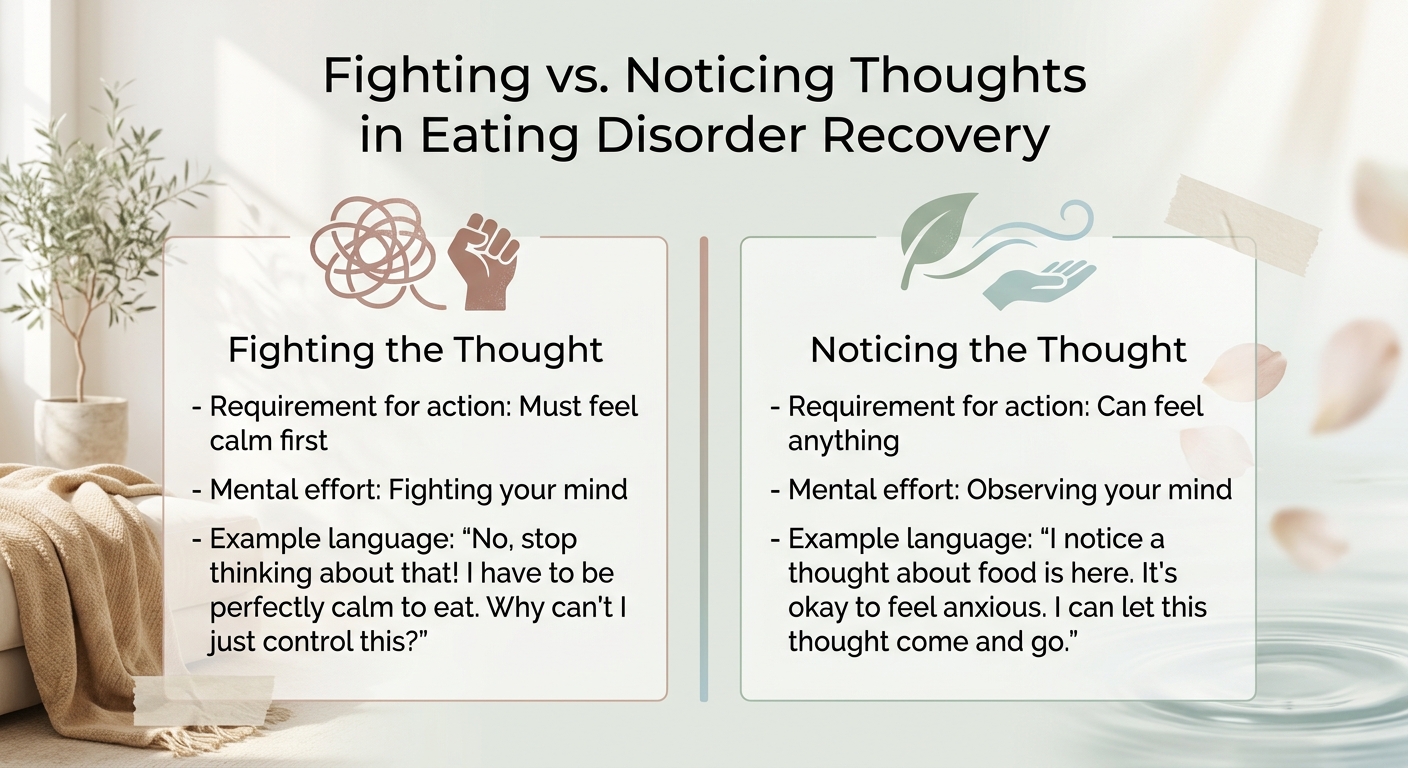
For many people, the first move is to fight back. No, that’s irrational, this food is fine. Or maybe you check your body to see whether the fear feels “earned.” Or you try to shove the thought out of your mind and move on. That response makes sense. If a thought feels sharp or urgent, of course you would want to get rid of it. But this kind of control often tightens the loop instead of loosening it. The same thing happens with body thoughts and shame. The more you argue, check, or push away, the more power the thought can seem to gain.What mindful noticing looks like
ACT calls this defusion. The goal is not to force the thought to change. The goal is to change your relationship to it. In practice, that shift can be plain and small. Instead of I shouldn’t eat this, you say to yourself: I’m having the thought that I shouldn’t eat this. That wording may seem minor, but it changes the position you are standing in. You are no longer inside the thought as if it were fact. You are noticing it. That distance matters. The thought may still be there. It just does not get to run the whole moment. Acceptance, in this sense, means making room for the thought without handing it the steering wheel. The thought can stay. It does not decide your next move.| Fighting the thought | Noticing the thought (ACT) | |
|---|---|---|
| Requirement for action | Must feel calm first | Can act on values while discomfort is present |
| Mental effort | Fighting your mind | Observing and letting go |
| Language used | “I can’t eat that” | “I’m noticing the thought that I can’t eat that” |
What change can look like at the table, in the mirror, and after a hard moment
Change in recovery often looks ordinary from the outside and hard from the inside. It may look like eating the snack while your chest feels tight. It may look like standing in front of the mirror, hearing the old criticism start up, and not following it where it wants to go. Recovery rarely feels calm while it is happening. More often, it looks like choosing nourishment while discomfort is still here.Making room for discomfort without going back to the rule
At the table, the pull is often immediate: fix the feeling, shrink the fear, go back to the rule. Food rules, body thoughts, and shame loops can make that urge feel urgent, as if relief must come now. But urgency is not the same thing as wisdom. One practice that helps is the “And” practice: I feel anxious about this snack, and I am choosing to nourish my body. That small word matters. It makes room for two truths at once. You can feel fear and still eat. You can feel doubt and still care for yourself. The discomfort gets a seat at the table. It just does not get to order for you. The same pattern often shows up in front of the mirror. A glance turns into scanning. Scanning turns into judgment. Judgment turns into a spiral. Acceptance here does not mean liking every thought you have about your body. It means noticing the urge to criticize, then staying with the next values-based action instead of handing the moment over to shame. As licensed therapist Payton Wortman puts it:“Recovery is not about achieving perfect balance – it’s about developing the flexibility to navigate life’s inevitable ups and downs with self-compassion and wisdom.”
Using mindfulness to return to the present moment
After eating, or during a body-image spiral, the mind can move fast. A single thought becomes a whole story about what this meal means, what your body means, or what you should do next. Mindfulness helps interrupt that slide by bringing you back to what is happening right now, not the story your mind is trying to write about it. A few tools can help anchor that shift:- the three-breath reset before a meal
- bringing attention to the taste, texture, and aroma of food during the meal
- the five-senses grounding practice after a hard moment: name five things you can see, four you can touch, three you can hear, two you can smell, and one you can taste
Choosing the next recovery step on purpose
This is where ACT links mindfulness and acceptance to something larger: values. Values are the qualities you want your life to reflect, such as connection, nourishment, and self-care. They are not goals you check off. They are directions you keep returning to. So when a rule tightens its grip, one question can shift the moment: What would be most caring for me right now? Sometimes the answer is finishing the meal even while the thought says not to. Sometimes it is choosing movement that feels good in your body instead of using exercise as punishment. The point is not perfection. It is choosing on purpose, rather than letting fear choose for you. As Wortman notes:“Each time you choose the moderate response instead of the rule, you’re building psychological flexibility.”And when that next step keeps feeling out of reach on your own, therapy can help turn that moment from something overwhelming into something more workable.
Recovery is easier when you are not practicing it alone
That next step usually gets easier when you do not have to keep doing it by yourself.How therapy can support this work
Sometimes the hardest part is not knowing what to do. It is noticing the thought, the urge, the shame spike, and feeling it turn into an order before you have time to catch it. ACT-based therapy helps slow that moment down. It helps you notice thoughts and urges without treating them like instructions. If perfectionism, trauma, or shame are part of the picture, ACT is often paired with IFS or EMDR. Each approach does a different job. ACT helps build more psychological flexibility. IFS can help name and understand the part of you that is pushing food rules so hard. EMDR can help when trauma is woven into the pattern and your nervous system is still reacting as if the threat is present now. For readers who want that kind of support, Empower Counseling offers ACT-informed care.Support through Empower Counseling
 Empower Counseling is a women-led therapy practice in Birmingham, Alabama, offering ACT-informed care for eating disorder thoughts, body-image spirals, perfectionism, and shame loops. Sessions are available in person in Birmingham and through telehealth across Alabama.
Key takeaways
Three ideas matter here:- Mindfulness helps you notice what is happening inside without turning every thought into a command or a verdict.
- Acceptance helps you make room for discomfort without handing the moment over to a rule.
- ACT connects both skills to values so the next step comes from what matters to you, not from what fear is demanding right now.


