
Eye Movement Desensitization and Reprocessing (EMDR) is a therapy designed to help people process and heal from trauma. Unlike traditional talk therapy, EMDR uses bilateral stimulation – like eye movements or tapping – to reprocess traumatic memories, reducing their emotional intensity. This method mimics the brain’s natural processing during REM sleep, helping to reorganize how memories are stored.
Trauma can physically alter the brain, overactivating the amygdala (fear center), shrinking the hippocampus (memory processing), and reducing activity in the prefrontal cortex (emotion regulation). EMDR works by reversing these effects, improving communication between brain regions and forming new neural pathways. Research shows it can increase emotional regulation, decrease fear responses, and help patients recover faster.
Studies reveal that 84%-90% of single-trauma patients no longer meet PTSD criteria after just 3 sessions, making EMDR a recognized and effective treatment option for PTSD and other trauma-related conditions.
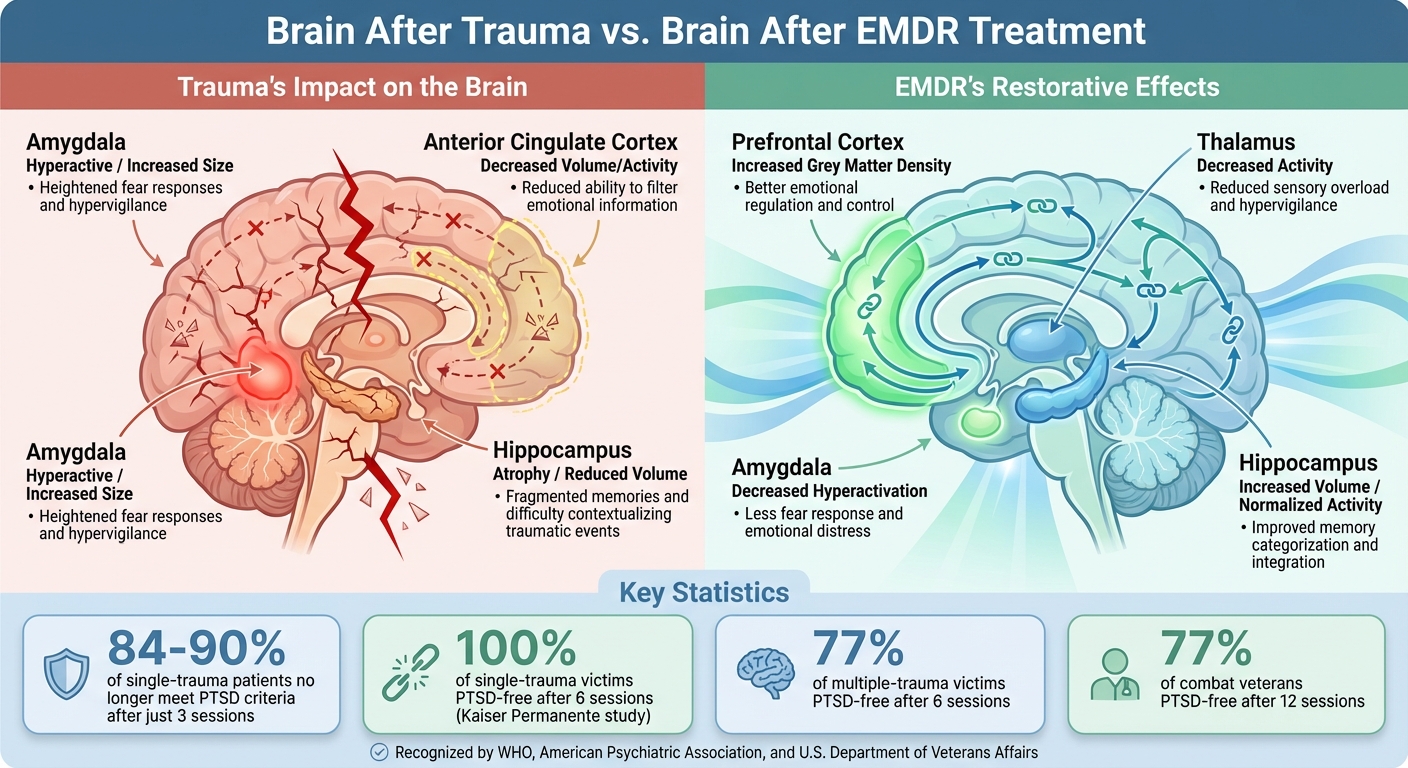
How Trauma Changes the Brain vs How EMDR Restores It
How EMDR Psychotherapy works in your brain
How Trauma Changes the Brain
Trauma doesn’t just leave emotional scars; it physically reshapes the brain, affecting how we store and process memories. Key areas like the amygdala, hippocampus, and prefrontal cortex are deeply involved in these changes. The shifts in these regions help explain common trauma-related symptoms, such as flashbacks, hypervigilance, and difficulties in regulating emotions.
Brain Regions Affected by Trauma
The amygdala, often referred to as the brain’s "fear center", becomes overactive after trauma. This heightened activity leads to exaggerated fear responses and keeps the brain in a constant state of alertness. Prolonged stress can even cause the amygdala to enlarge, further amplifying these fear responses.
On the other hand, trauma shrinks the hippocampus, a phenomenon called hippocampal atrophy. This shrinkage disrupts memory processing, leading to fragmented and intrusive memories. Research using MRI scans has consistently shown reduced hippocampal volume in trauma survivors. Stress hormones like cortisol overwhelm this region, preventing traumatic events from being properly integrated into a person’s life story. As a result, these events often resurface as vivid, intrusive flashbacks.
"The hippocampus plays a role in new learning formation, consolidation of information from short-term memory to encoding, and retrieval of long-term memories."
– Tracy M. McGuire, School of Psychology, Murdoch University
Meanwhile, the prefrontal cortex and anterior cingulate cortex – areas responsible for regulating the amygdala – show reduced activity in trauma survivors. This loss of regulatory control allows the amygdala to remain unchecked, making it harder to manage emotions effectively.
Interestingly, findings from the Fremantle Hospital Clinical Trial suggest that these structural changes can sometimes be reversed, offering hope for restoring brain balance.
| Brain Region | Change After Trauma | Functional Impact |
|---|---|---|
| Amygdala | Hyperactivity / Increased Size | Heightened fear responses and hypervigilance |
| Hippocampus | Atrophy / Reduced Volume | Fragmented memories and difficulty contextualizing traumatic events |
| Prefrontal Cortex | Decreased Activation | Impaired emotional regulation |
| Anterior Cingulate Cortex | Decreased Volume/Activity | Reduced ability to filter emotional and cognitive information |
Brain Imbalances in PTSD
The real challenge in PTSD isn’t just that individual brain regions are affected – it’s the breakdown of balance between them. This imbalance is what drives many PTSD symptoms. Marco Pagani from the Institute of Cognitive Sciences and Technologies explains:
"Clients exposed to psychologically traumatic events lack the capability to process traumatic memories, with representing a reduced medial frontal cortex and anterior cingulate inhibition over a hyperaroused amygdala the core functional mechanism of symptoms."
For individuals with PTSD, the prefrontal cortex and anterior cingulate fail to regulate the overactive amygdala. At the same time, the hippocampus struggles to consolidate and contextualize memories. This creates a loop where traumatic experiences remain vivid and sensory-rich, locked in the present moment.
A long-term study following survivors of the 2002 San Giuliano di Puglia earthquake in Italy sheds more light on this. Researchers tracked 37 PTSD patients over ten years and found that untreated trauma disrupted communication between critical brain regions, including the superior medial frontal gyrus and temporal areas. The severity of these disruptions directly correlated with the intensity of PTSD symptoms.
These findings underscore why traditional "talk therapy" may not always be enough. Trauma alters the brain’s physical structure, and recovery often requires treatments that address both the psychological and neurological aspects. To truly heal, interventions must actively rewire the brain and restore balance to these disrupted pathways.
How EMDR Rewires the Brain
Understanding how trauma disrupts the brain is only half the story. The real breakthrough lies in how EMDR actively works to reverse these effects. This therapy uses specific neurological processes to help the brain reprocess traumatic memories, restoring balance to areas affected by trauma.
Memory Reprocessing Through Bilateral Stimulation
At the core of EMDR is bilateral stimulation – techniques like eye movements, tapping, or alternating sounds. This isn’t just a distraction; it creates a unique neurological state that promotes healing.
How does it work? Bilateral stimulation triggers key neural changes. A study involving 22 healthy participants revealed that alternating auditory stimulation increased activation in the right amygdala, which processes negative emotional material, while decreasing activity in the left dorsolateral prefrontal cortex, the part of the brain that suppresses unwanted memories.
"The increase in limbic processing along with decreased frontal activation is in line with theoretical models of how bilateral alternating stimulation could help with therapeutic reintegration of information."
– Herkt et al., PLOS One
This combination of reduced suppression and heightened emotional processing creates the perfect conditions for reprocessing trauma. It allows traumatic memories to be integrated into the brain’s normal memory networks, reducing their emotional weight.
Interestingly, bilateral stimulation may mimic brain activity seen during slow-wave sleep. This state increases low-frequency brain rhythms that "depotentiate" fear memory synapses in the amygdala. In simpler terms, it weakens the receptors that keep traumatic memories emotionally charged, making them less distressing.
Improving Communication Between Brain Hemispheres
EMDR also plays a role in shifting brain activity. It moves processing from the orbito-frontal cortex – where emotional memories are stored – toward posterior associative regions, which integrate these memories into the brain’s regulated networks. This transition helps traumatic memories lose their emotional intensity and become part of the brain’s standard memory system.
Additionally, EMDR strengthens the connection between the right amygdala, where emotional memories reside, and the left dorsolateral prefrontal cortex, which handles logical processing. This improved communication allows individuals to recall traumatic events without being overwhelmed by the emotions tied to them.
A study of 31 PTSD survivors from the 2002 San Giuliano di Puglia earthquake offers compelling evidence. Conducted between January and March 2012, researchers Emiliano Santarnecchi and Letizia Bossini used fMRI scans to track brain changes. They found that clinical improvements were associated with increased functional connectivity between the bilateral superior medial frontal gyrus and the right temporal pole. In essence, the brain was relearning how to communicate effectively.
The therapy also calms hyperactive areas like the right superior temporal sulcus, responsible for the vivid, intrusive imagery typical of flashbacks. As these regions normalize, the sensory intensity of traumatic memories diminishes.
Building New Neural Pathways
Beyond balancing brain activity, EMDR helps build new neural connections essential for long-term recovery. This isn’t just about calming overactive areas – it’s about creating structural changes in the brain.
For instance, EMDR has been shown to increase grey matter density in the prefrontal cortex, a region critical for emotional regulation. This reverses the damage caused by chronic stress and trauma, such as dendritic atrophy. As researcher Sarah Boukezzi explains:
"Symptoms removal goes hand-in-hand with GM density enhancement of structures involved in emotional regulation."
The therapy also normalizes activity in the thalamus, a region linked to sensory overload and hypervigilance. In one study involving 16 PTSD patients, researchers found a strong correlation (r = 0.62) between decreased thalamic activity and symptom reduction. As overactivity in this area declines, patients experience relief from constant sensory overwhelm.
| Brain Region | Change After EMDR | Functional Outcome |
|---|---|---|
| Prefrontal Cortex | Increased Grey Matter Density | Better emotional regulation and control |
| Amygdala | Decreased Hyperactivation | Less fear response and emotional distress |
| Hippocampus | Increased Volume / Normalized Activity | Improved memory categorization and integration |
| Thalamus | Decreased Activity | Reduced sensory overload and hypervigilance |
EMDR encourages the brain to form new associations between traumatic memory networks and healthier, adaptive ones. This process allows the brain to replace harmful beliefs, such as "I am in danger", with more constructive ones like "I am safe now." These aren’t just abstract thoughts – they’re new neural pathways that reshape how the brain responds to trauma triggers.
The results are striking. Studies show that 84% to 90% of single-trauma victims no longer meet the criteria for PTSD after just three 90-minute EMDR sessions. In a Kaiser Permanente-funded study, 100% of single-trauma victims and 77% of multiple-trauma victims were PTSD-free after six 50-minute sessions. Even combat veterans, who often face more complex trauma, experienced remarkable improvements – 77% were free of PTSD after 12 sessions.
sbb-itb-92e3c8f
Research Evidence for EMDR
Brain Imaging Studies on EMDR
EMDR has been shown to reshape the brain’s neural pathways, and imaging studies provide solid evidence of these structural changes. These studies highlight the physical transformations in the brain that align with symptom relief.
In August 2017, Sarah Boukezzi and her team at Conception Hospital in Marseille, France, conducted a study using Voxel-Based Morphometry (VBM) to examine 11 PTSD patients. The participants underwent brain scans at three points: before starting EMDR therapy, one week after treatment, and five months later. The findings were striking – grey matter density in the prefrontal cortex significantly increased in the EMDR group. In contrast, a seven-person wait-list group showed no changes and remained symptomatic.
"EMDR seems to be an efficient therapy to reduce PTSD symptoms and further restore brain structural organization." – Sarah Boukezzi, Psychiatry Research: Neuroimaging
Another study using NIRS technology observed oxygenated hemoglobin levels in the right superior temporal sulcus. During trauma recall, these levels spiked but dropped sharply with bilateral eye movements. This brain region is closely tied to the vivid and intrusive imagery that defines flashbacks.
In September 2012, an EEG study followed 10 patients through their entire EMDR treatment. By the final session, researchers noticed a shift in neuronal activity – from the orbitofrontal and anterior cingulate cortex to the left temporo-occipital regions. This change suggests the brain had reprocessed trauma as a cognitive memory rather than an emotional threat. Remarkably, these changes held steady during a two-year follow-up.
Across various imaging technologies, consistent patterns of brain changes have been observed:
| Imaging Technology | Brain Change After EMDR | What It Means |
|---|---|---|
| MRI (VBM) | Increased grey matter density in prefrontal cortex | Improved emotional regulation |
| EEG | Shift from orbitofrontal to posterior regions | Effective trauma processing |
| NIRS | Reduced activation in right superior temporal sulcus | Stabilized memory recall |
| qEEG | Increased low-frequency rhythm power | Reduced fear response in the amygdala |
These objective findings from brain imaging are supported by clinical data, further reinforcing the effectiveness of EMDR therapy.
Clinical Results of EMDR Treatment
The brain changes observed in imaging studies are reflected in significant clinical outcomes. More than 30 randomized controlled trials have demonstrated EMDR’s success in treating PTSD for both adults and children. Leading organizations like the American Psychiatric Association and the World Health Organization recognize EMDR as a primary treatment for PTSD.
One standout feature of EMDR is its speed. A study involving survivors of the 2002 San Giuliano di Puglia school collapse in Italy found rapid symptom relief. Researchers monitored 20 survivors and relatives with EEG during EMDR sessions. Those diagnosed with PTSD experienced substantial symptom reductions after just 2–6 weekly sessions. The study also documented a neurobiological shift in brain activity, moving from the prefrontal cortex to posterior regions as traumatic memories were reprocessed.
When compared to other treatments, EMDR has shown advantages. Studies reveal that EMDR provides longer-lasting symptom relief than medication for PTSD. This is noteworthy given that only 30% of individuals typically achieve meaningful improvement with standard PTSD treatments.
A 2024 meta-analysis reviewed eight randomized controlled trials involving 346 patients and compared EMDR to other psychological therapies, including trauma-focused CBT and relaxation techniques. The results showed no significant difference in reducing PTSD symptoms, response rates, or remission between EMDR and these other treatments. However, EMDR is often faster. Canadian Clinical Guidelines highlight EMDR as more effective than stress management for PTSD care.
The impact of EMDR is also evident in measurable outcomes. In one study, participants’ Subjective Units of Disturbance (SUD) scores dropped from 8.0 to 1.1 after a single session, while their Validity of Cognition (VOC) scores rose from 3.0 to 6.1. These shifts illustrate the transformation from overwhelming distress to manageable memories, supported by observable brain function changes.
Conclusion: EMDR as a Tool for Trauma Recovery
EMDR therapy has shown itself to be a powerful method for addressing trauma, using the brain’s natural ability to adapt and heal. Through the process of reprocessing traumatic memories with bilateral stimulation, it helps individuals reduce fear and distress while integrating these memories into a more manageable and less overwhelming narrative.
Research, including brain imaging studies, highlights how EMDR can bring about noticeable changes in brain structure and function. For example, studies have linked increased grey matter density in the prefrontal cortex to better emotional regulation. At the same time, decreased activity in the amygdala has been associated with lower levels of hyperarousal and fear. These changes often translate into significant clinical improvements. In fact, many patients no longer meet the criteria for PTSD after completing treatment.
One notable example comes from a Kaiser Permanente study, which revealed that 100% of patients with single-trauma histories and 77% of those with multiple traumas no longer qualified for a PTSD diagnosis after just six 50-minute sessions of EMDR. Recognized by leading organizations like the World Health Organization, the American Psychiatric Association, and the U.S. Department of Veterans Affairs, EMDR is widely regarded as a key approach to trauma treatment. Beyond PTSD, it has also shown promise in addressing issues like depression, anxiety, eating disorders, and chronic pain.
These findings emphasize EMDR’s effectiveness in helping individuals recover from trauma and regain control over their lives.
EMDR Therapy at Empower Counseling

Empower Counseling, located in Birmingham, Alabama, incorporates EMDR therapy into its trauma-focused care. Their therapists follow a structured eight-phase protocol: starting with history-taking and preparation, moving through desensitization using bilateral stimulation, and concluding with re-evaluation to ensure lasting progress. Sessions are offered both in-person and online, with fees ranging from $150 to $250 depending on the therapist’s qualifications. Whether you’re working through a single traumatic event or more complex trauma, EMDR provides a path to healing that aligns with your brain’s natural recovery processes.
FAQs
What makes EMDR different from traditional talk therapy for trauma treatment?
EMDR takes a different route compared to traditional talk therapy by using bilateral stimulation – like guided eye movements – to help reprocess traumatic memories. Instead of diving deep into detailed discussions about the trauma, this method focuses on how the brain processes and responds to distressing experiences, aiming to "rewire" those responses. The result? Many find it leads to quicker and more impactful progress.
What sets EMDR apart even further is its simplicity. While talk therapy often involves lengthy conversations and cognitive exercises, along with homework assignments, EMDR keeps verbal recounting to a minimum. This makes it a streamlined and effective option for tackling trauma head-on.
How does EMDR therapy help rewire the brain after trauma?
EMDR therapy helps the brain process and reshape traumatic memories, leading to noticeable shifts in how the brain functions. Studies reveal that it can boost gray matter density in brain regions impacted by PTSD, restore more typical brain activity patterns, and enhance connections between areas responsible for memory and emotion. Remarkably, it may also aid in regaining hippocampal volume, which often shrinks following trauma.
These brain changes play a crucial role in recovery by lessening the emotional weight of traumatic memories and encouraging healthier thinking patterns. EMDR offers a promising path forward for individuals grappling with the lasting effects of trauma.
How effective is EMDR for individuals with complex trauma?
EMDR therapy has proven to be an effective option for people dealing with complex or multiple trauma experiences. Studies show it can greatly reduce symptoms of PTSD and other trauma-related issues. However, treating complex trauma often takes more sessions compared to single-event trauma, as it involves working through multiple layers of emotional and psychological effects.
By reshaping neural pathways, EMDR helps the brain process and recover from traumatic memories, paving the way for long-term healing. Many who undergo this therapy describe it as a powerful tool for reclaiming control and enhancing their overall quality of life.


