“I want to help, but every time I open my mouth, I worry I’ll make dinner worse.” If that sounds like me, this is what I need to know: family support in eating disorder therapy works best when I stay calm, keep routines steady, and stop arguing with the illness as if it were my loved one. This guide gives me a clear picture of what helps, what can backfire, and how my role shifts with age, distance, and treatment stage.
Family support is not about saying the perfect thing. It is about showing up in the same steady way, again and again, especially at meals and after hard days. That is why family involvement matters so much in treatment.
It Takes a Village: Supporting a Loved One with an Eating Disorder
sbb-itb-92e3c8f
When Home Life Starts Revolving Around Food, Fear, and Guessing
Meals can begin to run the house. You find yourself planning hours ahead, watching every bite, and steering clear of casual food talk because almost anything can set off distress. Home starts to feel tense in a very specific way, like everyone is bracing for the next meal before the current one is even over. That is often what family life feels like when an eating disorder is setting the pace.
FBT does not assign blame. It tells parents they are not responsible for causing the eating disorder. Once blame is moved out of the room, support can become something more useful: a series of steady, daily actions.
What Family Support Actually Means in Eating Disorder Treatment
Family support is both practical and emotional. It looks like keeping meals and routines steady, showing up to sessions when invited, reducing secrecy, and staying present after hard moments. Those small, repeated actions matter most at meals and in the stretch of time right after the hardest moments, when fear, guilt, or conflict can linger.
It also helps to separate your loved one from the disorder. The fear and resistance are coming from the illness, not from the person you know. That distinction can change the whole tone at home. Instead of arguing with symptoms as if they are character flaws, families can stay calm and steady in the face of them.
How Family Support Fits With Evidence-Based Therapy
Treatment gives home support a clear shape. For adolescents, FBT places parents in the lead during the early phase of recovery, while the therapist guides the parents rather than leading the change directly. That structure matters because eating disorders often create confusion at home. A plan helps.
In a large clinical trial, 49% of adolescents receiving FBT achieved full remission at 12-month follow-up, compared to 23% in individual therapy alone. For adults, ACT can help the person act on values while family support stays collaborative and boundaried. Guided family involvement does not replace clinical care. It helps make the space between sessions steadier.
What Family Sessions Are Actually For: Family Support for Eating Disorder Therapy
A lot of families walk into these meetings braced for blame. Someone expects to be told they did too much. Someone else expects to hear they did too little. Most of the time, that fear is already sitting in the room before anyone says a word.
Family sessions are not for assigning fault. They are for turning good intentions into a plan people can use at home. The point is not only to talk about treatment in the abstract. It is to make home responses calmer and more steady, to build a shared plan, to lower blame, and to help everyone respond in a more even way when things get hard.
When Family Sessions Help Most: Family Support for Eating Disorder Therapy
These sessions help most when people need a common plan for meals, communication, and relapse prevention. That usually matters in the moments that are hardest to improvise: at the table, after conflict, or during the stretch where recovery is moving forward but still feels fragile.
For college students and other transition-age young adults, family sessions can still help if the client wants family involved. And “family” does not have to mean only parents. Support can also come from partners, relatives, or other trusted people when the client wants them included. The structure matters because support changes across settings and stages of recovery.
How Support Roles Change During Treatment
Early in treatment, caregivers often take on a more active role. They may plate meals, watch intake, and interrupt behaviors that keep the eating disorder in control. That level of involvement can feel intense, but it serves a clear purpose: less guessing, less conflict, more steadiness.
If siblings are included, their role stays supportive only. The aim is to keep home life as normal as possible, not to turn siblings into monitors of food or weight.
As recovery becomes steadier, autonomy returns bit by bit. A parent who plated every meal at the start may later step back and oversee while the patient plates their own food. In the final phase, the focus shifts away from food alone and toward development, identity, and relapse prevention.
How a Specialized Practice Can Guide These Conversations
A specialized therapist can help families turn treatment goals into clear, workable support at home.
What Support Looks and Sounds Like at the Table and After a Hard Day
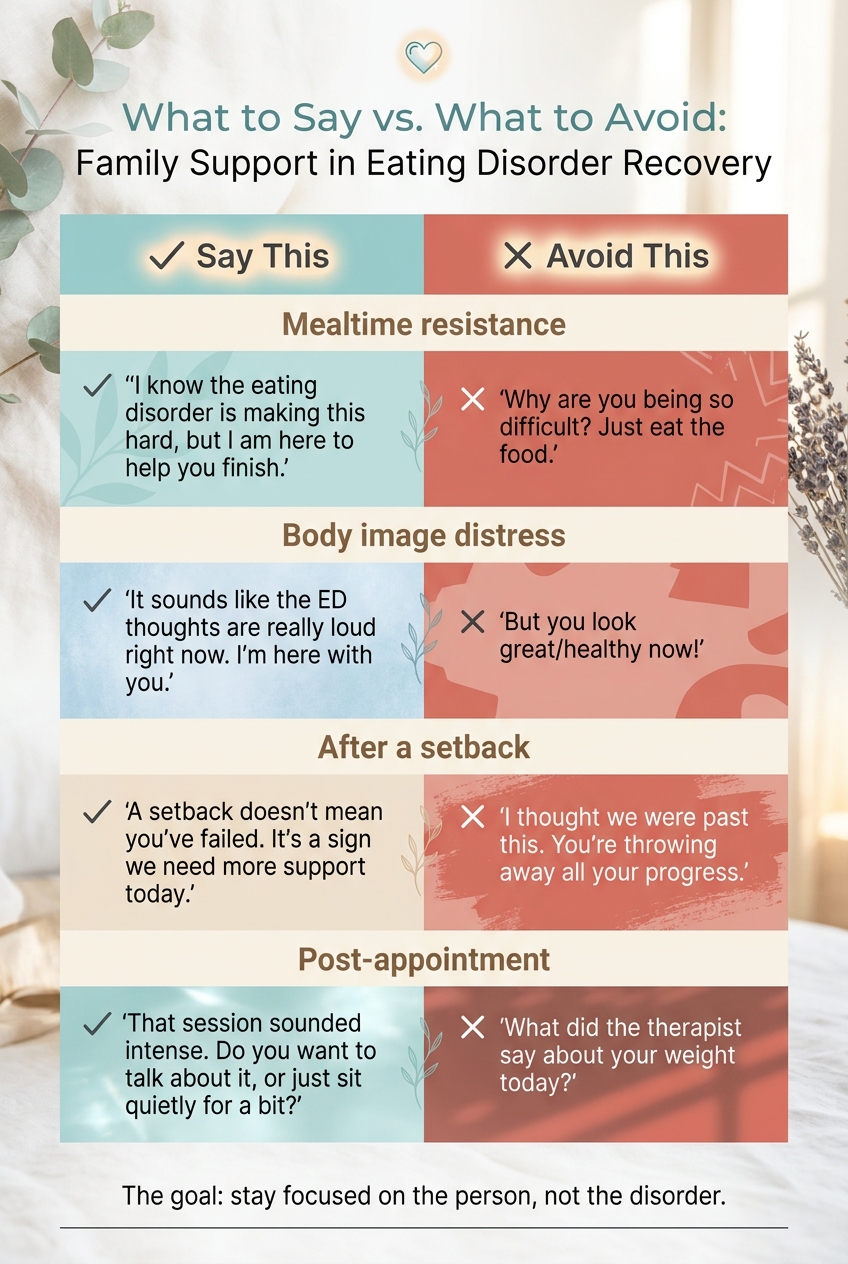
Helpful vs. Harmful Family Support Phrases in Eating Disorder Recovery
The hard part usually isn’t caring. It’s knowing what care sounds like when dinner is on the table, the room is tense, and every word feels like it might land wrong. It’s knowing what to do after a rough therapy session, a skipped meal, or a day that seemed to slide backward. Once the plan is clear, the next step is using it in the moments that test everyone. At meals and after setbacks, the aim is calm follow-through, not perfect wording.
At Meals: Stay Calm and Consistent
In early recovery, caregivers should plate the meal, keep the routine, and stay at the table through the whole meal, not just the first few minutes. That steadiness is support, not control.
For some people, food can set off a fight-or-flight response. That frame matters. A lot. What looks, from the outside, like refusal or pushing back may be the nervous system sounding an alarm. The resistance is not defiance. It is a symptom, and your calm presence is part of the treatment.
Keep conversation calm and brief. Skip comments about calories, weight, or body size, even if the comment sounds kind in your head. Do not bargain over portions or connect food to exercise; both feed the disorder’s logic.
After Hard Days: Connect Before Trying to Fix
After a hard therapy session, a skipped meal, or a setback, many caregivers move straight into fixing mode. That urge comes from love. But in the moment, it can feel like pressure.
Start by naming what you see and staying close. > “That session sounded intense. Do you want to talk about it, or just sit quietly for a bit?”
That kind of response gives the person a choice without making them explain themselves on demand.
And sometimes the sentence that lands best is the simplest one. > “I saw your effort today. I’m glad you showed up.”
In that moment, that matters more than going back through what went wrong. Avoid returning to weight or scale talk. Those questions, even when they come from care, can pull attention back to the eating disorder instead of the person. After a hard day, the goal is to restore connection, not to assess status.
Helpful Phrases vs. Unhelpful Phrases
When you’re unsure what to say, use words that stay on the person’s side.
Situation
Helpful Phrase
Unhelpful Phrase
Mealtime resistance
“I know the eating disorder is making this hard, but I am here to help you finish.”
“Why are you being so difficult? Just eat the food.”
Body image distress
“It sounds like the ED thoughts are really loud right now. I’m here with you.”
“But you look great/healthy now!”
After a setback
“A setback doesn’t mean you’ve failed. It’s a sign we need more support today.”
“I thought we were past this. You’re throwing away all your progress.”
Post-appointment
“That session sounded intense. Do you want to talk about it, or just sit quietly for a bit?”
“What did the therapist say about your weight today?”
None of these phrases are magic. What they do share is a direction: toward the person, not toward the disorder. That shift may look small from the outside. Over time, it changes the feel of the whole room.
What Makes Things Harder, Even When You Mean Well
You can care deeply and still say something that lands wrong. That does not make you careless. It means eating disorders can twist ordinary support into fuel for the illness.
A lot of families find themselves here. They try to help, then notice that reassurance turns into more checking, more fear, more tension at meals. The problem is not love. The problem is that some forms of support end up serving the eating disorder’s rules.
Comments and Habits to Avoid
The patterns that tend to go badly are body talk, moral language about food, long explanations, criticism, and accommodation. These are the places where care can start to feel like pressure.
Saying you look so much healthier may sound kind, but an eating disorder may hear healthy as fat. Language about “good” and “bad” foods gives the illness more rules to hold onto. And when someone is undernourished, logic often does not get through. A long, reasonable explanation can hit a brain that is simply not able to take it in.
Criticism and blame can show up fast, especially when everyone is worn down. Still, they tend to deepen shame and are linked to poorer outcomes. Accommodation is less obvious, which is part of why it can be so easy to miss. A family makes a separate meal. Dinner gets reorganized around rigid rules. The aim is kindness. But the effect is that the eating disorder starts shaping the home.
Common Harmful Patterns, Their Likely Impact, and Better Alternatives
Harmful Pattern
Likely Impact
Supportive Alternative
Body or weight comments (even positive ones)
Intensifies shape focus and can confirm ED fears
Focus on function: I’m glad you have more energy
Food morality (clean eating, bad foods)
Reinforces ED rules and rigid thinking
Use neutral language; treat all foods as food
Lecturing or logic during distress
Frustrates both parties; an undernourished brain cannot process complex reasoning
Stay calm; hold the meal plan without debating it
Accommodation (separate meals, avoiding conflict)
Lets the disorder’s rules shape family life
We are all eating the same meal together
Blame or criticism
Increases shame, secrecy, and resistance
The eating disorder is making this meal hard for you
Ultimatums
Drives symptoms underground and increases concealment
I’m worried about you and I want to support you in getting help
What helps most is steadiness. Clear language. Fewer debates. Less focus on bodies, more focus on what the person is going through and what the eating disorder is doing in the room.
Support tends to work better when it stays calm and consistent, and the form that takes often shifts with age and independence.
How Support Needs to Change as They Grow
A kind of help that steadies a 15-year-old at the dinner table can feel intrusive to a 20-year-old in a dorm, and it can feel flat-out out of bounds to an adult who has already said, “Please stop talking about what I’m eating.” The support is not wrong. It just has to fit the stage of life. What helps is still the same at its core: calm presence, steady follow-through, and less room for the eating disorder to run the show. What changes is who leads.
Trouble often starts when families keep using the same level of involvement long after the person has outgrown it. What once felt safe can start to feel like pressure. Then the focus shifts from recovery to conflict, and no one needs that.
Teens: More Structure and More Parental Leadership
For teens, more structure often helps. In Family-Based Treatment, or FBT, parents take charge of meals early in care and then hand responsibility back bit by bit as nutrition becomes more stable. That approach fits what many families already sense: a teenager who is still getting footing may need more direct help, not less.
At first, that can look plain and concrete. A parent plates dinner. A parent stays nearby. Over time, the teen may plate their own meal with support in the room, then start making small food choices while a parent still keeps watch. The point is not control for its own sake. It is to give the teen enough structure that recovery has a chance to take hold.
College Students: Shared Responsibility Across Distance and Independence
College changes the picture. A student may be far from home, working out who they are, trying to look fine, and having a hard time all at once. In that stage, support often shifts from direct oversight to steady coordination. With the student’s written consent, families can work with providers.
In day-to-day life, that may mean regular check-ins that stay centered on connection instead of surveillance. It can also mean working with campus dining and housing services and planning ahead for weeks that tend to be harder, like exams, breaks, or moving days. The student has more independence, but they should not have to carry recovery alone just because they left home.
Adults: Invited Support, Clearer Boundaries, and Collaboration
Adulthood asks for a different kind of care. Support tends to work best when it is invited rather than assumed. Partners, parents, and close friends can still matter a great deal, but the person in recovery gets to shape that role.
At this stage, help is usually less about managing meals directly and more about stepping back from habits that give the eating disorder more power, while staying in line with the treatment team’s plan. A therapist can help families sort out roles, boundaries, and ground rules for communication without taking over the person’s recovery. That matters. Adults often need support that feels respectful, clear, and steady, not parental by default.
Key Takeaways for Families
Across ages, the aim stays the same: support that is calm, consistent, and matched to the person’s level of independence. Help should make recovery easier, not hand more leverage to the eating disorder.
Across ages, support should stay calm, consistent, and matched to the person’s independence.
FAQs
How can I help without making things worse?
Comments about food, body size, or eating habits can land harder than you mean them to. Even praise can turn into pressure. A safer place to start is with care, not alarm: say they seem stressed, worn down, or not quite like themselves, and remind them you’re there.
If you’re a parent or caregiver, the tone matters as much as the words. Ultimatums often push fear underground rather than bringing relief into the room. A warm, low-stress home can make it easier for someone to feel less watched and more safe enough to talk.
Caregiving can ask a lot of you. More than most people see from the outside. Getting support for yourself matters too, not because you’re failing, but because carrying worry day after day is hard on a nervous system.
When should family join therapy sessions?
When meals turn tense, when every comment at the table seems to land wrong, or when a parent feels stuck between worry and frustration, it makes sense that treatment would need more than one person in the room. For many adolescents, family sessions are a core part of care. They can help adults, too.
In models like Family-Based Treatment, family members join on a regular basis to help monitor meals, manage symptoms, and support weight restoration. In other approaches, family sessions are used as needed, often around family crises, mealtime strain, or high parental criticism.
What if my loved one is an adult?: Family Support in Eating Disorder Therapy
Family support can still matter in eating disorder care, even when the person in treatment is an adult. You may be living on your own, paying your own bills, making your own choices, and still need steady people around you who know how to stand beside you without taking over. That matters.
The goal is not to have caregivers police meals or try to force change. It is to build support that helps recovery and respects adult autonomy at the same time. A therapist-guided plan can make that more clear. It can help family members respond in ways that lower conflict, stop patterns that accidentally prop up eating-disorder behaviors, and make treatment fit the life the person is already living, not some imagined version of it.
That often means shifting the tone at home. Less monitoring. Less panic. Less commentary on food, weight, or appearance. More calm, steady encouragement. More room for the adult in recovery to stay in charge of their care while still feeling held by the people who love them.
How to Journal for Mental Health: A 10-Minute Practice to Quiet Your Inner Critic When the replay will not stop: Journal for Mental Health “Why did I say that?” “I should have caught that mistake. Anyone else would have.” “I know it’s not a big deal. I still can’t let...
Whatever you are carrying right now — the worry that never quiets, the “not enough” that won’t go away, the grief that has no name, the exhaustion of holding it all together, the unfulfilling relationships — you do not have to manage it alone. You reached out. That matters.