I keep doing the work, but somewhere between the parking lot and the first patient, I already feel spent, flat, and braced for the day. If that sounds familiar, this piece is here to help me tell the difference between ordinary stress and physician burnout, and to spot the signs before I write them off as “just being tired.”
Physician burnout is a work-related syndrome marked by emotional exhaustion, detachment, and a growing sense that my work no longer means much or that I am no longer doing it well. In physicians, national survey data has put burnout at about 48% in some recent samples, which helps explain why this can feel isolating and still be common at the same time.
What stands out most is not just fatigue. It is fatigue that does not lift, distance where care used to live, and the quiet thought that no matter how hard I work, it is not enough. The Maslach Burnout Inventory, one of the best-known tools used in burnout research, describes those same three parts: exhaustion, depersonalization, and reduced personal accomplishment.
Riding the waves: Lessons from surfing to beat burnout | Diane Shannon | TEDxNortheasternU
sbb-itb-92e3c8f
This is more than being stressed
You may have carried stress for years and learned how to function inside it. You get through the day, tell yourself a weekend will help, and keep moving. But sometimes the feeling shifts. It stops lifting after time off or a vacation. The heaviness stays. When that becomes your normal, you are no longer dealing with ordinary stress. Clinically, that difference matters.
The clinical definition of physician burnout
Physician burnout is a work-related state caused by prolonged emotional, mental, and physical stress. It can leave you depleted in a way that goes past being tired, where even simple decisions start to feel like too much. As stress stays high over time, the body and mind lose their usual way of resetting.
What burnout is not
Burnout is not a hard week. It is not ordinary tiredness. It is a response to sustained work strain, not a personal weakness .
Often, the strain shows up first in ways that are easy to brush off: dread before the day starts, numbness where care used to be, fatigue that sleep does not touch, and the sinking sense that nothing you do matters.
Why everything starts to feel numb, heavy, or pointless
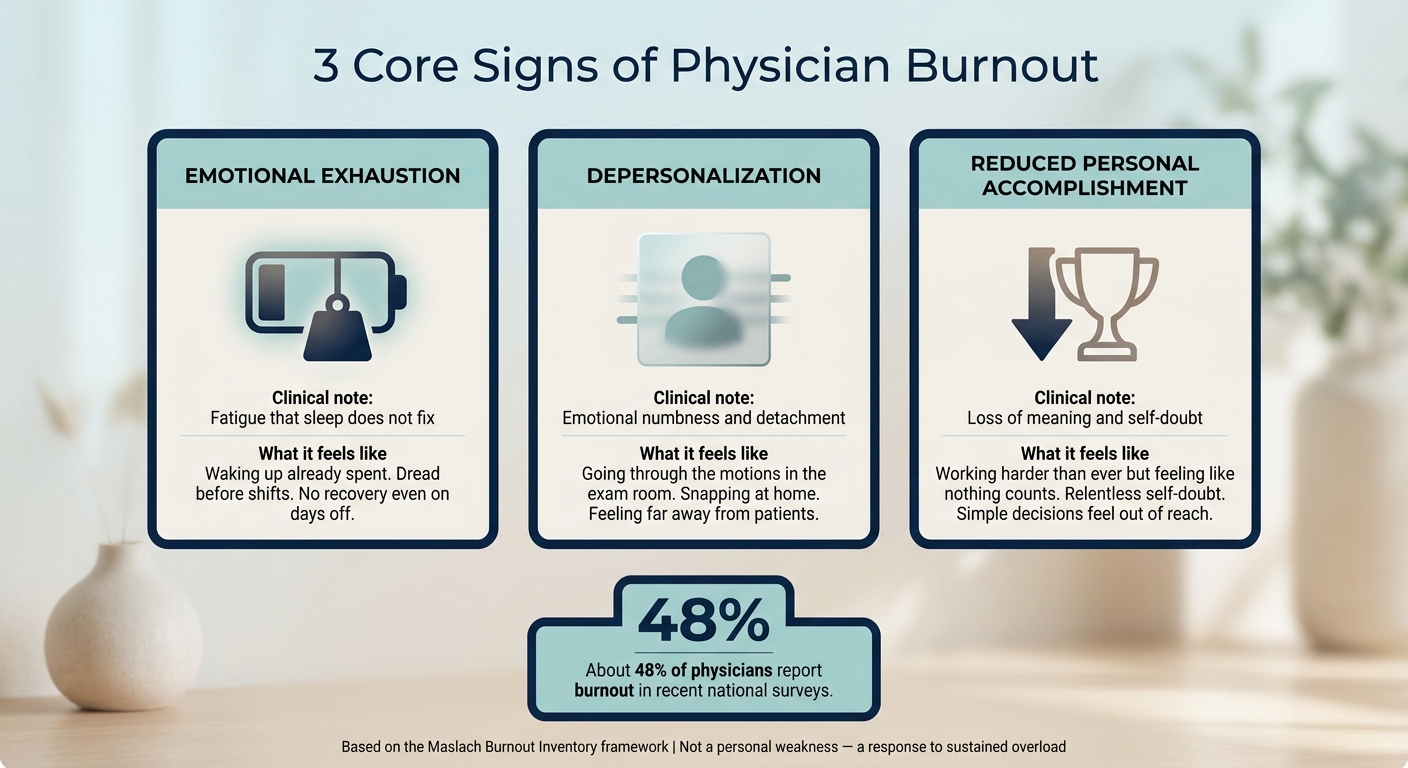
3 Core Signs of Physician Burnout (and What They Feel Like)
You may notice it before you have a name for it. Getting dressed for work starts to feel like gearing up for impact. The charting, the pace, the faces, the decisions. Even before the day begins, your body is already acting like it knows what’s coming. What often appears first in physician burnout is not random at all. It tends to take three forms: exhaustion that does not lift, detachment in the exam room, and a quiet, sinking sense that nothing you do counts. Those are the lived marks of prolonged work-related strain.
Dread before shifts and constant fatigue
This is not ordinary tiredness. It is depletion that goes all the way down, the kind sleep does not fix. You may wake up with your shoulders tight, your jaw set, your mind already running through the day before your feet hit the floor. Days off can feel less like rest and more like a short intermission before the weight returns.
That response makes sense. Burnout can keep the body on high alert even when no immediate threat is present. If your system stays activated long enough, rest stops feeling like rest. You lie down, but you do not land.
Numbness with patients and irritability with everyone else
Sometimes the shift is not tears or panic. Sometimes it is distance. You are in the exam room, saying the right things, asking the next question, moving the visit forward, while mentally feeling far away from the encounter.
That numbness is not indifference. It is what can happen when overload pushes the mind toward shutdown. And when there is no room left emotionally, the strain often leaks out sideways. You snap at home. You feel impatient in places that used to feel easy. Then comes the crash afterward, when the guilt catches up.
Burnout can leave you swinging between wired and numb instead of steady. That kind of detachment is a strain response, not a character flaw.
Feeling like nothing you do counts
This one can be easy to miss because, from the outside, you may still look highly capable. You are working hard, maybe harder than ever, but the sense of meaning has thinned out. The work gets done, yet something in you no longer feels met by it.
That can show up as relentless self-doubt, trouble concentrating, and the creeping feeling that nothing is enough no matter how much effort you give. In later stages, even simple decisions can start to feel out of reach.
When burnout reaches this point, the answer is not more pressure to push through. It is support that helps lower the load.
Your mind is responding to too much for too long
You can look steady on the outside and still feel like your body never stands down. The edge in your chest before a shift. The way your brain keeps scanning after you get home. The numbness that shows up not because you don’t care, but because you’ve cared hard for too long. That is not weakness. It is what sustained overload does to a nervous system.
When demands keep outpacing recovery, the body does not reset the way it should. It stays mobilized. High alert starts to feel normal. Hypervigilance becomes the baseline. That is the nervous system doing its job under strain, without enough room to come back down.
Burnout as strain, not failure
Medicine asks you to hold an enormous amount across a full shift, often without enough time, staffing, or system support. You are asked to be precise, compassionate, efficient, and emotionally available all at once, for hours at a time. Many physicians are also carrying work no one names out loud: the steady inner effort of looking calm while feeling flattened. That performance costs energy, even when no one else can see the bill.
There is often another layer for physicians. The drive that once came from care, purpose, and discipline can slowly start running on fear instead. Fear of missing something. Fear of letting someone down. Fear that one mistake will mean you were never enough to begin with. From the outside, it can still look like dedication. Inside, it feels like living braced.
When chronic vigilance becomes the fuel source, recovery does not happen between demands. The system stays on.
So the dread matters. The numbness matters. The sense that nothing you do makes a dent matters. These are signals of overload, not character flaws. If burnout is strain, then healing starts by reducing the load.
What support can look like from here
If your body has been carrying too much for too long, support often starts in a plain, almost unglamorous place: lower the load and make room for recovery. Not all at once. Usually in small moves you can repeat on an ordinary Tuesday, not just on your best day.
Small shifts that begin to help
The first changes need to be small enough to stick. A held breath. A tight jaw. Shoulders creeping up during a charting session. Those are often the first signs that strain is building. They are not overreactions. They are early signals. And when you notice them early, you usually have more room to choose what happens next.
From there, two things tend to matter most. Protect recovery time and treat it like part of the work of getting better, not something you earn after doing enough. It can also help to write down unfinished tasks and worries before you leave work. That simple step can make a little more room to breathe because your mind is not trying so hard to keep everything pinned in place. The goal is not perfect balance. It is a steadier use of energy.
Protecting your time is not selfish. It is part of recovery.
When self-management stops being enough, therapy can help with the deeper pattern underneath.
When therapy can be part of recovery
If dread, numbness, or exhaustion keep returning, therapy can help address the pattern, not just the symptoms. Sometimes burnout overlaps with anxiety that does not settle even after a good shift, perfectionism that makes rest feel risky, or a nervous system that stays on high alert long after the moment has passed. In those cases, support from a therapist can help.
ACT, EMDR, and IFS can each play a role in recovery by reducing avoidance, calming stress responses, and helping you work through inner conflict.
Key points to remember
Burnout is not weakness. It is what can happen when strain goes on too long without enough relief.
For physicians, burnout is a work-related syndrome marked by emotional exhaustion, depersonalization or emotional numbness and distance, and the sense that you are ineffective or that nothing you do counts. From the outside, it may look like plain exhaustion. On the inside, it can feel like numbness, dread, and a loss of meaning.
The early signs are often easy to brush off at first. You may feel dread before shifts. You may feel tired all the time, even after sleep. You may notice emotional numbness, irritability, or a creeping sense that you are failing at work no matter how hard you try.
That pattern matters.
When these signs stick around, the next step is to reduce the load and get support. Naming what is happening can come first. Recovery does not start once you have the perfect words for it. It often starts when you stop treating the strain as something you should just push through. The sooner these signs are named, the sooner recovery can begin.
FAQs
How is burnout different from depression?
Burnout can feel less like being “tired” and more like hitting a wall you can’t think your way around. You keep going for a while. You answer the email, make the dinner, show up to the meeting, smile when needed. But underneath that, there’s a kind of depletion that sleep does not fix. Burnout is a state of deep exhaustion caused by stress that has gone on too long without enough relief, often in the context of overwork or too much strain for too long.
That’s part of what makes it different from ordinary fatigue. Fatigue usually eases with rest. Burnout often does not. A weekend off may help a little, but it may not bring your focus, energy, or sense of self back online.
Burnout can overlap with depression, and the two can look similar from the outside. Still, burnout is linked to chronic strain. It often feels like being flattened, numb, or detached, rather than sad in a constant, all-the-time way.
When should I seek help for physician burnout?
If you keep waking up tired, moving through the day on autopilot, or carrying a low hum of dread that follows you into work and home, that strain may be asking for care. Chronic exhaustion, emotional numbness, and that sense of being braced all the time can start to shrink your life in quiet ways. They can make it harder to think clearly, harder to rest, and harder to feel like yourself.
Maybe the harder part is this: you doubt yourself, nothing you do seems to land, and even off the clock you can’t quite turn work off. Or you swing between constant tension and a strange kind of shut-down, like your mind is trying to protect you by going blank. That pattern is not a character flaw. It’s often what happens when a mind has been carrying too much for too long.
Reaching out for help isn’t overreacting. It’s a clear next step when this has started to feel like your new normal.
Can physician burnout affect patient care?
Yes. Sometimes it looks like, I’m still showing up, but I’m running on fumes. The work keeps moving. The charting still gets done. The next patient still walks in. But underneath that steady outward motion, there can be a long stretch of depletion that hasn’t had room to be named.
Burnout is prolonged exhaustion shaped by ongoing stress and overwhelm. When it goes unnoticed and untreated, it can affect work performance.
For physicians, that strain is not just emotional. It can wear down both mental and physical well-being, and with that can come a lower capacity to function well on the job. A doctor may still care deeply and still want to do right by patients, but the system they are working inside, along with the pace they are carrying, can leave them with less to give in the room. Patients may feel that shift. Care can start to feel less steady, less present, and less dependable.