I’m back at my desk, but my body still feels like it’s waiting for something bad to happen.
If that is where you are, this is for you. ACT can help me return to work after burnout by teaching me how to notice pressure, step back from harsh thoughts, and take the next step without treating fear like a command.
Coming back after burnout often looks less like relief and more like bracing. The goal is not to force myself back to my old pace. It is to return in a way my mind and body can keep living with.
We Suffer Where We Care: Rethinking Pain with ACT | Zhansaya Oralbekova | TEDxNazarbayev University
sbb-itb-92e3c8f
The Pressure Loop That Keeps Getting Louder
The pressure can turn into its own loop. The more you try to show that you’re fine, the more strain builds underneath. You open your laptop, and before you’ve even started, something in you is already keeping score: Am I keeping up? Am I behind? Those first weeks back can start to feel like one long evaluation.
For women who care deeply and hold themselves to a high bar, perfectionism can keep moving the finish line. You work more to quiet the anxiety, it helps for a moment, and then the bar moves again. From the outside, that may look like ambition. Inside, it often feels like dread. A body going tight. A held breath. A quiet sense that something could go wrong at any minute.
ACT helps interrupt that pattern by making room between the thought and what you do next.
How ACT Helps You Notice Thoughts Instead of Obey Them
ACT does not ask you to get rid of the pressure loop. It teaches cognitive defusion: the skill of noticing a thought as a thought, not as a fact and not as an order.
So when the thought I’m not doing enough shows up, the job is not to fight with it. The shift is smaller than that, and more useful. You notice, I’m having the thought that I’m not doing enough. That bit of distance can change the whole moment. It gives you a little more air. It can also help you step back from the mind’s habit of replaying conversations or jumping straight to the worst-case ending.
Harsh Self-Talk Often Sounds Like Discipline, Not Cruelty
The hardest pressure is often the kind no one else hears. Self-criticism does not always sound mean at first. It can sound responsible. Stay late. Do it again. Don’t let anyone see you struggling. On the outside, that may read as professionalism. On the inside, it can feel like survival mode.
A lot of the time, this voice is fear dressed up as discipline. The same analytical mind that helps you do good work can also start scanning for danger, rehearsing what might go wrong, and trying to stay three steps ahead. Naming that pattern matters. Once you can see the loop for what it is, you do not have to treat every thought like a task.
The Problem May Not Be Weakness. It May Be Overcontrol.
You may look fine from the outside. You answer the emails, make the plan, and tell yourself you’ll ease up once things settle. But the engine underneath it all may be running on one rule: don’t let anything slip. That isn’t weakness. It’s overcontrol.
Perfectionism and overfunctioning often start as protection. They help you stay ready, stay useful, stay ahead of trouble. For a while, that can look like strength. Run those strategies without a break, though, and the cost shows up as burnout. It also helps explain why going back to work can feel oddly unsafe, even when part of you wants the routine back.
Why Perfectionism Makes Recovery Feel Unsafe
If you’re used to doing well by pushing, resting can feel like you’re taking your hands off the wheel. Slowing down may register as danger: falling behind, losing your edge, or giving other people a reason to doubt you.
That fear makes sense. If your mind has learned that staying tightly managed is how you keep things from coming apart, recovery won’t feel restful right away. It may feel exposed.
Values Are Not the Same as Performance Metrics
ACT separates values from performance metrics. Metrics end; values point a direction. A value is a direction, not a finish line.
That matters on the days when confidence hasn’t come back yet. Performance metrics ask, Did I do enough? Values ask, What kind of person do I want to be while I do this? Those are not the same question.
When work is anchored in something like protecting your health or being reliable to your team, it can still hold on a slow day. The pace may change. The direction doesn’t have to.
Try writing down one value that has nothing to do with output, such as protecting your health or being reliable to your team. That small distinction can make the next step feel less loaded, and less tied to perfection.
What a Realistic Return to Work Can Look Like
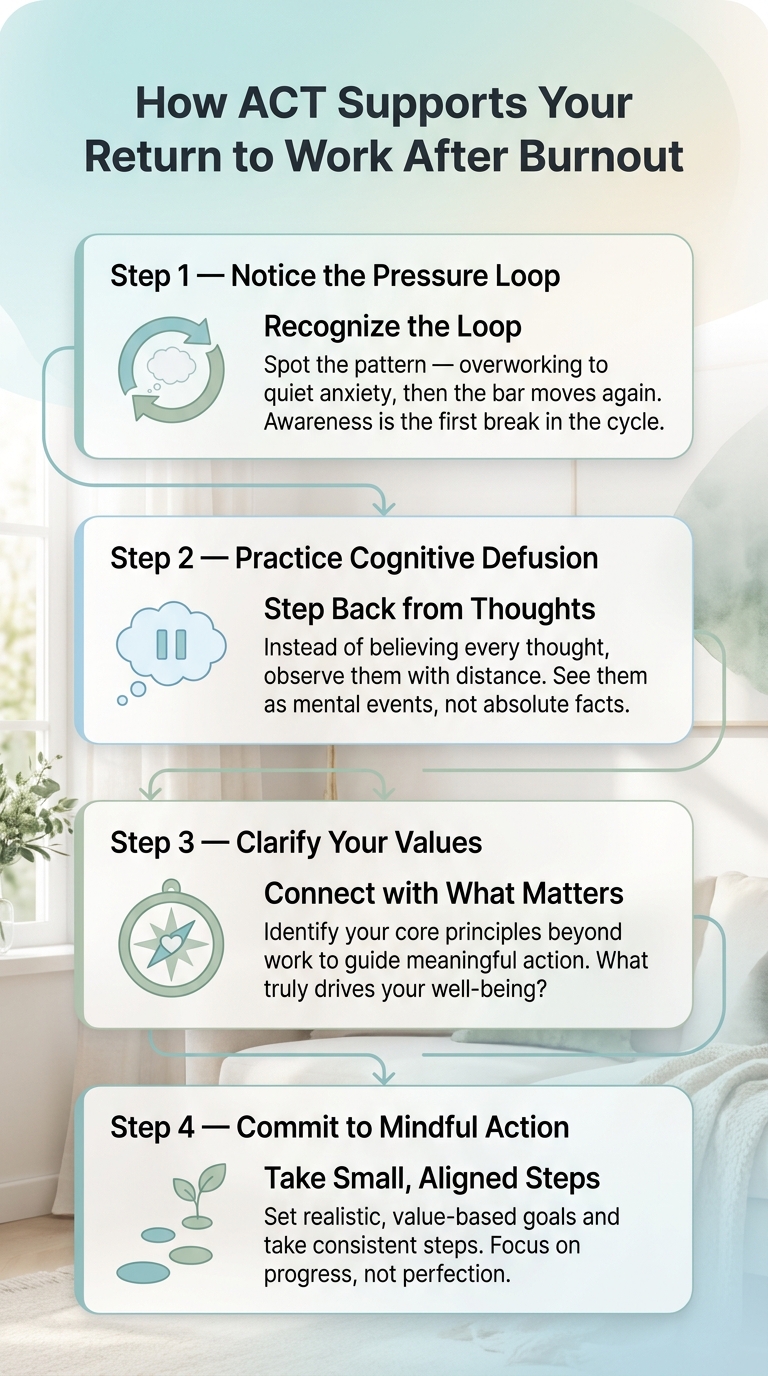
ACT for Burnout Recovery: 4 Steps to Return to Work
Once you can put words to the pressure and get clear on what matters to you, the next question gets more concrete: what does returning to work actually look like? After pressure and self-criticism, ACT moves the focus away from "Am I ready?" and toward a steadier question: "What is the next workable step?"
Smaller Steps That Protect Long-Term Capacity
A realistic return leans on process, not output. In practice, that might look like one value-based task each day, a simple weekly rhythm, or changing the plan when your capacity changes.
For many women, this is the hard part. If you’re used to measuring yourself by how much you can carry, smaller steps can feel like not enough. But scaling back is not giving up. It is a way of staying in the work without burning through the energy you need to keep going.
Saying no to work that is not needed can be part of that, too. If a task pulls time and attention away from what matters most, declining it may be the most values-based choice available. It protects capacity for the work that needs you.
Small steps protect capacity. They also make follow-through more likely.
Taking Action Before You Feel Fully Ready
High achievers often wait for an internal green light before they move. They want the fear to settle, the doubt to quiet down, the body to stop bracing. ACT turns that pattern around: take the step while the doubt is still in the room. For people who are used to pushing through or holding themselves to a hard standard, that can feel backwards. Still, the fear of falling behind does not have to disappear before you act.
"Committed action involves setting goals and taking steps that move you toward your values, even when it’s difficult or uncomfortable."
That can sound abstract until it lands in an ordinary moment. You might think, I’m having the thought that I’m not ready for this meeting. Instead of treating that thought like a command, you notice it and go anyway, if reliability is the value you want to honor.
The point is not to prove that you are back to your old level. The point is to build a return you can live inside and keep showing up for.
You Do Not Have to Push Harder to Earn Your Way Back
You may have learned to treat recovery like one more thing to prove. The moment you feel a little steadier, the bar moves again. Now you should do more, handle more, need less. That kind of earned-worth thinking turns healing into a test you can never quite finish.
ACT pushes back on that frame. A gentler return is not a retreat. It is a way to protect capacity so you can keep showing up for the parts of life and work that matter to you. Saying no to what drains you can make room for what matters. Scaling back, setting a boundary, or choosing one value-based task instead of a packed agenda is not surrender. It is one way to stay in the work without burning through what you need to keep going.
When the pressure to perform starts to loosen, the next step gets clearer: choose a return you can live with. What you are building now needs to hold, not just for this week, but over time. The old pace ran out of fuel. Your direction can stay the same even if the speed changes.
If that pressure still has a strong grip, support can help you loosen it without turning the whole process into another self-improvement project. If the loop stays loud, Empower Counseling offers ACT-informed therapy for burnout and perfectionism in Birmingham and via telehealth in Alabama.
You do not have to have it figured out before you reach out. Moving while uncertain still counts.
FAQs
How do I know if I’m ready to return to work?
Returning to work usually doesn’t happen because one day you wake up and feel calm, certain, and fully prepared. Most people don’t get that kind of clean starting line. If you’ve been telling yourself, I’ll go back when I feel ready, that may be the very thing keeping you in place.
Anxiety often works like an alarm for something that matters. It doesn’t mean you’re incapable. It may mean this return carries weight for you: income, identity, routine, pride, stability, or the wish to feel like yourself again. Waiting for that alarm to go silent before you move can turn fear into a gatekeeper.
Readiness often grows after you begin, not before. It builds through action. Small, intentional steps can help you get your footing: updating one part of your resume, replying to one email, driving the route, setting a morning routine, or having one honest conversation about what support you need. The point is not to force a huge leap. It’s to let movement create evidence that you can do hard things in pieces.
What helps here is direction, not perfection. Start with steps that match your values, then let the feeling of readiness catch up. And if everything feels noisy or tangled, a therapist can help you sort out what matters most so your next step feels more clear and less like guesswork.
What if slowing down makes me feel more anxious?
Slowing down can feel bad before it feels clear. If staying busy has been the way you’ve kept hard feelings at arm’s length, the moment you stop, everything you’ve been outpacing can get loud.
In ACT, that spike in anxiety is not a cue to fill your schedule again. It may mean you’ve paused long enough to notice what was already there.
Rather than trying to shove it out of the way, see if you can notice it, name it, and make a little room for it. Then come back to this moment. Feel your feet on the floor. Take one small step toward what matters to you, even if the anxiety comes along for the ride.
How can I use ACT when harsh self-talk shows up at work?
When harsh self-talk hits at work, it can sound less like a thought and more like a verdict. I blew that presentation. I always mess this up. I’m a failure. ACT offers a different move. Not arguing with the thought. Not trying to force it out. Creating a little space around it so it stops running the whole room.
One way to do that is to label the thought plainly. Instead of saying, “I am a failure,” try, “I am having the thought that I am a failure.” That small shift matters. It can help you notice the thought as something your mind is producing in a stressed moment, not a fact you have to obey.
Sometimes it also helps to give the inner critic a shape. You might picture it as a character: harsh, pushy, maybe even a little ridiculous. Not to mock yourself, but to make the voice easier to spot for what it is. From there, you can practice self-compassion and turn back toward one small step that lines up with your values. Send the email. Ask the question. Take the next honest action.


