
I know what would help, and I still cannot make myself do it. If that sentence feels familiar, this is for me: when depression and trauma show up together, even small steps can feel like too much, and that does not mean I am lazy or unwilling. The short answer is this: behavioral activation can help, but it often works best when the steps are small, paced, and built around what my body can tolerate, not just what looks good on paper.
Depression can drain me. Trauma can keep me braced. When both are present, a stalled plan may point to overload, fear, or shutdown, not a lack of effort. That is why the goal is not to push harder. It is to build motion in a way that feels safe enough to begin.
CBT for Depression | Mental Health Webinar
sbb-itb-92e3c8f
Why your body says no even when your mind wants to try
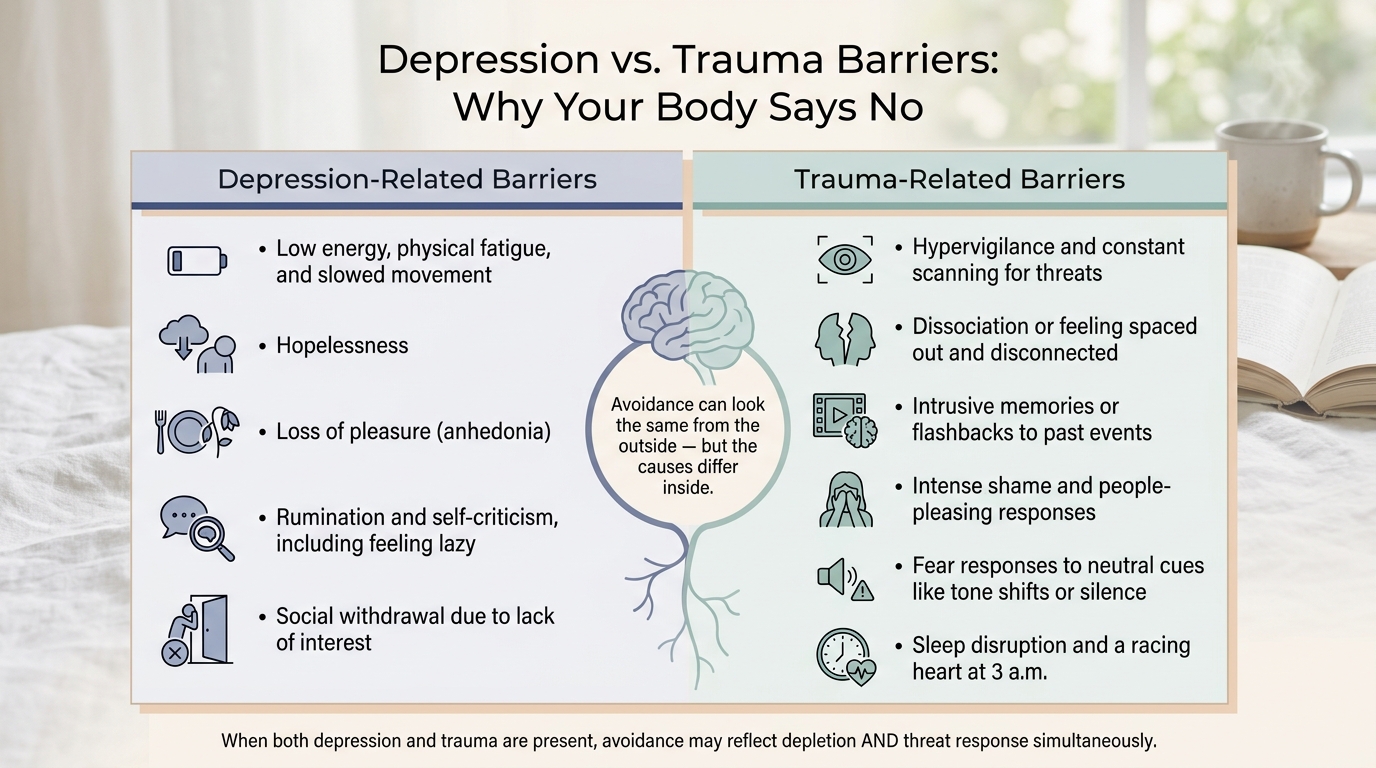
Depression vs. Trauma Barriers: Why Your Body Says No
You can look at a walk, a shower, one email, one plate in the sink, and think, I want to do that. Then nothing in your body follows. Not because you do not care. Not because you are failing some simple test of effort. Before anyone asks your body to say yes, it helps to understand what that no is doing.
Depression barriers and trauma barriers are not the same thing
From the outside, depression and trauma can look similar. A person cancels plans. She stays home. She stares at a task and cannot begin. But under the surface, these patterns are not built the same way.
Depression tends to slow and drain. Energy drops. Pleasure thins out. Hope can go flat. Even things you once wanted can start to feel far away, like they belong to someone else. That slowing is part of the condition, not proof that you have stopped trying.
Trauma often works differently. Instead of shutting the system down first, it keeps the system braced. The nervous system learns to scan, anticipate, tense, and prepare. Ordinary moments can start to carry the weight of danger, so leaving the house or starting a simple task may stir up alarm before anything has even happened.
Some people live with both at once. That can make the whole picture confusing. You may feel exhausted and on edge. You may want relief and feel afraid of the very things meant to help. That is one reason an activity can seem doable in your head and still feel out of reach once your body is involved.
| Depression-Related Barriers | Trauma-Related Barriers |
|---|---|
| Low energy, physical fatigue, and slowed movement | Hypervigilance and constant scanning for threats |
| Hopelessness | Dissociation or feeling spaced out and disconnected |
| Loss of pleasure (anhedonia) | Intrusive memories or flashbacks to past events |
| Rumination and self-criticism, including feeling lazy | Intense shame and people-pleasing responses |
| Social withdrawal due to lack of interest | Fear responses to neutral cues like tone shifts or silence |
| Sleep disruption and a racing heart at 3 a.m. |
Avoidance may look the same from the outside. Inside, it can be doing very different work. In depression, it may come from depletion, hopelessness, or the loss of pleasure. In trauma, it may be the nervous system trying to keep you from a cue it reads as unsafe.
Why a helpful activity may still feel out of reach
This is the part many people do not hear often enough: even helpful things can set off trauma cues.
A walk outside may sound simple, but being visible, being in open space, passing strangers, hearing footsteps behind you, or noticing a shift in someone’s tone can all register as danger for a nervous system shaped by trauma. An appointment may mean sitting in a waiting room, watching the door, tracking time, hearing names called, and trying to stay present while your body wants to leave.
Even advice that helps many people can miss the mark here. Rest can feel unsafe if your body has learned that letting down your guard comes with a cost. Breathing exercises can backfire if they feel like a demand, or if attention to the body stirs up more activation instead of less.
That gap matters. You can know you are safe and still not feel safe. Trauma lives in the body as well as memory, which is why a plan can look simple on paper and feel impossible in practice.
Behavioral activation has strong support for depression, and for many people it helps. But when depression and trauma overlap, the plan often needs more care. If the ask is bigger than what the nervous system can handle, the result is often shame, not momentum. The problem is not that you failed the plan. The problem is the fit.
When that mismatch shows up, the answer is not more pressure. It is a plan your body can work with.
Why action plans can backfire
A plan can look reasonable on paper and still fall apart in real life. Not because you are lazy. Not because you “just need more discipline.” Sometimes the plan asks a body under strain to act like nothing is wrong, and that mismatch turns the plan itself into one more place to feel ashamed.
That gap often shows up in ways people judge harshly: overwhelm, shutdown, avoidance. But those responses are not defiance. They are often the nervous system saying, this is too much, too soon, or too unforgiving.
When the plan is too big, too fast, or too rigid
If depression has already drained the day down to the bare minimum, a plan built around daily workouts or a long task list can feel impossible. Then the plan gets missed, and the missed plan starts to feel like evidence. Evidence that you are failing. Evidence that you should be able to do more. For someone who already ties worth to output, that lands hard.
And a rigid plan makes it worse. If there is no room to bend, one missed task can take on far more meaning than it should. A dysregulated nervous system does not respond well to added pressure, and chronic self-override adds strain.
Trauma changes the picture too. A goal can sound small from the outside and still push someone beyond the range where the body can stay regulated enough to cope. When that happens, the result is often not momentum. It is overwhelm, shutdown, or dissociation. At that point, the issue is not effort. The plan has to change.
From problem to adjustment
What tends to work better is a smaller, more specific ask. Not a whole new routine. Not a list that takes over the day. A 5- to 10-minute action tied to something that matters to you is often far more workable.
That shift matters. The aim stops being maximum output and becomes sustainable functioning. It stops treating limited capacity like a character flaw.
When a task goes undone, the more useful question is not What is wrong with me? It is: What protective response showed up here? Panic, exhaustion, freeze, dissociation. Those reactions carry information. They are not excuses.
A steadier plan leaves room for recovery, keeps choice in the picture, and uses small actions you can actually observe and repeat. It also does not treat pauses as failure. That is the logic built into trauma-informed behavioral activation from the start.
What trauma-informed behavioral activation looks like in therapy
In therapy, this often means changing the plan before asking you to do more. The aim is not to squeeze out more effort. It is to make action feel possible again. In trauma-informed care, the therapist helps you find a pace your body can live with, not just a pace that sounds good on paper.
Pacing, safety, and support come before bigger goals
Before any planning begins, the therapist looks at the full picture: mood, trauma symptoms, sleep, dissociation, substance use, and what your present capacity looks like right now. That matters because the work has to fit you. Not the other way around.
That fit also asks for honesty about what is not safe to push through. If suicidal thinking, self-harm risk, or unsafe living conditions are part of the picture, safety planning comes first. Behavioral activation is not crisis care, and a skilled therapist does not pretend it is.
Standard activation plan versus a trauma-informed adjustment
The difference here is not about softer wording or small tweaks. It comes from a different view of what is blocking movement in the first place. Sometimes the problem is not lack of will. Sometimes your system is trying to keep you from getting flooded.
| Feature | Standard Activation Plan | Trauma-Informed Adjustment |
|---|---|---|
| Goal size | SMART goals | Values-linked micro-commitments: 5–10 minute steps |
| Therapist stance | Expert/director of the plan | Collaborative guide |
| Monitoring | Mood and activity completion | Mood and nervous system response |
| Response to avoidance | Challenging avoidance as a barrier | Curiosity about what the avoidance is protecting |
| Exposure decisions | Structured hierarchy | Paced by window of tolerance |
| Recovery time | Focus on returning to functioning | Built-in recovery window and regulation tools |
When a plan is paced this way, one question starts to matter: how do you know when even this is still too much?
What a supported activation plan includes
A plan that people can stick with is usually simple and specific. It includes one functional goal, one small step, a safety check, a regulation option, a recovery window, and a review of the body’s response.
Sometimes behavioral activation also needs help from another therapy approach. ACT, EMDR, or IFS may be used alongside it when stuck threat responses, avoidance, or emotional overload keep taking over. At Empower Counseling, care may include ACT, EMDR, and IFS.
You do not have to force progress to make progress
You can make a plan on paper and still feel your whole body say no. That matters. A plan is not working just because it looks good or sounds reasonable. It has to be something your nervous system can live with.
Progress should feel manageable, not forced. If a step sends you into panic, shutdown, or numbness, that is not proof that you are failing or not trying hard enough. It is information. The pace needs to change.
Signs that a plan needs to slow down or change
If an activity leads to panic, hypervigilance, shutdown, dissociation, or numbness, the goal is too big for this moment. That does not mean the goal is wrong. It means the step needs to get smaller, simpler, or different.
Harsh self-pressure is not motivation. It often backfires. If your body starts bracing, freezing, or going blank, the next step is adjustment.
Depression and trauma care in Birmingham and across Alabama
Sometimes a plan keeps stalling because the pace is off, not because you do not care. Trauma-informed therapy can help reset that pace.
Empower Counseling offers trauma-informed therapy in Birmingham and via telehealth across Alabama, with care shaped around pacing, safety, and support.
If you are in immediate danger
This is different from a crisis. If you cannot stay safe right now, call or text 988 or call 911.
FAQs
How is trauma blocking my depression treatment?
When your body has learned to stay on guard, even small tasks can feel loaded. Sending the email. Taking the walk. Answering a text. On paper, those steps may look simple. In your nervous system, they may register as danger. That’s part of why trauma can get in the way of behavioral activation. The issue is not laziness or lack of will. It’s that your system may still be working hard to keep you safe.
In that state, “just take small steps” can land badly. If a plan asks more than your body can hold, it may not feel motivating. It may feel unsafe, overwhelming, or triggering. Then avoidance or shutdown makes sense. Your mind is not failing you. It is using the tools it found to survive.
That’s also why pushing harder can backfire. When action plans move past your window of tolerance, they can deepen avoidance instead of easing it. The pace matters. So does the order.
The way forward is slower and kinder than most advice makes room for. Build safety first. Then take very small steps that connect to what matters to you, with support when you need it. Not because you’re doing it wrong, but because your nervous system needs a different kind of plan.
How do I know if my plan is too much?
A behavioral activation plan can ask too much of you. You can usually feel it. The goals start to look larger than what you can carry right now, and instead of helping you move back into life a little at a time, they leave you more overwhelmed, shut down, or less safe.
That reaction is not laziness. It is not a lack of will. It is often your mind and body telling you the pace is off.
With trauma, this can mean your nervous system is outside its window of tolerance. That clinical phrase matters, but the felt sense comes first: you may notice your chest tighten, your thoughts speed up, your body go numb, or your whole system press the brake. In that state, pushing harder usually does not help. The plan may need smaller steps, a slower pace, and steady adjustments to the goals, the support around you, and the conditions that help you feel safe enough to try.
What does trauma-informed behavioral activation change?
Trauma-informed behavioral activation starts in a different place. Not with "just do more", and not with a color-coded plan that ignores what your body is saying. It begins with the fact that if a task feels impossible, there is often a reason. Your nervous system may be reading that task as too much, too fast, or not safe enough yet.
At Empower Counseling, the work is not about pushing productivity for its own sake. It centers felt safety, steadier nervous system regulation, and a pace your body can live with. That might mean making room for rest before action, easing into a task instead of forcing it, and choosing goals that fit your current energy rather than the energy you wish you had.
This is where trauma-informed behavioral activation shifts the frame. The aim is not to override your limits. The aim is to work with them, so movement becomes possible again. Therapy may focus on gradual exposure to tasks, smaller steps, and rhythms that match your present capacity, because progress tends to hold better when your nervous system is not being asked to sprint through what still feels overwhelming.


