“I want help with what happened, but I’m not sure how much I can talk about yet.” ACT focuses on changing how difficult thoughts and feelings guide daily choices, while EMDR uses an eight-phase process to address distress tied to traumatic memories. For PTSD, the 2023 VA/DoD guideline recommends EMDR but finds insufficient evidence to recommend for or against ACT. This comparison explains those differences and what to discuss with a therapist about pacing and readiness, without treating either approach as the right fit for everyone.
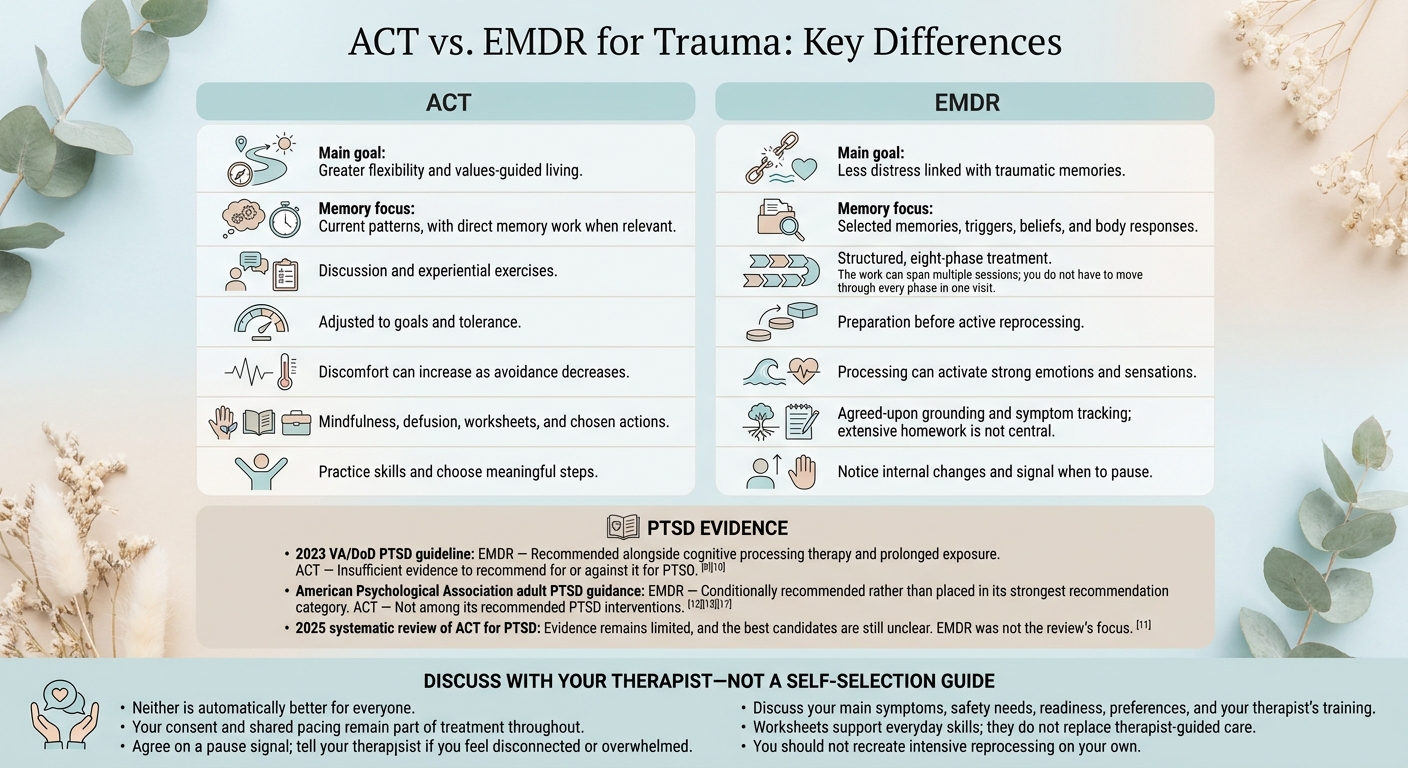
ACT vs. EMDR for Trauma: Key Differences
What is EMDR therapy?
sbb-itb-92e3c8f
What to Expect From ACT and EMDR
“I don’t know how much I can talk about yet.” You can bring that concern to your first session, along with questions about asking for a pause or changing the pace. Neither approach requires more detail than is clinically necessary. Ask your therapist how you’ll set the pace together and what you might practice between visits.
| Approach | Main focus | Typical session activities |
|---|---|---|
| ACT | Staying present and acting on what matters to you | Mindfulness, noticing thoughts, cognitive-defusion exercises, clarifying values, discussing avoidance patterns, and planning small values-based actions |
| EMDR | Reducing the emotional and sensory intensity of distressing memories and developing more adaptive beliefs | Treatment planning, preparation and grounding, choosing a target memory and negative belief, bilateral stimulation, noticing emotional or bodily changes, strengthening a preferred belief, closure, and later reevaluation |
What a session looks like will depend on your clinician, needs, trauma history, and readiness.
ACT: Skills for Daily Life
You might notice a familiar thought and still want more say in what happens next. ACT works toward that goal through acceptance, defusion, present-moment awareness, self-as-context, values, and committed action. The aim is to help you act on what matters, rather than let trauma reactions direct every choice.
Detailed trauma retelling is not required as a rule. Between sessions, you might use a worksheet to notice a thought, name a value, and choose one action that reflects it. Acceptance does not mean accepting abuse or staying in danger.
EMDR takes a different path, working more directly with distressing memories.
EMDR: Processing Distressing Memories
You generally won’t be asked to give a prolonged verbal retelling in EMDR. During processing, you briefly attend to one target memory at a time while your therapist guides bilateral stimulation.
Its eight-phase structure includes assessment and treatment planning, preparation with coping skills and a stop signal, memory processing, strengthening an adaptive belief, checking body sensations, closure, and reevaluation. The work can span multiple sessions; you do not have to move through every phase in one visit.
Grounding practice may continue between visits, but you should not recreate intensive reprocessing on your own. This structure helps shape both the pace of treatment and its emotional demands.
ACT vs. EMDR: Goals, Pace, and Emotional Load
“I feel far away,” or “I can’t get back to the room,” are things to tell your therapist, not experiences you need to push through. Let them know if you feel disconnected, overwhelmed, or unable to return your attention to the present. That information helps guide pacing.
In EMDR, preparation builds coping skills before reprocessing begins. Neither approach guarantees fast results.
| Dimension | ACT | EMDR |
|---|---|---|
| Main goal | Greater flexibility and values-guided living | Less distress linked with traumatic memories |
| Memory focus | Current patterns, with direct memory work when relevant | Selected memories, triggers, beliefs, and body responses |
| Session structure | Discussion and experiential exercises | Structured, eight-phase treatment |
| Pace | Adjusted to goals and tolerance | Preparation before active reprocessing |
| Emotional intensity | Discomfort can increase as avoidance decreases | Processing can activate strong emotions and sensations |
| Between-session practice | Mindfulness, defusion, worksheets, and chosen actions | Agreed-upon grounding and symptom tracking; extensive homework is not central |
| Your participation | Practice skills and choose meaningful steps | Notice internal changes and signal when to pause |
If PTSD is your main concern, the research and treatment guidelines also belong in that conversation.
Research and Guidelines for PTSD Treatment
For PTSD, EMDR has stronger guideline support than ACT. The 2023 VA/DoD PTSD guideline recommends EMDR, while finding insufficient evidence to recommend for or against ACT for PTSD. ACT may still have a role in coping and readiness, though a 2025 systematic review found that its evidence for PTSD remains limited and the best candidates are still unclear. Your treatment choice should account for both the evidence and what you’re ready to take on.
| Source | EMDR | ACT |
|---|---|---|
| 2023 VA/DoD PTSD guideline | Recommended alongside cognitive processing therapy and prolonged exposure. | Insufficient evidence to recommend for or against it for PTSD. |
| American Psychological Association adult PTSD guidance | Conditionally recommended rather than placed in its strongest recommendation category. | Not among its recommended PTSD interventions. |
| 2025 systematic review of ACT for PTSD | Not the review’s focus | Evidence remains limited, and the best candidates are still unclear. |
Choosing Where to Start With Your Therapist
“I’m getting things done, but I have less room for the people and things I care about.” Staying busy can protect you from difficult feelings while leaving less space for relationships, rest, and daily life. Treatment aims to expand your choices, not force confrontation. With your therapist, look at what busyness protects you from and what it costs you.
As you weigh the evidence alongside your readiness, start with the problem you most want help with. Your current capacity and goals both matter. Use this table to guide that conversation, not to choose treatment alone.
| Your goal | What to discuss with your therapist |
|---|---|
| You want to function better day to day | Whether ACT can reduce avoidance and help you act on what matters to you. |
| You want help with recurring trauma triggers, nightmares, or body reactions | Whether EMDR fits those symptoms and your readiness for processing. |
| You need stabilization before trauma work | Whether more stabilization, combined care, or another type of care fits your needs. |
When ACT Skills May Help
“I know what matters to me, but I keep putting it off.” If that pattern is narrowing your daily life, ACT may be a place to start. It can stand alone or help you function before or alongside EMDR. You do not automatically need both.
If your main goal is relief from symptoms tied to trauma memories, rather than help with daily avoidance, EMDR may be the better starting point.
When to Consider EMDR
“The memory keeps coming back,” or “My body reacts before I can think.” Distressing memories, nightmares, and trauma-linked body reactions are reasons to discuss EMDR with your therapist.
Preparation should fit your needs, including helping you stay oriented and use coping skills. Processing begins only when you and your therapist agree you are ready.
Safety, Dissociation, and Your Preferences
Before choosing ACT, EMDR, or combined care, review safety and crisis risk with your clinician, along with substance use, dissociation, emotional regulation, sleep, and available support. Symptom severity and trauma complexity also shape the plan. These factors guide care; they do not automatically rule a treatment out.
Agree on a pause signal and ask what support is available between sessions. Your consent and shared pacing remain part of treatment throughout.
Using ACT Exercises and Worksheets Safely
You may want something to practice between sessions without having to revisit trauma memories. If you and your therapist begin ACT, optional worksheets can support that practice. They offer space to work on regulation and choice, not a test of how hard you’re trying or a replacement for assessment. Use them for everyday skills, not detailed trauma processing or decisions about readiness.
Notice Your Thoughts and Surroundings
Look around and name a few neutral details in the room. Then, if it feels workable, try saying:
I’m noticing the thought that I am not safe.
Keep your eyes open if that feels safer. In ACT, this is called defusion: noticing a thought without treating it as a command. You do not have to decide that the thought is false or make yourself feel calm. If there is real danger, take practical safety steps instead. Stop or change the exercise if distress increases.
Choose One Values-Based Action
Start with this question:
What matters to me here?
Name one value, then choose one small action you can take today.
For connection, contact someone you trust; for self-respect, set a boundary.
Optional worksheets can address avoidance, willingness, self-compassion, grounding, and committed action without asking for trauma details. Willingness means making room for discomfort, not staying in danger or pushing through overwhelm. Resting or making the action smaller can also fit your values.
When to Stop and Get Support
During worksheet practice, you should still be able to stay present and manage discomfort. This range is called your window of tolerance. Worksheet practice is not trauma processing or clinician-led EMDR, which includes assessment, preparation, and paced processing. More distress does not mean the exercise is helping.
Stop if flashbacks escalate, panic becomes overwhelming, or you feel unreal, lose track of time, cannot reconnect with the room, or have urges to harm yourself. Orient to your surroundings if that helps, and contact your therapist rather than doing more practice. These reactions give your therapist information to adjust care. They do not mean you failed or did not try hard enough.
If you are in immediate danger, call 911. For suicide or mental health crisis support, call or text 988. If your immediate safety is at risk, seek help from a trusted person rather than remaining alone.
Conclusion: Match Treatment to Your Needs
“I want to make choices without difficult thoughts or memories deciding for me.” ACT and EMDR approach that goal differently. ACT helps you notice difficult thoughts, feelings, and body sensations without letting them control your choices. EMDR follows a structured, eight-phase process to reduce distress tied to traumatic memories. Neither is automatically better for everyone.
The choice depends on your main symptoms, safety needs, and readiness, along with treatment evidence, your preferences, and your therapist’s training. Worksheets can support practice between sessions, but they cannot replace therapist-guided care. Progress may look like having more choice around triggers, setting firmer boundaries, or taking part more fully in daily life. Ask a therapist how each approach could fit your pace and goals.
Discuss ACT and EMDR With Empower Counseling
You do not need to choose a treatment approach before asking for support. You can request a consultation with Empower Counseling, a women-centered private therapy practice in Birmingham, Alabama. In-person care is available in Birmingham, with telehealth throughout Alabama and in Tennessee through select clinicians. The practice is private pay and out of network; treatment availability varies by clinician.
During that conversation, ask about the therapist’s training, how you’ll set the pace together, and what happens if distress increases. Discuss your goals, schedule, and fees before starting.
FAQs
How will I know if trauma therapy is helping?
Progress may look like spending less of your day on guard or having more room for activities that matter to you. You might notice less emotional distress, anxiety, or disruption from intrusive thoughts. You may also find it easier to recover when emotions run high and to treat yourself with more kindness. Progress includes both feeling less distress and being more able to live a meaningful life.
Strong emotions during sessions do not necessarily mean you are moving backward. They can be part of reprocessing difficult experiences or making space for feelings that have been hard to face.
Can EMDR help if my trauma memories are unclear?
You may remember only pieces of what happened, while the feelings or physical distress remain. You don’t need a complete memory to begin EMDR. The therapy can still help your brain process and integrate trauma when memories are unclear or fragmented.
During history-taking and preparation, your therapist at Empower Counseling will work with you to identify the distress connected to your experiences. Before moving into deeper processing, you’ll work together to help you feel safe and grounded.
When should I consider switching from ACT to EMDR?
You may know what happened and still feel that you have to get everything right to stay safe. If your perfectionism or anxiety is tied to specific traumatic events or deeply held negative beliefs, EMDR may be worth discussing with your therapist. It focuses on reprocessing those memories and beliefs to reduce their emotional weight, while ACT helps you build mindfulness and emotional regulation skills.
Starting with ACT may give you time to develop coping skills and a sense of emotional safety before beginning EMDR’s structured memory work. Your therapist can help you assess whether you’re ready for that transition.