“I want to say yes to dinner, but I’m already worried about being watched.” My urge to cancel may be an attempt to protect myself from judgment, not a personal flaw. Acceptance and Commitment Therapy (ACT) can help with social anxiety and eating-disorder recovery by supporting values-guided choices while working alongside needed medical and nutritional care. Here, I can learn what that support might look like, without making feeling calm a condition for taking a <u>supported next step</u>.
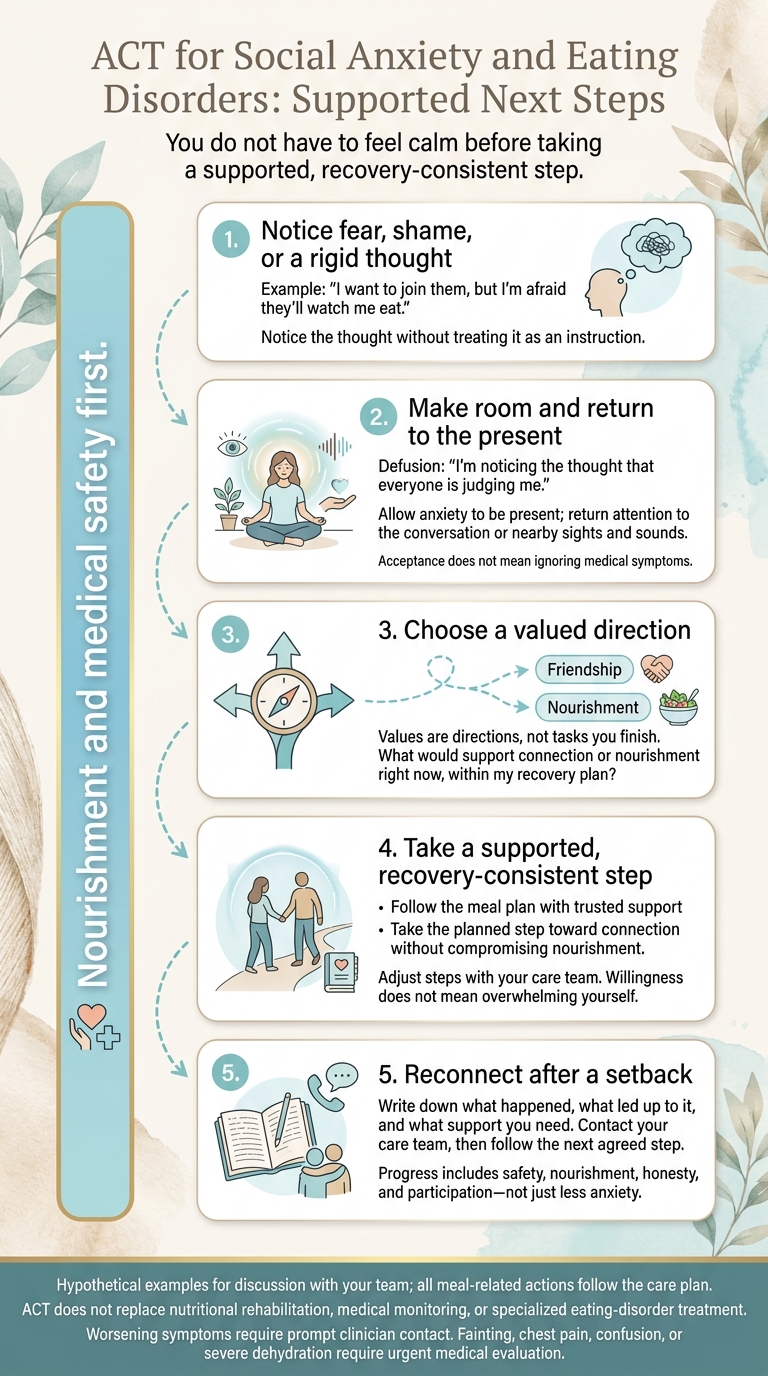
ACT for Social Anxiety and Eating Disorders: Supported Next Steps
Beyond the Behavior: Trauma, Culture, and Emotional Avoidance in Eating Disorders and Mental Health
sbb-itb-92e3c8f
How ACT Helps With Fear, Shame, and Avoidance
A meal invitation can bring fear of judgment or shame about eating, making staying home or following strict food rules feel safer. Those responses may serve a protective purpose. Restriction, binge eating, or compensatory behaviors may briefly ease distress while carrying longer-term emotional, social, and medical costs. Eating disorders arise from interacting biological, psychological, and social factors.
ACT helps create space between distress and your next step. It builds psychological flexibility: making room for difficult thoughts and feelings while choosing actions guided by your values. You do not have to like anxiety or force yourself through distress. The aim is to have more choices.
What would support connection or nourishment right now, within my recovery plan?
Adjusting a step for medical needs or treatment guidance is flexibility, too.
Defusion, Acceptance, and Present-Moment Awareness
A thought can feel like an instruction, especially when fear is loud. Defusion means noticing that thought without automatically obeying it.
A person might notice a prediction as a “judgment story,” then return to the conversation or to the feel of their feet on the floor.
Acceptance means allowing anxiety to be present, not approving harmful behavior or ignoring medical symptoms. Present-moment awareness can involve noticing what is around you rather than looking inward. If inward attention increases distress, nearby sights or sounds offer another place to focus.
Values, Committed Action, and Self-as-Context
Friendship and nourishment can guide a next step even when comfort feels out of reach. In ACT, these are values: directions you keep moving toward rather than tasks you finish. Committed action puts those directions into practice through recovery-consistent steps.
“Friendship: send the message I have been avoiding.”
Self-as-context means noticing shame without treating it as your identity. You can recognize the feeling without letting it define who you are, making room for supported participation rather than perfect comfort.
ACT Research: Findings and Limits
ACT has stronger research support for anxiety than for eating disorders. A 2023 review found small anxiety reductions compared with control conditions. An eating-disorder review covering research through January 2022 included 22 studies and 674 participants, but only 5 randomized controlled trials, which limits confidence in the findings.
ACT is not a universally established standalone eating-disorder treatment. The American Psychiatric Association emphasizes a thorough assessment and eating-disorder-focused care tailored to diagnosis, age, medical status, and individual circumstances. When fear turns into rigid rules or a recovery setback, treatment decisions need to account for those limits and the person’s care needs.
Recognizing Rigid Rules and Handling Setbacks
A restaurant invitation can bring a familiar thought: “I can’t eat there.” A rule like this may be your mind’s way of seeking safety. Acceptance and Commitment Therapy (ACT) helps you notice that rule without having to obey it. Avoidance and perfectionism can take the form of fear-driven rules:
Skipping restaurant meals or clinging to “safe food” lists may reduce anxiety briefly while increasing isolation.
Notice whether a rule comes from fear, leaves no room for change, or harms your nourishment and relationships. Then practice separating what the rule says from what you are worth.
Separating Self-Worth From Appearance and Performance
“I need to look a certain way to fit in” can make belonging feel conditional. Pressure to appear confident or successful can do the same, turning a difficult meal into a verdict on your worth. You deserve care without having to like your appearance or feel socially confident.
After a difficult meal, tell your care team honestly what happened. Taking a step with support still counts; recovery does not require perfect confidence. Ask:
What is the next recovery step I can take with support?
What to Do After a Recovery Setback
After a setback, you may want to keep it to yourself. Treat that moment as a signal to reconnect rather than hide: secrecy delays care, while naming what happened can help clarify the support you need.
Write down what happened, what led up to it, and what support you need. Contact your care team, then follow the next agreed step, such as eating your next planned meal with support.
Worsening symptoms call for reassessment. Renewed restriction, bingeing, purging, compulsive exercise, or trouble following your plan require prompt clinician contact. Fainting, chest pain, confusion, or severe dehydration require urgent medical evaluation.
Using ACT at Meals and Social Events
“I want to join them, but I’m afraid they’ll watch me eat.”
That fear may be your mind’s way of protecting you from judgment, not a personal flaw. At the next meal or event, ACT can help you notice the fear and choose a supported next step, such as staying in the conversation rather than letting fear decide whether you participate.
The examples below are hypothetical and require clinician guidance. Plan this work with a qualified eating-disorder clinician and, when appropriate, a registered dietitian and medical provider.
Taking Supported Steps Toward Social Connection
“I need to stop blushing before I speak.”
You may feel you have to settle what’s happening inside before you can join in. Defusion offers some distance from that demand:
“I’m noticing the thought that everyone is judging me.”
With clinician-supported practice, you can make room for blushing or uncertainty while bringing your attention back to the conversation. A supported step might mean speaking once in a small group or sharing a meal with trusted people.
The goal is participation that supports recovery. Willingness does not mean overwhelming yourself.
Following Your Recovery Plan Through Shame
“I feel guilty, so I must have done something wrong.”
Guilt can feel like proof, but ACT helps you separate the feeling from what your recovery requires. One sentence to discuss with your team is:
“I feel anxious AND I can still follow my meal plan.”
These skills can support following your meal plan and completing clinician-guided food challenges. They can also support less body checking in mirrors or photos and a return to activities that matter to you.
They do not replace nutritional rehabilitation, medical monitoring, or specialized treatment. Ask your team who to contact when shame makes the plan hard to follow.
Hypothetical Examples: Meals, Events, and Setbacks
“I want to know what progress could look like.”
Progress includes safety and nourishment, alongside less avoidance, honesty, and participation. Getting through an event by restricting or using other unsafe behaviors is not recovery progress.
Hypothetical examples for discussion with your team; all meal-related actions follow the care plan.
Situation Fear or shame trigger ACT skill Recovery action Progress Restaurant meal Fear of judgment; urge to cancel Defusion and willingness Follow the meal plan with trusted support Nourishment and connection Family gathering Comparison; pressure to explain eating Notice thoughts; use a planned boundary Seek trusted support to follow the meal plan Nourishment with less avoidance Appearance talk Urge to compare or check Defusion and committed action Say, “I’d rather talk about something else,” or seek support Less checking; continued connection Recovery setback Shame; urge to hide Acceptance and reconnection Tell the designated care-team contact when shame blocks the next planned meal Earlier disclosure and faster support School, work, or community event Fear of blushing or scrutiny Present-moment attention Take the planned step toward connection without compromising nourishment Involvement that supports recovery
Conclusion: Making ACT Part of Your Care Plan
“I want to join the meal, but I’m afraid of what comes with it.” When fear, shame, or avoidance make meals and social events difficult, ACT can help you take supported steps without waiting for the discomfort to pass. The work involves noticing those feelings, loosening rigid thoughts, and moving toward what matters to you while keeping nourishment and medical safety first.
Assessing Safety, Care Needs, and Recovery Goals
An assessment should address social anxiety, eating-disorder symptoms, and avoidance, alongside your readiness for change and values. Your goals might include eating with support, reducing secrecy, attending social events, or following through with recovery care.
Your care plan should also make clear who monitors your health and nutrition. Depending on your needs, that team may include a medical clinician, an eating-disorder-informed registered dietitian, and a psychiatric prescriber.
Progress means tracking symptoms, safety, and daily functioning, not just whether anxiety decreases. ACT does not replace nutritional rehabilitation or medical stabilization. Fainting, severe weakness, inability to keep food or fluids down, chest symptoms, severe dehydration, or suicidal intent require urgent help.
Finding ACT Therapy in Birmingham and Alabama
If you’re seeking ACT-based care in Alabama, local support can help you address social anxiety, shame, and eating-disorder avoidance.
At Empower Counseling, you can discuss ACT and other evidence-based approaches for anxiety, eating disorders, body image, and perfectionism. Men whose concerns fit the practice’s specialties can also receive care. Services are private pay and out of network, with in-person sessions in Birmingham, telehealth throughout Alabama, and select availability in Tennessee.
You can request a free consultation to discuss whether the care fits your needs, ask insurance or private-pay questions, and talk through next steps. The consultation is not an emergency service; urgent concerns require immediate help.
FAQs
How can I tell acceptance from giving in to my eating disorder?
“I can feel this fear without letting it choose for me.” That’s the distinction between acceptance and giving in. Acceptance means changing how you relate to difficult thoughts and feelings, not passively letting your eating disorder control you.
Giving in means letting fear dictate your choices. Acceptance means noticing urges and emotions without judging them, making room for discomfort rather than fighting it, and choosing actions that move you toward your goals and what you value instead of reacting to the disorder.
What if ACT exercises make me more anxious?
“I’m doing the exercise, but I feel more anxious.” That doesn’t necessarily mean you’re doing it wrong. Acceptance and Commitment Therapy (ACT) aims to change your relationship with anxiety, not eliminate it. When you stop pushing feelings away, they may briefly feel stronger or become easier to notice. That discomfort can be part of practicing a different response, rather than a sign of failure.
Try noticing the discomfort with curiosity instead of judging yourself for having it. A slow, deep breath or naming the emotion can help create some distance:
“I’m noticing anxiety right now.”
The aim isn’t to force the feeling away. It’s to give yourself room to choose what you do next, even while anxiety is present.
How can I track progress if meals still feel scary?
“I didn’t check the calories this time.” A moment like that can mark a step toward choices guided by your values, rather than perfection or rigid numbers. Adding a food you enjoy or choosing a middle path instead of reacting with an extreme are also steps worth noticing. Give yourself credit for that growth.
At Empower Counseling in Birmingham, Alabama, Acceptance and Commitment Therapy (ACT) offers support as you build a kinder, more mindful relationship with food and your body.