I did everything I had to do, so why does my body still act like I’m behind? If that question follows me to the couch, the shower, or bed, this piece is for me. The short answer is this: my mind can turn “not enough” into a command, and ACT defusion helps me notice that thought without letting it run the next moment.
What helps is not winning a debate with my mind. It is learning to spot the pattern, make a little room around it, and choose one next step that fits the life I want to live.
Why these thoughts are so hard to shake: Defusion Practice
You may have tried to talk yourself out of “I’m not doing enough” and ended up feeling even more tangled in it. That can feel confusing. If the thought is irrational, why doesn’t reason settle it?
Part of the trouble is that arguing with the thought can make it dig in. The more you debate it, the more the mind treats it like something that must be solved. It stops passing through and starts taking up space. Before long, it doesn’t sound like a thought at all. It sounds like a fact.
When the mind stops sounding like a mind: cognitive fusion in ACT
There is a point where “I might be behind” turns into “I am behind.” In ACT, that shift is called cognitive fusion, when a thought feels like fact or instruction.
Once that happens, the thought no longer feels like something you can notice from a little distance. It starts to sound like an order. Do more. Fix this. Get ahead. Brace yourself. Nothing outside you may have changed, but inside, the alarm is already going off.
That helps explain why perfectionism can feel urgent, not just cruel.
Why perfectionism can feel protective, not just harsh
That “never enough” voice is not proof that something is wrong with you. More often, perfectionism is doing a job. It may be trying to guard you from criticism, shame, or disappointment, and culture can press that pattern deeper.
In that light, the thought can start to make more sense. Not because it is right, but because it has been trying to keep you safe in the only way it knows how.
That is why the thought can land with the force of truth.
The next move is not to win an argument with the thought. It is to notice it for what it is, and keep moving anyway.
A 3-to-5-minute defusion practice for ‘never enough’
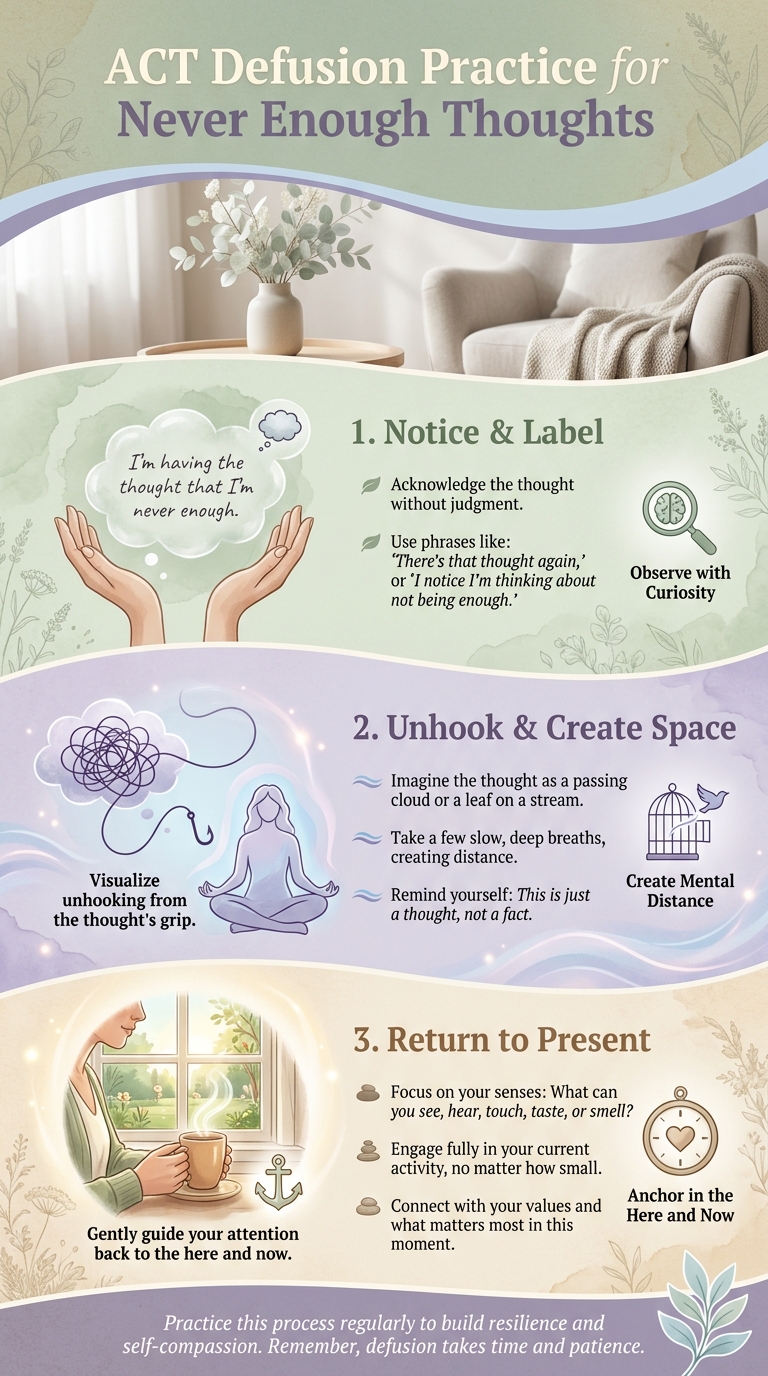
ACT Defusion Practice for ‘Never Enough’ Thoughts: 3 Steps
Some thoughts arrive like a verdict. I’m behind.I should be doing more.I don’t bring much to the table. When that voice gets loud, the task is not to make it vanish. The task is to loosen its hold enough that you can decide what happens next.
You can do this at your desk, on the couch, or lying in bed. It takes a few minutes. Nothing fancy.
Step 1: Name the exact thought in Defusion Practice
Say the thought the way it lands in your mind. Don’t tidy it up. Don’t make it sound more reasonable than it feels.
“I’m behind.”“I should be doing more.”“I’m not smart enough.”“I don’t bring anything to the table.”
If you want, you can also call it the “not enough” story. That small bit of naming can help you see the pattern for what it is: a thought your mind knows how to produce, often on repeat.
Step 2: Add ‘I’m having the thought that…’ and come back to the present
Now take the sentence and place four words in front of it: “I’m having the thought that…”
So “I’m behind” becomes “I’m having the thought that I’m behind.” It sounds small, maybe even a little odd at first. But that shift matters. You are no longer speaking from the thought as if it is plain fact. You are noticing that the thought is happening.
That is defusion in action: not arguing with the thought, not obeying it, just seeing it.
Then come back to something physical and here, not five hours from now and not last week. Feel your feet on the floor. Notice the temperature in the room. Hold the warmth of a mug in your hands. Let your body give your mind a place to land.
Step 3: Let the thought pass, then pick one good-enough action in Defusion Practice
Once there’s a little space, choose the next step. Not the perfect step. Not the most productive one. Just one action that fits the person you want to be in this moment.
If it helps, picture the thought resting on a leaf and drifting past. You don’t have to chase it. You don’t have to shove it away either.
Then ask: “What is one values-based action I can take now?”
Maybe it’s sending the email you’ve been circling all morning. Maybe it’s drinking a glass of water. Maybe it’s sitting with your child for 10 minutes without your phone. Maybe it’s resting, because your body has been asking for that all day.
The thought may still be there. That’s okay. You’re not waiting for perfect inner silence before you move. You’re choosing your next step with the thought in the room, not in charge.
What ACT is doing underneath this practice
You finish the task, clear the inbox, get everyone where they need to go, and your mind still says it wasn’t enough. That moment can feel less like a thought and more like a verdict. ACT works by changing your stance toward that inner verdict. Not by making it vanish, but by helping you relate to it in a different way.
From obeying the thought to noticing it
That first shift is called defusion. In ACT, fusion means a thought lands with the force of fact. Defusion helps you notice that the thought is happening without handing it the keys. So when the “never enough” feeling shows up at the end of a full day, defusion can create a small but meaningful bit of space. Enough space to act from choice instead of alarm.
Acceptance is the next part. Here, acceptance does not mean liking the discomfort or giving up. It means making room for it without turning it into a fight. The fight often keeps the thought loud and busy. Acceptance interrupts that loop.
Then values help guide what comes next. Once the thought loosens, even slightly, values can point you toward the action that matters most. The inner critic may still be there. You might still hear it. And you can still choose the next right thing, like sitting with your child for 10 minutes instead of checking tomorrow’s list one more time.
When deeper support helps
Sometimes the pattern runs deeper. A short practice can help in the moment, but it does not replace therapy. For some people, this pattern is tied to trauma, chronic criticism, body image concerns, or ADHD. In those cases, a brief exercise often is not enough on its own. Therapy can help you work with the thought pattern that shows up now and the earlier experiences that taught your mind to produce it so reliably.
What changes when ‘never enough’ stops running the day: Your Defusion Practice
When “never enough” stops acting like the alarm system for every part of your day, the first change is often in your body. You may notice you are not clenching quite so hard. Your breathing opens up. Your shoulders come down from around your ears. If the thought is no longer treated like an emergency, your nervous system does not have to stay on guard every minute.
That shift is not small.
It creates room. And with room, choices get clearer. A parent who cares about being present can set the phone aside during dinner, not because every task is done, but because presence matters more in that moment. The list may still be there. The thought may still show up. But it is no longer the one calling the shots.
Rest starts to change, too. It stops feeling like proof that you are lazy or not trying hard enough. It becomes something your body is allowed to do.
This is one of the core aims of ACT: psychological flexibility. In plain terms, that means staying in contact with the moment, making space for discomfort, and still moving toward what matters. The goal is not to erase hard thoughts or make anxiety vanish. It is to help you hold a hard day, miss your own standard, and begin again without turning the whole day into a verdict on who you are.
If “never enough” keeps running the day, support can help loosen that pattern. Empower Counseling is a private therapy practice in Birmingham, Alabama, offering ACT-based therapy for perfectionism and anxiety. When that pattern is linked with trauma, ADHD, or perinatal mental health concerns, therapists also draw on EMDR and IFS-informed care to work with the deeper roots. Services are available by telehealth across Alabama.
FAQs
How is defusion different from positive thinking?
Defusion asks for something different than positive thinking. It does not tell you to swap a hard thought for a happier one, debate with it, or force yourself into a brighter mood.
It starts in a more honest place. The thought may still be there: I’m failing.I can’t handle this.Something bad is about to happen. Defusion does not ask you to pretend those thoughts feel good. It helps you notice that a thought is happening, and that is not the same thing as a fact being proven or an order you have to obey.
That shift matters. A thought can feel loud, urgent, even convincing, and still be a passing mental event rather than the final word on what is true.
Why do “never enough” thoughts feel true in my body?
When a thought lands with that much force, it can stop feeling like a thought and start feeling like the truth. Not temporary. Not passing. Just factual. And once that happens, it can steer your mood, your choices, and the way you make sense of who you are.
These thoughts often don’t repeat because something is wrong with you. They repeat because your mind is trying to keep you safe, or trying to make sure you don’t fall short. For many women, that inner pressure grows out of caring deeply, reading the room well, and wanting to do things right. But over time, the system can turn harsh. Self-worth starts to get measured by mistake-free performance, as if being human were only allowed after everything is done perfectly.
When should I get therapy for perfectionism?
You may benefit from therapy for perfectionism if the voice in your head is hard to turn down, or if you keep pushing and still feel stuck. This often shows up as bracing for failure before anything has even gone wrong, picking yourself apart after small mistakes, or feeling like good enough is never quite safe enough.
That pattern is not about laziness or lack of grit. More often, it comes from caring deeply, staying alert, and trying to protect yourself from shame, disappointment, or loss of control. But protection can get expensive.
If this feels like too much to carry by yourself, or you don’t have a steady person to talk to, a consultation can be a useful next step.
How to Journal for Mental Health: A 10-Minute Practice to Quiet Your Inner Critic When the replay will not stop: Journal for Mental Health “Why did I say that?” “I should have caught that mistake. Anyone else would have.” “I know it’s not a big deal. I still can’t let...
Whatever you are carrying right now — the worry that never quiets, the “not enough” that won’t go away, the grief that has no name, the exhaustion of holding it all together, the unfulfilling relationships — you do not have to manage it alone. You reached out. That matters.