
Acceptance and Commitment Therapy (ACT) is a mindfulness-based approach that helps couples navigate challenges by focusing on values, emotional awareness, and present-moment connection. Instead of avoiding conflicts or difficult emotions, ACT encourages partners to embrace them while working toward a shared vision. Here’s how ACT can improve relationships:
- Clarify Values: Identify personal and shared priorities to guide decisions and strengthen bonds.
- Accept Emotions: Learn to acknowledge feelings without trying to fix or suppress them.
- Stay Present: Focus on the "here and now" to improve communication and reduce reactive habits.
- Reframe Thoughts: Use cognitive defusion techniques to create mental distance from unhelpful thoughts.
- Act on Values: Turn shared values into consistent actions that reinforce commitment.
Research shows ACT improves marital satisfaction, communication, and intimacy by addressing internal struggles rather than surface-level issues. Whether you’re dealing with mismatched priorities or recurring arguments, ACT offers tools to build a balanced and resilient partnership.
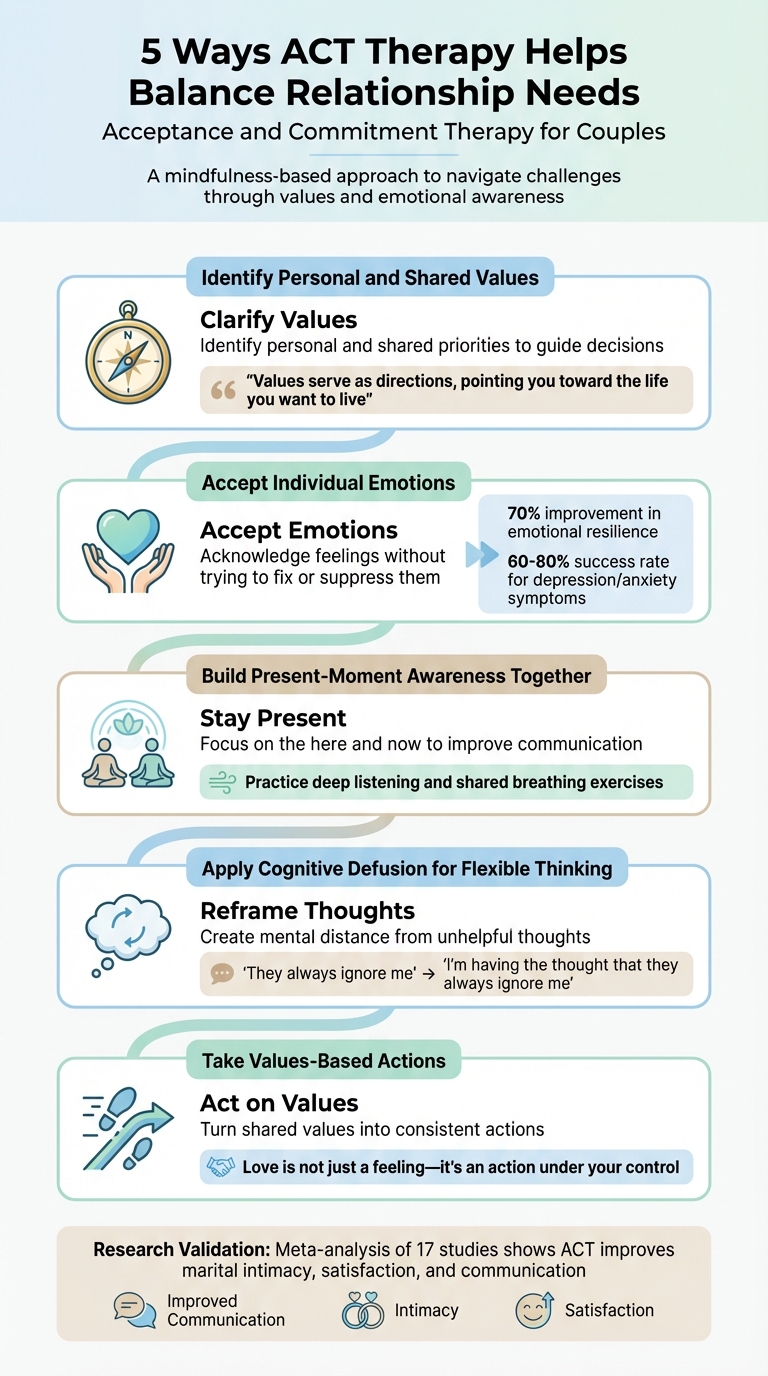
5 Ways ACT Therapy Balances Relationship Needs
ACT for Couples: Introduction to ACT and Psychological Flexibility (#1)
sbb-itb-92e3c8f
1. Identify Personal and Shared Values
In ACT (Acceptance and Commitment Therapy), values aren’t about ticking off goals on a list – they’re more like a compass, guiding you toward the kind of life you want to live. Instead of debating who’s "right" about issues like money, chores, or how to spend time together, couples can ask a deeper question: "What do we both care about underneath this conflict?"
Take financial disagreements, for example. They often highlight a shared desire for family security. Shifting the focus to these underlying values can pave the way for teamwork and compromise.
Emma Carpenter, a therapist from Philadelphia, explains it well:
"By refocusing on our value, instead of the rules we have about it, partners can create workable strategies for compromise and validation."
This idea is echoed by Mental Health @ Home:
"Values serve as directions. You never arrive at your values; they continue pointing you in the direction of the life you want to live."
By clarifying both personal and shared values, couples create space for individual growth while strengthening their bond. When you acknowledge your partner’s evolving goals – whether it’s related to their career, creative pursuits, or community engagement – it builds mutual respect and understanding. At the same time, defining a shared vision for the relationship provides a helpful anchor for decision-making and navigating difficult conversations.
To make this process actionable, tools like values card sorts or the ACT Life Compass can help pinpoint what truly matters most. Once those priorities are clear, it’s important to act on them. Small routines – like a weekly walk to reconnect or a monthly check-in to discuss shared goals – can go a long way in building trust and reinforcing commitment.
2. Accept Individual Emotions
In relationships, you don’t need to fix every uncomfortable feeling that arises. In fact, trying to suppress or avoid emotions often backfires, making things even more challenging. Instead, Acceptance and Commitment Therapy (ACT) suggests a different path – allowing space for difficult emotions rather than resisting them.
This approach, known as "expansion", encourages you to notice your emotions without rushing to react. For instance, during a conflict, if anxiety or frustration bubbles up, take a moment to observe where you feel it in your body. Maybe it’s a tight chest, a warm sensation, or a lump in your throat. By simply acknowledging these physical sensations – without labeling them as "bad" – you open the door to a more measured response. This kind of mindful awareness lays the groundwork for meaningful strategies.
As Dr. Sarah Carpenter puts it:
"Acceptance of one’s emotions is learning how to accept one’s self – that our emotional experiences are understandable, important, and make sense. ACT postulates that our emotional experiences do not necessarily need to be ‘fixed,’ rather they need attention and permission to be experienced fully."
When you embrace your emotions rather than avoid them, it can significantly reduce conflict. Instead of trying to make painful feelings vanish, you start addressing them head-on. This shift allows you to take ownership of your internal reactions without casting blame on your partner. Studies show that ACT can improve emotional resilience by 70% and boasts success rates of 60% to 80% in alleviating symptoms of depression and anxiety.
A simple way to practice this is to pause during a conflict and focus on where the emotion is present in your body. Breathe into that sensation and reframe your thoughts from "I am angry" to "I notice anger." This subtle change creates distance, helping you see emotions as passing experiences rather than permanent states.
3. Build Present-Moment Awareness Together
Once couples embrace their individual emotions, they can deepen their bond by focusing on the present. Dwelling on past conflicts or worrying about the future can disrupt genuine connection. Present-moment awareness, a key concept in ACT, encourages staying grounded in the "here and now." This mindset shifts attention to the interaction happening right in front of you, rather than getting lost in old narratives or future uncertainties.
As Dr. Rubin Khoddam puts it:
"Mindfulness in relationships means actively listening and responding in the present moment, a powerful tool for deepening connection."
The importance of presence becomes even clearer during times of conflict. Pay attention to your body’s reactions and use your breath to stay calm. Practice deep listening by fully tuning into your partner’s words rather than preparing your next response. You could also try a simple exercise like shared breathing – sitting together quietly for a few minutes, focusing on your breath. These practices can break reactive habits and remind you that both your needs and your partner’s needs can coexist peacefully.
Therapist Emma Carpenter highlights this process:
"Partners learn to identify their inner voice – the one that judges themselves and their partners – and create space in their awareness to be able to move through difficult moments together."
4. Apply Cognitive Defusion for Flexible Thinking
Sometimes, disagreements can trigger unhelpful thoughts that take over your reactions. This is where cognitive defusion – a key technique from Acceptance and Commitment Therapy (ACT) – comes in. It helps you step back from these thoughts, seeing them not as absolute truths but as fleeting mental events – just words passing through your mind. Think of it as learning to observe your thoughts rather than getting swept up in them.
Dr. Rubin Khoddam from COPE Psychological Center puts it this way:
"Cognitive defusion involves distancing oneself from unhelpful thoughts, preventing them from dictating responses."
By creating this mental distance, you open the door to more thoughtful and adaptable responses that reflect shared values. For instance, if you catch yourself thinking, "They always ignore me", try rephrasing it to, "I’m having the thought that they always ignore me." This subtle shift creates a psychological buffer, letting you acknowledge the thought without letting it steer your actions.
Cognitive defusion doesn’t erase challenges, but it reduces their grip on your behavior. It gives you the mental room to respond in ways that align with your values, rather than falling back on rigid, reactive patterns. This approach helps pave the way for actions that support healthier, value-driven relationships.
5. Take Values-Based Actions
Understanding your values is only the starting point – what truly strengthens a relationship is putting those values into action, even when emotions run high or challenges arise. This approach transforms love from a fleeting feeling into a conscious, ongoing choice.
ACT (Acceptance and Commitment Therapy) emphasizes that love is not just something you feel but something you do. As the initial spark of passion naturally fades, couples discover that consistent, values-driven actions are what keep the connection alive. As Ineffable Living puts it:
"This is why it’s more helpful to think of love not as a feeling, but as an action – the feelings will come and go, but the action is something under your control, regardless of how you are feeling." – Ineffable Living
Feelings are unpredictable, but actions are within your control. Simple, thoughtful gestures – like sending a kind message or sharing a quiet moment – help nurture the bond over time.
ACT also introduces the concept of "workability" in relationships, shifting the focus from being right to asking, "Is this working for us?". This mindset can be especially helpful during everyday conflicts, whether it’s about household chores, money, or scheduling. These surface-level disagreements often hide shared priorities, like wanting stability or harmony. By approaching these moments as a team instead of opponents, couples can create a more supportive and understanding partnership.
Another key point: values-based actions don’t require both partners to change simultaneously. You can take the first step on your own. When one person begins acting in alignment with their values, it often encourages the other to respond in kind, fostering a cycle of positive interaction.
How Empower Counseling Uses ACT in Couples Therapy
Empower Counseling & Coaching in Birmingham, Alabama, uses Acceptance and Commitment Therapy (ACT) to help couples navigate challenges and strengthen their relationships. Under the guidance of Marti Burton – an experienced professional with advanced ACT training and clinical experience at UAB – the practice focuses on moving couples from reactive conflicts to living in alignment with shared values.
"ACT helps partners face hard emotions, align on shared values, and rebuild trust through mindfulness, acceptance, and committed, value-driven actions." – Empower Counseling & Coaching
Sessions are available both in-person and online for clients across Alabama, with fees ranging from $200 to $300 per session. The approach prioritizes privacy and rapport-building to create a safe space for partners to work through their issues effectively.
During therapy, couples engage with ACT’s five core processes: mindfulness, acceptance, cognitive defusion, values clarification, and committed action. For example, partners might label recurring negative thoughts with playful names like "Mr. Catastrophe" to reduce their emotional weight and introduce humor into the process. Progress is tracked using tools like the Outcome Questionnaire 45 (OQ-45), which often shows significant reductions in distress as couples develop psychological flexibility.
This approach shifts the focus from arguing over who is "right" to taking meaningful, value-driven steps to tackle real-life issues like finances, schedules, trust, and even trauma. For trauma-related concerns, Empower Counseling combines ACT with EMDR techniques to support healing. By clarifying values and fostering emotional awareness, the therapy helps couples take actionable steps toward building a more balanced and resilient relationship.
Conclusion
Finding harmony between personal needs and relationship goals is achievable without compromising one for the other. ACT therapy offers practical tools that help couples acknowledge individual emotions while creating a life rooted in shared values. By developing psychological flexibility, partners can face discomfort head-on and make choices that align with their deeper priorities, rather than reacting impulsively to fleeting emotions.
The five key techniques – values clarification, emotional acceptance, present-moment awareness, cognitive defusion, and committed action – turn conflicts into opportunities for collaborative growth. Instead of focusing on changing a partner or erasing differences, ACT encourages individuals to concentrate on what they can control: their own actions, guided by their core values.
Research backs this up. A meta-analysis of 17 studies highlights ACT’s effectiveness in improving marital intimacy, satisfaction, and communication. This success stems from addressing the way we navigate internal struggles during relationship challenges, rather than just the surface-level issues.
For couples caught in cycles of recurring arguments or reactive behavior, ACT provides a structured path forward. Empower Counseling in Birmingham, Alabama, offers in-person and online ACT-based therapy across the state, giving couples the tools to build resilience and foster a partnership grounded in shared values and balance.
FAQs
How is ACT different from traditional couples therapy?
Acceptance and Commitment Therapy (ACT) centers on building psychological flexibility, encouraging emotional acceptance, and focusing on value-driven actions. Instead of concentrating exclusively on resolving specific relationship issues or behaviors, ACT helps partners embrace emotions without judgment, remain present in the moment, and align their actions with shared values. Unlike traditional methods that often prioritize communication strategies or conflict resolution, ACT emphasizes mindfulness and resilience. This approach nurtures deeper connections and promotes lasting growth by fostering acceptance and committed action.
Can ACT help if only one partner is willing to participate?
Yes, ACT can still help a relationship even if just one partner is involved. By promoting psychological flexibility, fostering acceptance, and encouraging actions that align with personal values, ACT empowers individuals to make meaningful changes. These personal shifts can naturally influence the relationship dynamic, leading to healthier interactions and a stronger sense of connection over time.
How long does it take to see results from ACT couples therapy?
The timeline for seeing results from ACT couples therapy can differ from couple to couple. Studies indicate that many couples notice improvements in their relationship satisfaction and overall functioning after just a handful of sessions. With regular commitment, meaningful progress often becomes evident within a few weeks to a few months.


