
Acceptance and Commitment Therapy (ACT) is an effective approach for managing depression among college students. It stands out by teaching students to accept difficult emotions rather than avoiding or fighting them, while focusing on actions aligned with their personal values. This method builds long-term skills that help students navigate academic pressures, social challenges, and life transitions. Here are the key ways ACT supports students:
- Psychological Flexibility: Helps students handle stress and uncertainty without becoming overwhelmed.
- Cognitive Defusion: Teaches techniques to reduce the impact of negative thoughts, such as labeling thoughts or using word repetition exercises.
- Emotional Regulation: Encourages acceptance of emotions, reducing the tendency to avoid or suppress them.
- Values-Based Action: Guides students to focus on meaningful goals, improving mental health through purposeful actions.
- Addresses Anxiety and Depression Together: Tackles overlapping symptoms by improving mental flexibility and present-moment focus.
- Lasting Benefits: Builds skills like mindfulness and values-based living that continue to support students beyond therapy.
- Support During Transitions: Provides tools to manage stress and build resilience during major life changes.
ACT offers practical, research-backed strategies to help students manage depression while building resilience for the future. It’s particularly effective for addressing the unique challenges of college life, such as academic stress, social pressures, and uncertainty about the future.
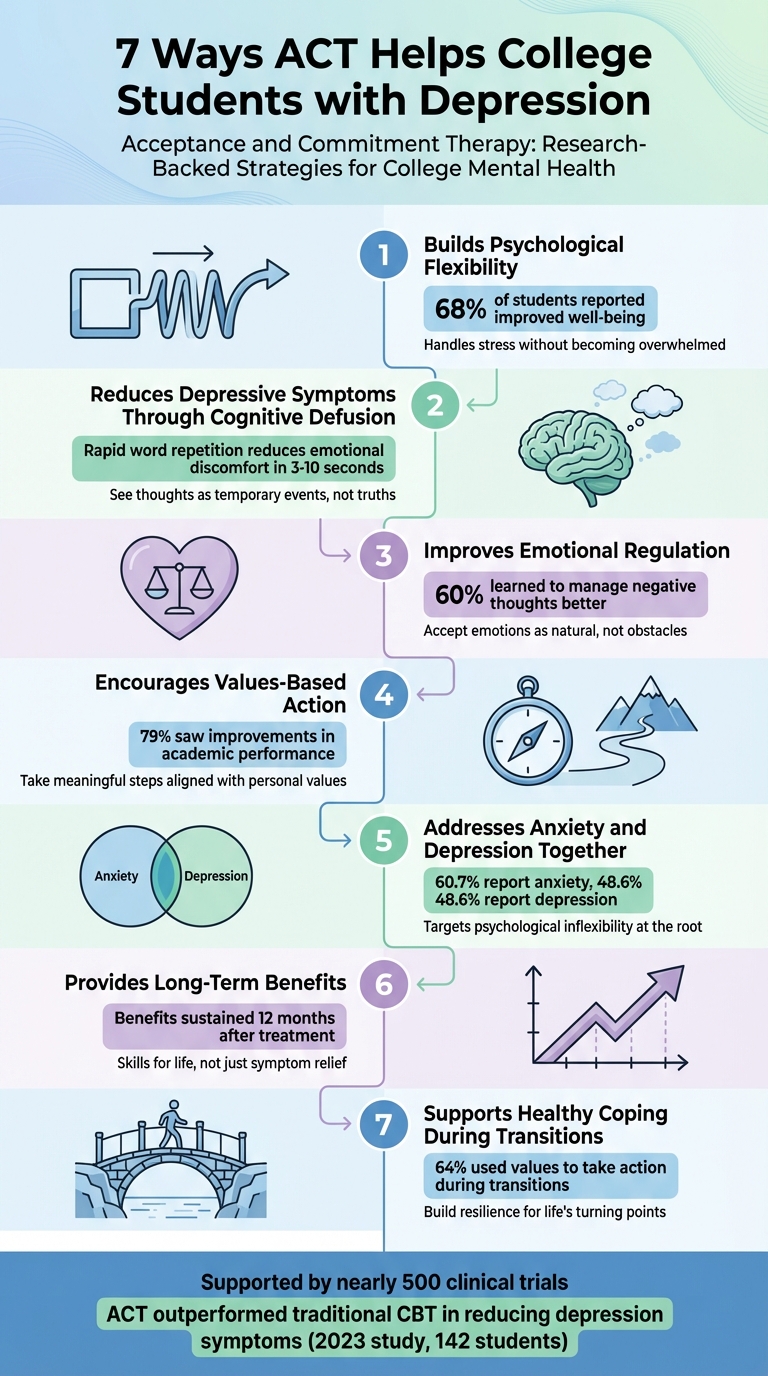
7 Ways ACT Helps College Students with Depression
Depression and Anxiety with Acceptance and Commitment Therapy | Mental Health Webinar
sbb-itb-92e3c8f
1. Builds Psychological Flexibility in High-Stress Environments
College life can feel like a whirlwind of challenges – tight deadlines, roommate drama, financial concerns, and figuring out your future. Psychological flexibility is the skill that helps you handle these stressors without falling into harmful patterns. Steven C. Hayes, the founder of ACT, describes it as "the ability to contact the present moment more fully as a conscious human being, and to change or persist in behavior when doing so serves valued ends". Instead of trying to fight stress or eliminate negative emotions, ACT encourages you to acknowledge them and keep moving forward.
ACT fosters this flexibility through six core processes: acceptance, cognitive defusion, being present, self-as-context, values, and committed action. Together, these processes help you respond to academic and social pressures in a healthier way. Picture this: you’ve got a big presentation coming up. Acceptance helps you recognize your anxiety without letting it control you. Cognitive defusion teaches you to see thoughts like "I’ll totally mess this up" as just thoughts, not facts. And being present shifts your focus to preparing effectively instead of spiraling into worry.
The impact of ACT is backed by research. A Spring 2018 web-based ACT course at the University of Helsinki, involving 184 students, showed impressive results. Sixty-eight percent of participants reported improved well-being, 64% found value-aligned time management insightful, 83% gained new study tools, and 79% noticed positive changes in their approach to studying. These findings highlight how ACT’s techniques equip students to handle high-pressure situations with greater ease.
Mindfulness practices within ACT, particularly non-reactivity, add another layer of support for managing stress. Non-reactivity helps you let stressful thoughts and emotions come and go without letting them take over. So, when you’re juggling a packed schedule or battling social anxiety, this skill keeps you from reacting impulsively – like isolating yourself or procrastinating. Instead, you can observe your discomfort, acknowledge it, and take actions that align with your goals and values.
Studies consistently link psychological flexibility to better student engagement, smoother study progress, and stronger self-regulation. By shifting your mindset from trying to "fix" your emotions to accepting them as natural, ACT helps you stay on track academically and socially – even during tough times. For college students dealing with depression or academic stress, these skills lay a solid foundation for tackling deeper challenges through ACT’s other techniques.
2. Reduces Depressive Symptoms Through Cognitive Defusion
Negative thoughts like "I’m a failure" can make feelings of hopelessness even worse. Cognitive defusion – a key method used in Acceptance and Commitment Therapy (ACT) – helps you step back from these thoughts, seeing them as temporary mental events rather than absolute truths.
Instead of trying to change the thoughts themselves, defusion shifts how you interact with them. Researcher Akihiko Masuda describes it as "altering the literal meaning and behavior‐regulatory function of private events without necessarily altering the form, frequency, or situational sensitivity of these events". The goal isn’t to erase negative thoughts but to weaken their grip on your emotions and actions. This perspective shift can be achieved with practical techniques.
One approach is linguistic labeling. For instance, instead of saying, "I am depressed", you might say, "I am having the thought that I am depressed." This subtle change creates space between you and the emotion.
Another technique is rapid word repetition. Here’s how it works: take a word tied to your negative thought – like "failure" or "worthless" – and repeat it quickly for about 30 seconds. Studies show that emotional discomfort often starts to fade within 3 to 10 seconds, and the believability of the thought can drop significantly after 20 to 30 seconds. A 2010 study conducted in Georgia tested this with 132 undergraduates using the "Milk, Milk, Milk" technique. The findings? Rapid repetition of negative self-referential words reduced emotional discomfort more effectively than distraction or control tasks.
Research also highlights the broader benefits of cognitive defusion. In one study involving 33 participants, reduced cognitive fusion – paired with increased actions aligned with personal values – was found to be a key factor in ACT’s success in alleviating depression. For college students juggling coursework and emotional stress, defusion offers a practical way to break free from negative thought cycles without needing to "fix" every thought.
"Cognitive defusion aims to help people notice their thoughts and feelings and relate to them differently".
As Kate Bramwell and Thomas Richardson from the University of Southampton explain, defusion allows you to acknowledge depressive thoughts without letting them control your actions. This makes it easier to focus on what truly matters to you.
3. Improves Emotional Regulation and Acceptance
ACT (Acceptance and Commitment Therapy) goes beyond just promoting psychological flexibility – it also helps you manage emotions more effectively through acceptance. Think about those moments when sadness or anxiety feels overwhelming. It’s tempting to sidestep these feelings by skipping a class or avoiding social interactions. But research shows that avoiding emotions can actually make depressive symptoms worse.
ACT offers a different perspective. Instead of seeing painful emotions as something to push away, it encourages you to accept them as a natural part of life. As Ashley Gardner, LCSW and Director of the Trauma Program at Compass Health Center, puts it:
"ACT teaches that painful emotions are a normal part of human experience and that resisting them only amplifies suffering".
By embracing acceptance and practicing non-reactivity, you can ease the inner battles that often intensify depressive episodes.
ACT provides practical tools to help with this process. Techniques like "expansion" encourage you to breathe into tough emotions, allowing space for them without resistance. Another tool, the "Leaves on a Stream" exercise, helps you imagine negative thoughts floating away, fostering a sense of calm detachment. In an 8-week ACT program for university students, 60% said they learned to manage their negative thoughts better, and 83% felt they gained tools to handle their academic and personal challenges. These methods pave the way for taking actions that align with your values.
Acceptance doesn’t mean giving up; it’s about moving forward with purpose. Whether it’s preparing for an exam, reaching out to a friend, or seeking professional support, ACT equips you to take meaningful steps. For personalized guidance, Empower Counseling offers in-person and online counseling tailored to college students in Alabama.
4. Encourages Values-Based Action and Purpose
Depression often traps you in a smaller world, making it hard to engage in activities that once brought joy or fulfillment. ACT takes a different path by focusing on what truly matters to you – whether it’s family, career, friendships, or personal growth – and encouraging you to take steps that align with those values.
Taking actions rooted in your values has been shown to significantly reduce feelings of depression and distress. For instance, a study involving 33 participants found that improvements in mental health were closely tied to increases in values-based actions. Interestingly, just identifying values as "important" wasn’t enough to make a difference – it’s the actions that count. This emphasis on living according to your values creates a foundation for noticeable mental health progress.
"Acceptance, mindfulness, and values are key psychological tools needed for that transformative shift".
Research backs this up. A 7-week online ACT program at the University of Helsinki revealed that 79% of students saw improvements in their academic performance, and 64% took meaningful steps that aligned with their core values.
The process isn’t about eliminating discomfort altogether. As Megan Ann Corrieri, MS, LPC, explains:
"Navigating depression isn’t about eliminating all discomfort but about cultivating the skills to live a meaningful and fulfilling life despite it".
When you make choices that reflect your values – like reaching out to loved ones, dedicating time to personal projects, or seeking help – you not only take control of your life but also build self-esteem and confidence.
5. Addresses Anxiety and Depression Together
ACT doesn’t just focus on isolated symptoms – it also tackles the often-overlapping nature of anxiety and depression, a combination that many college students experience.
Statistics show this overlap clearly: 60.7% of counseling center clients report anxiety, while 48.6% struggle with depression. Despite these high numbers, only 19.4% of students sought treatment for anxiety in 2020, with 63% feeling overwhelmed by their mental health challenges.
What sets ACT apart is its ability to address both conditions at once. Instead of treating anxiety and depression as separate issues, ACT zeroes in on the shared root cause: psychological inflexibility. Whether you’re stuck in a loop of future worries or weighed down by past regrets, ACT equips you with tools to observe these thoughts without reacting to them. This approach helps you let go of the struggle and stay grounded in the present.
A recent study highlights ACT’s effectiveness. Between March and June 2023, researchers Z. Vally and colleagues tested a 4-module, internet-based ACT program with 129 Arab college students in the UAE and Oman. The results? The intervention group showed a marked reduction in generalized anxiety (F(1, 126) = 23.95, p < .001) and a significant boost in mental wellbeing (F(1, 126) = 16.81, p < .001) compared to the control group. By targeting behaviors like experiential avoidance and fostering engagement in meaningful activities, the program successfully tackled multiple psychological challenges at once.
"ACT helps individuals recognize that these thoughts and feelings do not define them and that they can still take meaningful action despite their presence." – Ashley Gardner, LCSW, Director of Trauma Program, Compass Health Center
One of ACT’s biggest strengths is its efficiency. Instead of wasting time and energy trying to banish anxious or depressive thoughts, ACT teaches you to accept them as fleeting mental events. This shift allows you to focus on what truly matters, a huge advantage for busy college students who often cite time constraints as a barrier to seeking help.
For students looking for tailored ACT support, Empower Counseling offers personalized services at https://empowercounselingllc.com.
6. Provides Long-Term Benefits After Treatment Ends
ACT isn’t just about short-term symptom relief – it’s about creating skills that stick with you for life. By focusing on mindfulness and values-based living, ACT equips you with tools to handle challenges long after treatment ends.
The evidence speaks for itself. In Spring 2018, the University of Helsinki conducted an 8-week ACT-based online course for 184 students struggling with issues like stress and study habits. The course covered topics like values, acceptance, and mindfulness. By the end, 143 students reported noticeable improvements in psychological flexibility, better study organization, and reduced stress levels. Insights from 97 learning journals revealed that students learned to manage negative thoughts and improve time management, with these benefits lasting through the term. Additionally, studies confirm that the positive effects of ACT – like reduced stress and improved well-being – are often sustained even 12 months later.
This lasting impact comes from mastering two key skills. The first is non-reactivity, which helps you observe tough thoughts without getting stuck in them. Panajiota Räsänen from the University of Jyväskylä explains:
"The results suggest that the use of practices focusing on non-reactivity, meaning the ability to allow thoughts and feelings to come and go without getting carried away by them, is especially important for enhancing the wellbeing of university students".
The second is values-based living, which acts as a guide for making meaningful decisions. Whether it’s prioritizing relationships, personal growth, or career goals, this approach helps you focus on what truly matters.
"ACT equips individuals with skills that promote resilience and adaptability, helping them navigate future challenges without falling back into depressive patterns." – Ashley Gardner, LCSW, Director of Trauma Program, Compass Health Center
7. Supports Healthy Coping During Life Transitions
College life is full of constant changes, and these transitions can often intensify feelings of depression if students lack effective coping strategies. Acceptance and Commitment Therapy (ACT) provides tools to navigate these challenges, offering practical ways to build resilience during life’s turning points. The goal isn’t just to manage immediate stress but to develop skills that foster long-term emotional strength.
One of ACT’s key components is values clarification, which helps students focus on what truly matters – whether it’s personal growth, relationships, or academics. This clarity can be a guiding light during turbulent times. In fact, an 8-week ACT-based course found that 64% of students reported using their values to take meaningful action during transitional periods.
ACT also equips students with essential study and time management skills, which are critical during periods of change. Research highlights that many students who engage in ACT learn practical tools to manage their time effectively, reducing burnout and increasing productivity during challenging transitions.
Another powerful aspect of ACT is its encouragement to step outside the comfort zones that depression often reinforces. Kathryn from Empower Counseling & Coaching puts it well:
"When you stay locked in your comfort zone, you become less and less satisfied with life, and more depressed and anxious".
By pushing students to venture beyond these self-imposed limits, ACT promotes both social and academic growth, helping them build the support networks they need during times of change.
Perhaps most importantly, ACT fosters a sense of self-worth that remains steady, even as external circumstances shift. Instead of tying their value to grades or social status, students learn to see their worth as unchanging. This internal stability becomes a reliable anchor during significant life events, such as changing majors or navigating relationship challenges.
Conclusion
ACT provides a solid framework for tackling depression in college environments. The seven strategies highlighted – fostering psychological flexibility, practicing cognitive defusion, enhancing emotional regulation, promoting values-based actions, addressing anxiety alongside depression, ensuring lasting benefits, and aiding healthy transitions – work together to drive meaningful, lasting change. What sets ACT apart is its focus on equipping students with skills they can carry beyond therapy.
With nearly 500 clinical trials backing its effectiveness, ACT has a strong evidence base. For example, a March 2023 study by Carter H. Davis and Michael P. Twohig at Utah State University involved 142 college students with severe depression. Their findings showed ACT outperformed traditional CBT in reducing symptoms. Another study conducted between March and June 2023 demonstrated that a self-guided, internet-based ACT program significantly reduced anxiety and boosted mental well-being for 129 Arab college students in the UAE and Oman. These results highlight ACT’s potential as a reliable, research-supported approach.
"ACT equips individuals with skills that promote resilience and adaptability, helping them navigate future challenges without falling back into depressive patterns".
Ashley Gardner, LCSW and Director of Trauma Program at Compass Health Center, emphasizes that ACT’s long-term focus makes it especially impactful during the pivotal college years.
Whether through one-on-one sessions or online programs, ACT is accessible and adaptable to different schedules and locations. Empower Counseling specializes in ACT for college students, offering tailored support for those at Samford, Auburn University, and the University of Alabama. Their approach helps students challenge cognitive distortions, uncover intrinsic self-worth, and gain clarity for both present struggles and future aspirations.
ACT provides practical tools to address depression today while building resilience for tomorrow. It meets you where you are and guides you toward living a life grounded in what truly matters to you.
FAQs
How is ACT different from CBT for college depression?
Acceptance and Commitment Therapy (ACT) takes a different route compared to Cognitive Behavioral Therapy (CBT) when addressing depression. Instead of concentrating on identifying and altering negative thought patterns like CBT does, ACT encourages individuals to accept challenging thoughts and emotions without attempting to change them. It emphasizes mindfulness, psychological flexibility, and taking actions that align with one’s personal values. This approach can be especially useful for students who find traditional cognitive restructuring methods difficult to navigate.
Can ACT work if I still have negative thoughts?
Acceptance and Commitment Therapy (ACT) can still work even if negative thoughts linger. The goal isn’t to erase these thoughts but to acknowledge their presence without letting them take over. ACT encourages you to focus on actions that align with your core values, helping you lead a more meaningful life despite the negativity. This shift in perspective can have a positive impact on your mental well-being.
How long does ACT take to start helping?
Acceptance and Commitment Therapy (ACT) often starts to produce positive changes within just a few weeks. Studies indicate that many people experience improvements in their overall well-being and quality of life by about four months. However, the timeline can differ depending on personal factors and individual situations.